Antony Beevor - Berlin - The Downfall 1945
Здесь есть возможность читать онлайн «Antony Beevor - Berlin - The Downfall 1945» весь текст электронной книги совершенно бесплатно (целиком полную версию без сокращений). В некоторых случаях можно слушать аудио, скачать через торрент в формате fb2 и присутствует краткое содержание. Город: New York, Год выпуска: 2007, ISBN: 2007, Издательство: Penguin Books, Жанр: nonf_military, История, на английском языке. Описание произведения, (предисловие) а так же отзывы посетителей доступны на портале библиотеки ЛибКат.
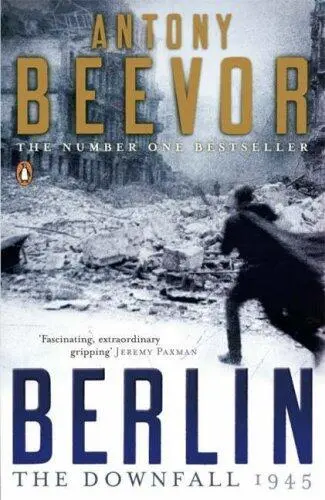
- Название:Berlin: The Downfall 1945
- Автор:
- Издательство:Penguin Books
- Жанр:
- Год:2007
- Город:New York
- ISBN:978-0-141-90302-6
- Рейтинг книги:3 / 5. Голосов: 1
-
Избранное:Добавить в избранное
- Отзывы:
-
Ваша оценка:
Berlin: The Downfall 1945: краткое содержание, описание и аннотация
Предлагаем к чтению аннотацию, описание, краткое содержание или предисловие (зависит от того, что написал сам автор книги «Berlin: The Downfall 1945»). Если вы не нашли необходимую информацию о книге — напишите в комментариях, мы постараемся отыскать её.
Antony Beevor reconstructs the experiences of those millions caught up in the nightmare of the Third Reich's final collapse, telling a terrible story of pride, stupidity, fanatacism, revenge and savagery, but also one of astonishing endurance, self-sacrifice and survival against all odds.
Berlin: The Downfall 1945 — читать онлайн бесплатно полную книгу (весь текст) целиком
Ниже представлен текст книги, разбитый по страницам. Система сохранения места последней прочитанной страницы, позволяет с удобством читать онлайн бесплатно книгу «Berlin: The Downfall 1945», без необходимости каждый раз заново искать на чём Вы остановились. Поставьте закладку, и сможете в любой момент перейти на страницу, на которой закончили чтение.
Интервал:
Закладка:
Reichhelm left with a sense of relief at escaping from a madhouse. At Döberitz he could lay his hands on only a dozen vehicles. Finding Wenck and the headquarters of the Twelfth Army was even harder. Eventually, he found Wenck in the sapper school at Rosslau on the opposite bank of the Elbe from Dessau. To his great pleasure, he saw that the chief operations officer was an old friend, Colonel Baron Hubertus von Humboldt-Dachroeden. Part of the Twelfth Army, he heard, was made up with ‘astonishingly willing young soldiers trained for half a year in officers’ schools’, as well as many NCOs with front experience who had returned from hospital. Both officers greatly admired their army commander. Wenck was young, flexible and a good field commander who ‘could look soldiers in the eye’.
Although the headquarters was improvised and had few radio sets, they found that they could use the local telephone network, which was still functioning well. The army was better supplied than most thanks to the army ammunition base at Altengrabow and the number of stranded barges and boats in the Havelsee. Wenck refused to follow Hitler’s ‘Nero’ order, and he prevented the destruction of the electricity plant at Golpa, south-east of Dessau, one of the main electricity supply points for Berlin. On Wenck’s orders, the Infantry Division Hutten provided guards to prevent any fanatics from trying to blow it up.
The Twelfth Army’s principal task was to prepare for an attack by the American Ninth Army ‘along and either side of the Hanover-Magdeburg autobahn’. The Americans were expected to develop a bridgehead on the east bank of the Elbe and then head for Berlin. The first attack took place sooner than expected. ‘On 12 April, the first contact report arrived of the enemy attempt to cross near Schönebeck and Barby.’ The Scharnhorst Infantry Division attempted to counterattack with a battalion and a few assault guns on the following day. They put up fierce resistance on the first day, but they found the enemy, especially the US Air Force, far too strong.
Reichhelm realized that if the Americans were to cross the Elbe in force, there was ‘no other possibility but to surrender’. The Twelfth Army could not have continued to fight ‘for more than one or two days’. Humboldt was of exactly the same opinion. The Americans were across the Elbe in a number of places. By Saturday 14 April, SHAEF recorded, ‘the Ninth Army has occupied Wittenberge, 100 kilometres north of Magdeburg. Three battalions of the 83rd Infantry Division have crossed the Elbe at Kameritz to the south-east of Magdeburg.’ The 5th Armored Division, meanwhile, had reached the Elbe on a twenty-five kilometre front around Tangermünde. On 15 April, Wenck’s Twelfth Army mounted a strong counter-attack against the 83rd Infantry Division near Zerbst, but this was repulsed.
The bridgeheads across the Elbe appeared to present more of a problem to Eisenhower than an opportunity. He spoke to General Bradley, the army group commander, to ask his view about pushing on to Berlin. He wanted to know his view of the casualties they would have to face taking the city. Bradley estimated that it might involve 100,000 casualties (a figure which, he later admitted, was far too high). He then added that it would be a stiff price to pay for a prestige objective when they would have to withdraw again once Germany surrendered. This clearly coincided with Eisenhower’s thoughts, although he claimed later that the ‘future division of Germany did not influence our military plans for the final conquest of the country’.
Eisenhower was also concerned about his extended lines of communication. The British Second Army was on the edge of Bremen, the US First Army was approaching Leipzig and Patton’s lead units were close to the Czechoslovak border. The distances were so great that forward units had to be supplied by Dakotas. Large numbers of civilians, including prison and concentration camp inmates, also had to be fed. Considerable resources were required. Like many others, Eisenhower was totally unprepared for the full horror of the concentration camps. Seeing such unbelievable suffering at first hand affected many for years afterwards in a liberator’s version of survivor guilt.
Commanders on the Western Front had little idea of the situation on the Eastern Front. They did not appreciate quite how keen the German Army was to allow the Americans in to Berlin before the Red Army reached it. ‘Soldiers and officers,’ observed Colonel de Maizière of the OKH, ‘believed that it was far better to be beaten by the west. The exhausted Wehrmacht fought to the end purely to leave the Russians as little territory as possible.’ The instincts of Simpson and his formation commanders in the Ninth Army proved much more accurate than those of the Supreme Commander. They estimated that there would be pockets of resistance but that these could be bypassed in a charge to the capital of the Reich, which lay less than 100 kilometres away.
The 83rd Infantry Division had already set up a bridge capable of taking the 2nd Armored Division’s tanks, and during the night of Saturday 14 April, vehicles crossed in a steady stream. The forces in the bridgehead, which now stretched to Zerbst, started to build up rapidly. The excitement among the American troops was infectious. They longed for their orders to move out. But early on the Sunday morning, 15 April, their army commander, General Simpson, was summoned by General Bradley to his army group headquarters at Wiesbaden. Bradley met Simpson at the airfield. They shook hands as he climbed out of the plane. Bradley, without any preamble, told him that the Ninth Army was to halt on the Elbe. It was not to advance any further in the direction of Berlin.
‘Where in the hell did you get this?’ Simpson asked.
‘From Ike,’ Bradley answered.
Simpson, feeling dazed and dejected, flew back to his headquarters, wondering how he was going to tell his commanders and his men.
These orders to stand fast on the Elbe, coming on top of the unexpected death of President Roosevelt, constituted a great blow to American morale. Roosevelt had died on 12 April, but the news was not released until the following day. Goebbels was ecstatic when told on his return from a visit to the front near Küstrin. He telephoned Hitler in the Reich Chancellery bunker immediately. ‘My Führer, I congratulate you!’ he said. ‘Roosevelt is dead. It is written in the stars that the second half of April will be the turning point for us. This Friday, 13 April. It is the turning point!’
Just a few days before, Goebbels had been reading Carlyle’s History of Friedrich II of Prussia aloud to Hitler to lift him from his depression. The passage had been the one where Frederick the Great, faced with disaster in the Seven Years War, thought of taking poison. But suddenly news of the death of the Tsarina Elizabeth arrived. ‘The Miracle of the House of Brandenburg had come to pass.’ Hitler’s eyes had filled with tears at these words. Goebbels did not believe in astrological charts, but he was prepared to use anything to boost the Führer’s flagging spirits and he worked Hitler up into a frenzy of optimism. The recluse in the bunker now gazed lovingly at the portrait of Frederick the Great, which had been brought down for him. On the next day, 14 April, in his order of the day to the army, Hitler became utterly carried away. ‘At the moment when Fate has removed the greatest war criminal of all time from this earth, the turn of events in this war will be decisive.’
Another symbolic event involving Frederick the Great took place, but Hitler never mentioned it. In a massive air raid that night, Allied bombers attacked Potsdam. A Hitler Youth sheltering in a basement that night found the walls around him ‘rocking like a ship’. The bombs destroyed much of the old town, including the Garnisonkirche, the spiritual home of the Prussian military caste and aristocracy. Ursula von Kardorff burst into tears in the street after hearing the news. ‘A whole world was destroyed with it,’ she wrote in her diary. But many officers still refused to acknowledge the responsibility of the German military leadership for supporting Hitler. Talk of the honour of a German officer when the liberation of concentration camps showed the nature of the regime they had fought for was unlikely to arouse sympathy, even among their most sporting opponents.
Читать дальшеИнтервал:
Закладка:
Похожие книги на «Berlin: The Downfall 1945»
Представляем Вашему вниманию похожие книги на «Berlin: The Downfall 1945» списком для выбора. Мы отобрали схожую по названию и смыслу литературу в надежде предоставить читателям больше вариантов отыскать новые, интересные, ещё непрочитанные произведения.








Обсуждение, отзывы о книге «Berlin: The Downfall 1945» и просто собственные мнения читателей. Оставьте ваши комментарии, напишите, что Вы думаете о произведении, его смысле или главных героях. Укажите что конкретно понравилось, а что нет, и почему Вы так считаете.