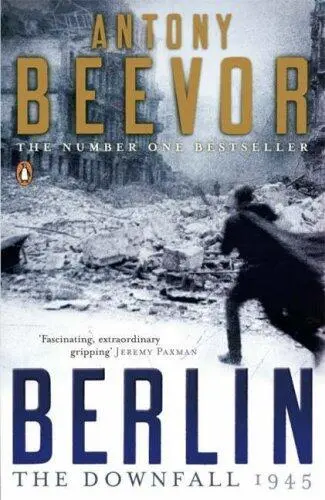
Antony Beevor - Berlin - The Downfall 1945
Здесь есть возможность читать онлайн «Antony Beevor - Berlin - The Downfall 1945» весь текст электронной книги совершенно бесплатно (целиком полную версию без сокращений). В некоторых случаях можно слушать аудио, скачать через торрент в формате fb2 и присутствует краткое содержание. Город: New York, Год выпуска: 2007, ISBN: 2007, Издательство: Penguin Books, Жанр: nonf_military, История, на английском языке. Описание произведения, (предисловие) а так же отзывы посетителей доступны на портале библиотеки ЛибКат.
- Название:Berlin: The Downfall 1945
- Автор:
- Издательство:Penguin Books
- Жанр:
- Год:2007
- Город:New York
- ISBN:978-0-141-90302-6
- Рейтинг книги:3 / 5. Голосов: 1
-
Избранное:Добавить в избранное
- Отзывы:
-
Ваша оценка:
Berlin: The Downfall 1945: краткое содержание, описание и аннотация
Предлагаем к чтению аннотацию, описание, краткое содержание или предисловие (зависит от того, что написал сам автор книги «Berlin: The Downfall 1945»). Если вы не нашли необходимую информацию о книге — напишите в комментариях, мы постараемся отыскать её.
Antony Beevor reconstructs the experiences of those millions caught up in the nightmare of the Third Reich's final collapse, telling a terrible story of pride, stupidity, fanatacism, revenge and savagery, but also one of astonishing endurance, self-sacrifice and survival against all odds.
Berlin: The Downfall 1945 — читать онлайн бесплатно полную книгу (весь текст) целиком
Ниже представлен текст книги, разбитый по страницам. Система сохранения места последней прочитанной страницы, позволяет с удобством читать онлайн бесплатно книгу «Berlin: The Downfall 1945», без необходимости каждый раз заново искать на чём Вы остановились. Поставьте закладку, и сможете в любой момент перейти на страницу, на которой закончили чтение.
Интервал:
Закладка:
However much the authorities disapproved of songs or poems about unfaithful girlfriends, iconoclasts still thought up ribald versions of officially approved songs. The tear-jerker ‘Dark Night’, about a soldier’s wife standing beside their child’s cot ‘secretly wiping her tears’, was turned into ‘secretly taking her streptocide’, the Soviet wartime medicine for venereal disease.
Official patriotic songs never really took on. The only exception was the ‘Song of the Artillerists’, which came from the film At Six o ’clock in the Evening after the End of the War. The film was screened for soldiers at the front just before the battle of Berlin. It showed an artillery officer who has survived to meet his true love in Moscow during the victory celebrations, but although this may have been good for morale in one way, it certainly did not help soldiers with the very natural fear of risking death when the fighting was almost over.
Other songs also looked beyond the end of the war. Soldiers of the 4th Guards Tank Army composed a sequel to the hit of spring 1943, Davai Zakunim:
Soon we will return home.
The girls will meet us,
And the stars of the Urals will shine for us.
Some day we will remember these days.
Kamenets-Podolsk and the blue Carpathians.
The fighting thunder of the tanks.
Lvov and the steppe behind the Vistula.
You won’t forget this year.
You’ll tell your children of it.
Some day, we will remember these days.
Red Army soldiers experienced an irresistible urge to finish the war, but the closer they were to victory, the more they hoped to survive. And yet men desperately wanted a medal to take home. It would make a great difference to their standing in the community and especially within their own family. But there was one thing that they feared even more than being killed in the last days of the war after having survived so far against all odds. That was to lose legs and arms. A limbless veteran, known as a samovar, was treated like an outcast.
After sunset on the evening of 15 April, Colonel Kalashnik, the chief of the 47th Army’s political department, sent Captain Vladimir Gall and the young Lieutenant Konrad Wolf to the front line, ready to interview the first prisoners brought back. Koni Wolf, a German, was the son of the Communist playwright Friedrich Wolf, who had become part of the ‘Moscow emigration’ in 1933 when the Nazis came to power. Koni’s elder brother, Misha, became notorious in the Cold War as Markus Wolf, the chief of East German espionage.
It was virtually dark as the two friends, armed only with pistols, made their way forward through woods to the bank of the Oder. Tanks and men were camouflaged all around them. As the two young officers walked forward between the trees, they could sense that ‘huge forces were concentrated there’ all around them, even though they could hardly see anything because of the dark. ‘It felt like a huge spring about to be released,’ remarked Gall.
Others were engaged on much more dangerous work. Sappers had slipped out at nightfall into no man’s land to clear mines. ‘We warned all infantry people of what we were doing,’ said Captain Shota Sulkhanishvili of the 3rd Shock Army, ‘but when one of my sappers was returning, an infantry man threw a grenade at him. He was asleep and panicked when he heard steps. I was furious and beat him almost to death. For me, all my men were worth gold, especially the mine-clearers.’
Those who had already acquired watches longed to look at the time — to know how many more minutes remained before the attack. But no lights were allowed. It was hard to think of anything else.
15. Zhukov on the Reitwein Spur
General Chuikov, the commander of the 8th Guards Army, had the best view of the Oderbruch and the Seelow Escarpment from his forward command post on the Reitwein Spur. He was not pleased when Marshal Zhukov decided to join him there to watch the opening bombardment and the attack. Chuikov ordered Captain Merezhko, a staff officer who had been with him since Stalingrad, to go back across the Oder and lead the Front commander and his retinue to the position.
To Chuikov’s fury, Zhukov’s convoy of vehicles with their headlights on could be seen approaching from a great distance. Chuikov had almost certainly been prejudiced against Zhukov since the winter of 1942. He seems to have felt that the heroic role of his 62nd Army in Stalingrad was overlooked, and too much attention paid to Zhukov. Much more recently, he resented the remarks made about the length of time he had taken to capture the fortress of Poznan. And his own comments about the failure to have pushed straight on to Berlin at the beginning of February had clearly angered Zhukov.
Below them on the Oderbruch, an officer remembered, the trenches were alive with rattling pots. They could all smell the soup being ladled out by cooks to feed the men before the attack. In the forward trenches dug into the cold, sodden earth, troops took sips from their vodka ration. In command posts field telephones rang constantly and runners came and went.
Zhukov arrived, accompanied by a retinue including General Kazakov, his artillery commander, and General Telegin, the head of the Front political department. They were led up a path round the side of the spur and reached the bunker dug by Chuikov’s engineers in the side of the small cliff below the observation post. ‘The hands of the clock had never gone round so slowly,’ Zhukov recorded later. ‘To fill the remaining minutes somehow, we decided to drink some hot, strong tea, which had been prepared in the same bunker by a girl soldier. I can remember for some reason that she had a non-Russian name, Margo. We drank the tea in silence, everyone occupied with his own thoughts.’
General Kazakov had 8,983 artillery pieces, with up to 270 guns per kilometre on the breakthrough sectors, which meant a field gun every four metres, including 152mm and 203mm howitzers, heavy mortars and regiments of katyusha rocket launchers. The 1st Belorussian Front had a stockpile of over 7 million shells, of which 1,236,000 rounds were fired on the first day. This artillery overkill and the overwhelming superiority of his forces had tempted Zhukov into underestimating the scale of the obstacle facing them.
Zhukov usually insisted on visiting the front line in person to study the terrain before a major offensive, but this time — mainly due to constant pressure from Stalin — he had relied largely on photo-reconnaissance. This vertical picture failed to reveal that the Seelow Heights, dominating his bridgehead on the Oderbruch, was a far more formidable feature than he had realized. Zhukov was also enamoured of a new idea. One hundred and forty-three searchlights had been brought forward, ready to blind the German defenders at the moment of attack.
Three minutes before the artillery preparation was due to start, the marshal and his generals filed out of the bunker. They went up the steep little path to the observation post, concealed by camouflage nets, on the top of the cliff. The Oderbruch below them was obscured by a pre-dawn mist. Zhukov looked at his watch. It was exactly 5 a.m. Moscow time, which was 3 a.m. Berlin time.
‘Immediately the whole area was lit by many thousands of guns, mortars and our legendary katyushas.’ No bombardment in the war had been so intense. General Kazakov’s artillerymen worked in a frenzy. ‘A terrible thunder shook everything around,’ wrote a battery commander with the 3rd Shock Army. ‘You would have thought that even us artillerists could not be scared by such a symphony, but this time, I too wanted to plug my ears. I had the feeling that my eardrums would burst.’ Gunners had to remember to keep their mouths open to equalize the pressure on their ears.
Читать дальшеИнтервал:
Закладка:
Похожие книги на «Berlin: The Downfall 1945»
Представляем Вашему вниманию похожие книги на «Berlin: The Downfall 1945» списком для выбора. Мы отобрали схожую по названию и смыслу литературу в надежде предоставить читателям больше вариантов отыскать новые, интересные, ещё непрочитанные произведения.







Обсуждение, отзывы о книге «Berlin: The Downfall 1945» и просто собственные мнения читателей. Оставьте ваши комментарии, напишите, что Вы думаете о произведении, его смысле или главных героях. Укажите что конкретно понравилось, а что нет, и почему Вы так считаете.