Antony Beevor - Berlin - The Downfall 1945
Здесь есть возможность читать онлайн «Antony Beevor - Berlin - The Downfall 1945» весь текст электронной книги совершенно бесплатно (целиком полную версию без сокращений). В некоторых случаях можно слушать аудио, скачать через торрент в формате fb2 и присутствует краткое содержание. Город: New York, Год выпуска: 2007, ISBN: 2007, Издательство: Penguin Books, Жанр: nonf_military, История, на английском языке. Описание произведения, (предисловие) а так же отзывы посетителей доступны на портале библиотеки ЛибКат.
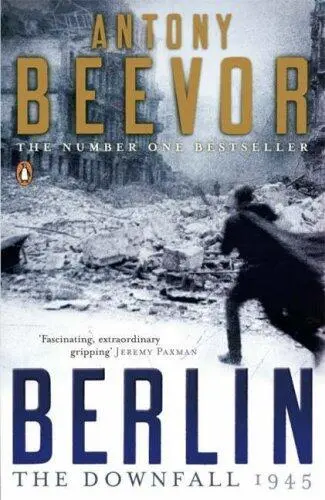
- Название:Berlin: The Downfall 1945
- Автор:
- Издательство:Penguin Books
- Жанр:
- Год:2007
- Город:New York
- ISBN:978-0-141-90302-6
- Рейтинг книги:3 / 5. Голосов: 1
-
Избранное:Добавить в избранное
- Отзывы:
-
Ваша оценка:
Berlin: The Downfall 1945: краткое содержание, описание и аннотация
Предлагаем к чтению аннотацию, описание, краткое содержание или предисловие (зависит от того, что написал сам автор книги «Berlin: The Downfall 1945»). Если вы не нашли необходимую информацию о книге — напишите в комментариях, мы постараемся отыскать её.
Antony Beevor reconstructs the experiences of those millions caught up in the nightmare of the Third Reich's final collapse, telling a terrible story of pride, stupidity, fanatacism, revenge and savagery, but also one of astonishing endurance, self-sacrifice and survival against all odds.
Berlin: The Downfall 1945 — читать онлайн бесплатно полную книгу (весь текст) целиком
Ниже представлен текст книги, разбитый по страницам. Система сохранения места последней прочитанной страницы, позволяет с удобством читать онлайн бесплатно книгу «Berlin: The Downfall 1945», без необходимости каждый раз заново искать на чём Вы остановились. Поставьте закладку, и сможете в любой момент перейти на страницу, на которой закончили чтение.
Интервал:
Закладка:
Troops caught in the open were naturally the most vulnerable. The Volkssturm company of Erich Schröder, a forty-year-old called up only ten days before, was rushed to the front in trucks at 7 a.m. when they received the order ‘Maximum Alert’. There was no time to dig in before the air attacks started. He remembered two almost simultaneous bomb explosions. One splinter took off a big toe, another penetrated his left calf and a third impaled him in the small of the back. He tried to limp to cover. Most of the vehicles in which they had just arrived were ablaze and the panzerfausts still on them began to explode. Eventually, he was taken in a surviving vehicle to a dressing station in Fürstenwalde, but that night a heavy Soviet bombing raid destroyed the whole building save the cellar in which they had been sheltered.
The young German conscripts and trainees had been panic-stricken by the bombardment and the searchlights. Only the seasoned soldiers prepared to open fire, but the problem was to identify a target in the virtually impenetrable mixture of river mist, smoke and dirt drifting in the air from the shellbursts. The defenders could hear the Russians calling to each other as they advanced, but it was impossible to see them. They could also hear in the distance the engines of Russian tanks straining. Even the broad tracks of the T-34 had trouble coping with the mud of the waterlogged flood plain. Survivors from forward positions who had abandoned their weapons fled back through the second line, yelling, ‘ Der Iwan kommt!’ One young soldier running back saw someone ahead and shouted the warning to him, but the figure who turned round proved to be a Red Army soldier. They both leaped for cover and began to fire at each other. The German boy, to his astonishment, killed the Russian.
The ground had been so broken up by the massive bombardment that Soviet anti-tank guns and divisional artillery found it very hard to follow the infantry. This was particularly true of the katyusha batteries mounted on the backs of trucks. Nevertheless, the Guards mortar regiments who fired the katyushas watched with satisfaction as the first German prisoners sent to the rear cringed on seeing the weapon which had struck more fear into the Wehrmacht than any other.
What the prisoners might also have seen were the huge traffic jams of vehicles in heavy mud, waiting for Chuikov’s 8th Guards Army and Berzarin’s 5th Shock Army to make a breakthrough. But progress that morning had been very slow. Zhukov, in the observation post on the Reitwein Spur, was losing his temper, swearing and threatening commanders with demotion and a shtraf company. He had a furious row with General Chuikov in front of staff officers, because the 8th Guards Army was bogged down on the Oderbruch below the escarpment.
By the middle of the day, an increasingly desperate Zhukov, no doubt dreading the next radio-telephone conversation with Stalin, decided to change his operational plan. The tank armies were not supposed to move forward until the infantry had broken open the German defence line and reached the Seelow Heights. But he could not wait. Chuikov was horrified, foreseeing the chaos this would cause, but Zhukov was adamant. At 3 p.m. he called the Stavka to speak to Stalin. Stalin listened to his report. ‘So you’ve underestimated the enemy on the Berlin axis,’ he said. ‘I was thinking that you were already on the approaches to Berlin, but you’re still on the Seelow Heights. Things have started more successfully for Konev.’ He seemed to take Zhukov’s change of plan in his stride, but Zhukov knew only too well that everything depended on results.
Katukov received orders in the afternoon to attack with the 1st Guards Tank Army in the direction of Seelow, while Bogdanov’s 2nd Guards Tank Army was ordered to attack the Neuhardenberg sector. This premature movement of the tanks meant that the close-support artillery, which the rifle divisions had been demanding to deal with strongpoints, could not get forward, because of the state of the ground. There was indeed chaos, as Chuikov had predicted, with so many thousands of armoured vehicles packed into the bridgehead. Sorting out the different formations and units was a nightmare for the traffic controllers.
On the right, Bogdanov’s tanks suffered badly from both the 88mm guns dug in below Neuhardenberg and fierce counter-attacks from small groups with panzerfausts. A platoon of assault guns led by Wachtmeister Gernert of the 111th Training Brigade suddenly appeared out of the smoke on the Oderbruch near Neutrebbin and engaged a mass of Soviet tanks. Gernert alone accounted for seven of them: his personal tally rose to forty-four enemy tanks the following day. ‘His outstanding bravery and tactically clever leadership saved the flank of the brigade,’ General Heinrici wrote, confirming the award of a Knight’s Cross. But by the time he signed it on 28 April, the brigade, and indeed the Ninth Army as a recognizable formation, would have ceased to exist.
Eventually the leading brigades of the tank armies reached the bottom of the Seelow Heights and started the ascent. Engines began screaming with the effort. In many places the gradient was so steep that tank commanders had to find alternative routes. This often made them blunder into a German strongpoint.
Katukov’s leading brigades on the left received their nastiest shock when advancing to the Dolgelin-Friedersdorf road south-east of Seelow. A murderous armoured engagement began there when they found Tiger tanks of SS Heavy Panzer Battalion 502 holding the line. The Soviet tank brigades were hampered by deep ditches and suffered heavy casualties.
In the centre, meanwhile, between Seelow and Neuhardenberg, Göring’s vaunted 9th Parachute Division had buckled under the hammering. When the bombardment had begun that morning, the 27th Parachute Regiment had moved its headquarters from Schloss Gusow on the ridge back to a bunker in the woods behind. Hauptmann Finkler remained in the manor house connected by field telephone. He could see little through the smoke to report back, but the stream of young Luftwaffe personnel running from the front, having abandoned their weapons, indicated the collapse that was taking place. Eventually, a lieutenant arrived with the warning that the Soviet troops were already advancing towards the edge of the village. Colonel Menke, the regimental commander, ordered an immediate counter-attack. Finkler scraped together some ten men from the forward headquarters, charged out and ran almost straight into the enemy. Nearly all the paratroopers were shot down. Finkler and the lieutenant found an abandoned Hetzer tank-destroyer and sheltered in that.
In the headquarters for the defence of Berlin on the Hohenzollerndamm, Colonel Refior, General Reymann’s chief of staff, was ‘not surprised’ when they were awoken that morning by ‘a dull, continuous rolling thunder from the east’. The intensity of the bombardment was so great that in Berlin’s eastern suburbs, sixty kilometres from the target area, the effect was like a small earthquake. Houses trembled, pictures fell off walls and telephone bells rang of their own accord. ‘It’s started,’ people murmured anxiously to each other in the streets. Nobody had any illusions about what this signified. In the grey light of that overcast morning, ‘women and girls stood around in huddled groups, listening in dread to the distant sounds of the front’. The most frequently asked question was whether the Americans would get to Berlin in time to save them.
The authorities’ loudly stated confidence in the defence line on the Oder was rather undermined by the flurry of activity back in the capital, sealing barricades and manning defence points. Goebbels made a passionate but unconvincing speech about this new storm of Mongols breaking itself against their walls. The immediate preoccupation of Berliners, however, was to fill their larders before the siege of the city began. The queues outside bakeries and food shops were longer than ever.
Читать дальшеИнтервал:
Закладка:
Похожие книги на «Berlin: The Downfall 1945»
Представляем Вашему вниманию похожие книги на «Berlin: The Downfall 1945» списком для выбора. Мы отобрали схожую по названию и смыслу литературу в надежде предоставить читателям больше вариантов отыскать новые, интересные, ещё непрочитанные произведения.








Обсуждение, отзывы о книге «Berlin: The Downfall 1945» и просто собственные мнения читателей. Оставьте ваши комментарии, напишите, что Вы думаете о произведении, его смысле или главных героях. Укажите что конкретно понравилось, а что нет, и почему Вы так считаете.