Antony Beevor - Berlin - The Downfall 1945
Здесь есть возможность читать онлайн «Antony Beevor - Berlin - The Downfall 1945» весь текст электронной книги совершенно бесплатно (целиком полную версию без сокращений). В некоторых случаях можно слушать аудио, скачать через торрент в формате fb2 и присутствует краткое содержание. Город: New York, Год выпуска: 2007, ISBN: 2007, Издательство: Penguin Books, Жанр: nonf_military, История, на английском языке. Описание произведения, (предисловие) а так же отзывы посетителей доступны на портале библиотеки ЛибКат.
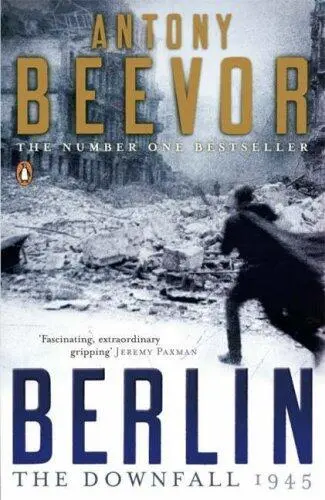
- Название:Berlin: The Downfall 1945
- Автор:
- Издательство:Penguin Books
- Жанр:
- Год:2007
- Город:New York
- ISBN:978-0-141-90302-6
- Рейтинг книги:3 / 5. Голосов: 1
-
Избранное:Добавить в избранное
- Отзывы:
-
Ваша оценка:
Berlin: The Downfall 1945: краткое содержание, описание и аннотация
Предлагаем к чтению аннотацию, описание, краткое содержание или предисловие (зависит от того, что написал сам автор книги «Berlin: The Downfall 1945»). Если вы не нашли необходимую информацию о книге — напишите в комментариях, мы постараемся отыскать её.
Antony Beevor reconstructs the experiences of those millions caught up in the nightmare of the Third Reich's final collapse, telling a terrible story of pride, stupidity, fanatacism, revenge and savagery, but also one of astonishing endurance, self-sacrifice and survival against all odds.
Berlin: The Downfall 1945 — читать онлайн бесплатно полную книгу (весь текст) целиком
Ниже представлен текст книги, разбитый по страницам. Система сохранения места последней прочитанной страницы, позволяет с удобством читать онлайн бесплатно книгу «Berlin: The Downfall 1945», без необходимости каждый раз заново искать на чём Вы остановились. Поставьте закладку, и сможете в любой момент перейти на страницу, на которой закончили чтение.
Интервал:
Закладка:
The massive bombardment meant that few Germans in the forward positions were capable of effective resistance. Many were seriously shell-shocked. ‘We had nowhere to hide,’ Obergefreiter Karl Pafflik told his captors. ‘The air was full of whistling and explosions. We suffered unimaginable losses. Those who survived were rushing around in trenches and bunkers like madmen trying to save themselves. We were speechless with terror.’ Many took advantage of the smoke and chaos to surrender. No fewer than twenty-five men from the 500th Straf Regiment, who had better reasons to desert than most, gave themselves up in one group. German soldiers on their own or in batches would put up their hands, shouting in pidgin-Russian, ‘Ivan, don’t shoot, we are prison.’ A deserter from the 500th Straf Regiment told his interrogators the well-known Berlin remark, ‘The only promise Hitler has kept is the one he made before coming to power. Give me ten years and you will not be able to recognize Germany.’ Other Landsers complained that they had been lied to by their officers, with promises of V-3 and V-4 rockets.
Once cables were secured over the river, ferries brought across the first T-34 tanks to support the infantry. The 1st Ukrainian Front engineer formations had planned no fewer than 133 crossing points in the main attack sectors. They were responsible for all the Neisse crossings. The engineers attached to the 3rd and 4th Guards Tank Armies had been ordered to keep all their equipment ready for the next river, the Spree. Soon after midday, with the first of the sixty-ton bridges in position in the area of the 5th Guards Army, the lead elements of Lelyushenko’s 4th Guards Tank Army began to cross. During the afternoon, the remaining bulk of the fighting forces crossed the river and continued the advance. The tank brigades, ordered to push ahead with all speed, were ready to take on the Fourth Panzer Army’s counterattack spearheaded by the 21st Panzer Division. On the southern part of the sector, the 2nd Polish Army and the 52nd Army had also crossed successfully and were pushing forward. Their orders were to make for Dresden.
Konev had good reason to be satisfied with the first day of the offensive. His lead units were halfway to the River Spree. The only fault established afterwards was that the evacuation of the wounded to hospitals was ‘unbearably slow’, but, like most other commanders, Konev did not seem unduly perturbed. At midnight, he reported to Stalin via radio-telephone that the 1st Ukrainian Front’s advance was developing successfully. ‘Zhukov is not getting on very well,’ said Stalin, who had just spoken to him. ‘Turn Rybalko [3rd Guards Tank Army] and Lelyushenko [4th Guards Tank Army] towards Zehlendorf [the most south-western suburb of Berlin]. You remember, like we arranged at the Stavka’. Konev remembered the meeting only too well, especially the moment when Stalin stopped the boundary between him and Zhukov at Lübben, thus leaving open the possibility that the 1st Ukrainian Front could attack Berlin from the south.
Stalin’s choice of Zehlendorf as reference point is most interesting. He evidently wanted to spur Konev on to the furthest south-western part of Berlin as quickly as possible, since that would be the obvious line of approach from the American bridgehead at Zerbst. It was also perhaps no coincidence that just inside Zehlendorf lay Dahlem, where the Kaiser Wilhelm Institute had its nuclear research facilities.
Three hours earlier, at a 9 p.m. meeting at the Stavka, General Antonov, no doubt on Stalin’s instructions, had yet again deliberately misled the Americans when they mentioned German reports of an all-out offensive against Berlin. ‘[Antonov] said,’ stated the signal to the State Department in Washington, DC, ‘that actually the Russians are undertaking a large-scale reconnaissance on the central sector of the front for the purpose of finding out details of the German defences.’
16. Seelow and the Spree
After Stalin’s two midnight telephone conversations on 16 April, the race between Zhukov and Konev began in earnest. Konev, incited by Stalin, rose enthusiastically to the challenge. Zhukov, although rattled by the setback on the Seelow Heights, believed that Berlin was his by right.
The overcast sky and drizzle gave way to better weather on Tuesday 17 April. The Shturmoviks were able to attack the remaining German positions on the Seelow Heights with much greater accuracy. Down on the Oderbruch and up on the escarpment, small towns, hamlets and individual farmhouses still burned. The Soviet artillery and aviation had targeted any building in case it housed a command post. This resulted in an overpowering smell of charred flesh, mostly human in the villages and livestock on the farms. The shelling of farm buildings as likely depots and headquarters led to a terrible slaughter of animals unable to escape from being burned alive.
Behind the indistinct German lines, dressing stations were filled with wounded far beyond the capacity of the doctors. A stomach wound was as good as a death sentence under the system of triage, since the surgery it required took too long. The first priority for treatment were those capable of further combat. Specially detailed officers trawled the field hospitals for walking wounded capable of firing a gun.
The Feldgendarmerie at their improvised roadblocks were always on the lookout for stragglers, whether fit or lightly wounded, who could be forced back into scratch companies. As soon as a reasonable number had been assembled, they were marched into the line. Soldiers called the Feldgendarmerie not only ‘chain-hounds’, but also ‘Heldenklauen ’, or ‘hero-stealers’, a play on the Nazi term ‘Kohlenklau’ used to attack those who stole government coal for use at home.
In their brutal zeal, the Feldgendarmerie often grabbed men who were genuinely trying to rejoin their battalions. They then found themselves mixed in with stragglers and fifteen- or sixteen-year-old Hitler Youth, some of whom were still in shorts. A smaller size of steel helmet had been manufactured for boy soldiers, but not nearly enough were produced. Their tense, pale faces could barely be seen under helmets that dropped over their ears. A group of Soviet sappers from the 3rd Shock Army called forward to clear a minefield were taken by surprise when a dozen Germans emerged from a trench to surrender. Suddenly a boy appeared from a bunker. ‘He was wearing a long trench-coat and a cap,’ recorded Captain Sulkhanishvili. ‘He fired a burst with his sub-machine gun. But then, seeing that I didn’t fall over, he dropped his sub-machine gun and started to sob. He tried to shout, “ Hitler kaputt, Stalin gut!” I laughed. I hit him only once in the face. Poor boys, I felt sorry for them.’
The most dangerous of the Hitler Youth were often those whose homes and families had been ripped apart in the east by the Red Army. The only course for them seemed to be death in battle, taking as many hated Bolsheviks with them as possible.
The fighting qualities of the German Army had not yet collapsed, as Zhukov and his troops found to their cost. Another artillery and aviation bombardment on the morning of 17 April, followed by a renewed advance by Katukov and Bogdanov’s tank armies, did not achieve the success which Zhukov had promised Stalin. The 88mm anti-aircraft guns and tank-hunting infantry with panzerfausts immobilized many of the tanks. At midday, almost as soon as Katukov’s tank brigades moved into Dolgelin and Friedersdorf, they faced a counter-attack by the remaining Panther tanks of the Kurmark Panzer Division.
General Yushchuk’s 11th Tank Corps, on the other hand, managed to surround Seelow itself astride the Reichstrasse 1, the old Prussian highway which used to lead from Berlin all the way to the now destroyed East Prussian capital of Königsberg. But Yushchuk’s tanks soon found themselves under fire from the artillery of the neighbouring 5th Shock Army. This led to a ‘distinctly uncultured’ row with Berzarin’s headquarters. It was not just the tank troops which suffered. ‘In the opinion of the infantry,’ a report on the fighting stated tactfully, ‘the artillery is not firing at precise targets but at general area targets.’
Читать дальшеИнтервал:
Закладка:
Похожие книги на «Berlin: The Downfall 1945»
Представляем Вашему вниманию похожие книги на «Berlin: The Downfall 1945» списком для выбора. Мы отобрали схожую по названию и смыслу литературу в надежде предоставить читателям больше вариантов отыскать новые, интересные, ещё непрочитанные произведения.








Обсуждение, отзывы о книге «Berlin: The Downfall 1945» и просто собственные мнения читателей. Оставьте ваши комментарии, напишите, что Вы думаете о произведении, его смысле или главных героях. Укажите что конкретно понравилось, а что нет, и почему Вы так считаете.