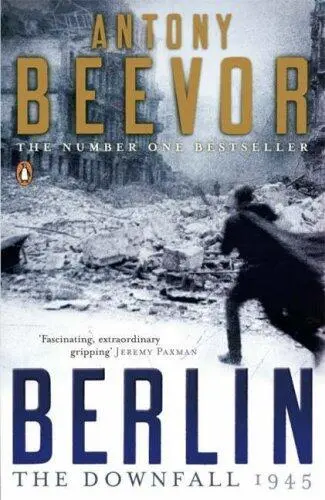
Antony Beevor - Berlin - The Downfall 1945
Здесь есть возможность читать онлайн «Antony Beevor - Berlin - The Downfall 1945» весь текст электронной книги совершенно бесплатно (целиком полную версию без сокращений). В некоторых случаях можно слушать аудио, скачать через торрент в формате fb2 и присутствует краткое содержание. Город: New York, Год выпуска: 2007, ISBN: 2007, Издательство: Penguin Books, Жанр: nonf_military, История, на английском языке. Описание произведения, (предисловие) а так же отзывы посетителей доступны на портале библиотеки ЛибКат.
- Название:Berlin: The Downfall 1945
- Автор:
- Издательство:Penguin Books
- Жанр:
- Год:2007
- Город:New York
- ISBN:978-0-141-90302-6
- Рейтинг книги:3 / 5. Голосов: 1
-
Избранное:Добавить в избранное
- Отзывы:
-
Ваша оценка:
Berlin: The Downfall 1945: краткое содержание, описание и аннотация
Предлагаем к чтению аннотацию, описание, краткое содержание или предисловие (зависит от того, что написал сам автор книги «Berlin: The Downfall 1945»). Если вы не нашли необходимую информацию о книге — напишите в комментариях, мы постараемся отыскать её.
Antony Beevor reconstructs the experiences of those millions caught up in the nightmare of the Third Reich's final collapse, telling a terrible story of pride, stupidity, fanatacism, revenge and savagery, but also one of astonishing endurance, self-sacrifice and survival against all odds.
Berlin: The Downfall 1945 — читать онлайн бесплатно полную книгу (весь текст) целиком
Ниже представлен текст книги, разбитый по страницам. Система сохранения места последней прочитанной страницы, позволяет с удобством читать онлайн бесплатно книгу «Berlin: The Downfall 1945», без необходимости каждый раз заново искать на чём Вы остановились. Поставьте закладку, и сможете в любой момент перейти на страницу, на которой закончили чтение.
Интервал:
Закладка:
An armoured breakthrough towards Berlin ran the risk of a German counter-thrust to its lines of communications. Konev therefore angled Zhadov’s 5th Guards Army to the left towards Spremberg and the 3rd Guards Army to the right to force the Germans back on Cottbus.
That evening, when the leading brigades of the 3rd Guards Tank Army reached the Spree, General Rybalko, their army commander, who took pride in leading from the front, did not wait for bridging equipment to come up. He selected a point which looked as if it might not be too deep, then sent a tank straight into the river, which was about fifty metres wide at this point. The water rose above the tracks but no more. The tank brigade followed across in line, fording the river like cavalry. Unlike cavalry, however, they could ignore the German machine guns firing at them from the far bank. The bulk of both tank armies was able to follow on across the Spree during the night.
Konev knew that his tanks would find the lakes, marshes, watercourses and pine forests of the Lausitz region difficult going, but if they were quick, the roads to Berlin would be sparsely defended. The German Fourth Panzer Army had already committed its operational reserve in an attempt to hold the second line, while commanders in Berlin would be more preoccupied by the threat from Zhukov’s armies.
Konev had come to a similar conclusion to Zhukov, that it was easier to break the enemy early in the open than later in Berlin. But he did not mention this when he spoke to Stalin that evening on the radio-telephone from his forward command post, a castle perched on a small hill with views across the top of the surrounding pine forests.
Konev had almost finished his report when Stalin suddenly interrupted him. ‘With Zhukov things are not going so well yet. He is still breaking through the enemy defences.’ A long pause followed, which Konev decided not to break. ‘Couldn’t we,’ Stalin continued, ‘redeploy Zhukov’s mobile troops and send them against Berlin through the gap formed in the sector of your Front?’ This was probably not a serious proposal, but a gambit to make Konev put forward his own plan.
‘Comrade Stalin,’ he replied, ‘this will take too much time and will add considerable confusion… The situation for our Front is developing favourably, we have enough forces and we can turn both tank armies against Berlin.’ Konev then said that he would advance via Zossen, which they both knew was the headquarters of OKH.
‘Very good,’ Stalin replied. ‘I agree. Turn the tank armies towards Berlin.’
In the government quarter of Berlin during the course of 17 April, nobody really knew what to do except draft stirring declarations combined with further threats of execution. ‘No German town will be declared an open city’, read the order sent by Himmler to all military commanders. ‘Every village and every town will be defended with all possible means. Any German who offends against this self-evident duty to the nation will lose his life as well as his honour.’ He ignored the fact that the German artillery was virtually out of ammunition, tanks were already being abandoned for lack of fuel and the soldiers themselves were without food.
Nazi bureaucracy, even at the lowest levels, did not change in the face of annihilation. The little town of Woltersdorf, just south of the Reichstrasse 1 to Berlin, found itself overrun with refugees on 17 April. Yet the local authorities still allowed just their ‘non-employed [inhabitants] and those not liable for Volkssturm service’ to leave, and then only if they had ‘written confirmation from their host location’ that shelter was available. In addition, each person had to seek permission of the Kreisabschnittsleiter, the Nazi district chief. The local spirit of resistance, however, was far from fanatical. The town’s Volkssturm emergency platoon asked permission to be excused further duty.
Konev’s forces were now less than eighty kilometres to the south-east of the OKH and OKW command centres at Zossen. Yet neither the Fourth Panzer Army nor Field Marshal Schörner’s Army Group Centre had reported that the Soviet 3rd and 4th Guards Tank Armies were crossing the Spree in force and that there were no further reserves to stop them. The attention of staff officers at Zossen was fixed primarily on the struggle for the Seelow Heights.
General Heinrici had already sent the major part of his army group reserve — Steiner’s 111 S S Germanische Panzer Corps — to support Busse’s beleaguered Ninth Army. The 11th SS Division Norland received orders at midday on 17 April to move south to Seelow. The Nordland consisted mainly of Danes and Norwegians but also Swedes, Finns and Estonians. Some have suggested that there was even a handful of British in its ranks, but this seems more than doubtful. Commanded by SS Brigadeführer Joachim Ziegler, it had around fifty armoured vehicles, mainly with its reconnaissance battalion and the Hermann von Salza Panzer Battalion. The bulk of the remaining manpower was with the ‘Danmark’ and the ‘Norge’ panzergrenadier regiments, and a sapper battalion. The Nordland, which had been evacuated from the Courland encirclement and then thrown into the heavy fighting for the Oder estuary east of Stettin, had suffered just under 15,000 casualties since the beginning of the year, with 4,500 killed or missing.
Heinrici sent another formation of foreign Waff en SS, the Nederland Division, even further south. Its destination was south-west of Frankfurt an der Oder and Müllrose, where it would come under the command of the V SS Mountain Corps. Relations between SS and Wehrmacht were enflamed. Himmler was furious that Heinrici should strip Steiner’s SS Corps of his strongest divisions. And the Nordland itself, demonstrating great reluctance to serve under an army commander, did not exactly hurry to join its new formation.
Dawn on Wednesday 18 April produced a red sky along the eastern horizon. Those still fighting to cling on to the Seelow Heights were filled with foreboding. It was not long before they heard the deep, harsh noise of tank engines and churning tracks. Air attacks began soon afterwards. Shturmoviks again dive-bombed the Nordland column while it was still some way from the front, and the SS panzergrenadiers in the open trucks were showered with earth. Ziegler had gone on ahead to Weidling’s headquarters to inform him that his vehicles had run out of fuel and that was why the division was taking so long to get to him. Weidling was furious.
Zhukov, too, was in a dangerous mood that morning. He now knew that Konev’s tank armies had been allowed to swing north on Berlin. Stalin had also raised the possibility during their night-time conversation of turning Rokossovsky’s 2nd Belorussian Front down towards Berlin once it crossed the Oder to the north. The Verkhovny had goaded him even further by offering Stavka advice on how to run his Front. Zhukov’s orders to his army commanders that morning were uncompromising. They were to reconnoitre their front in person and report back on the exact situation. Artillery was to be moved forward to take on German strongpoints over open sights. The advance was to be accelerated and continued day and night. Once again, soldiers were to pay with their lives for the mistakes made by a proud commander under pressure from above.
After another heavy barrage and bombing raids, Zhukov’s exhausted armies went back into the attack early that morning. On the right, the 47th Army attacked Wriezen. The 3rd Shock Army pushed up to the Wriezen-Seelow road, but met heavy resistance around Kunersdorf. The 5th Shock Army and 2nd Guards Tank Army managed to push across the road north of Neuhardenberg but were also halted. Chuikov’s 8th Guards Army and Katukov’s 1st Guards Tank Army, meanwhile, continued to hammer at the town of Seelow itself and the Friedersdorf–Dolgelin sector. Chuikov was furious that the neighbouring 69th Army on his left had hardly advanced at all. This exposed his flank dangerously. But fortunately for him, all of Busse’s forces were heavily engaged already.
Читать дальшеИнтервал:
Закладка:
Похожие книги на «Berlin: The Downfall 1945»
Представляем Вашему вниманию похожие книги на «Berlin: The Downfall 1945» списком для выбора. Мы отобрали схожую по названию и смыслу литературу в надежде предоставить читателям больше вариантов отыскать новые, интересные, ещё непрочитанные произведения.








Обсуждение, отзывы о книге «Berlin: The Downfall 1945» и просто собственные мнения читателей. Оставьте ваши комментарии, напишите, что Вы думаете о произведении, его смысле или главных героях. Укажите что конкретно понравилось, а что нет, и почему Вы так считаете.