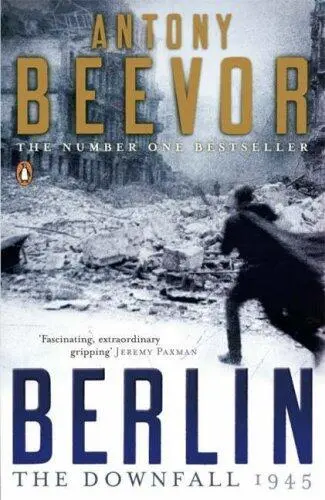
Antony Beevor - Berlin - The Downfall 1945
Здесь есть возможность читать онлайн «Antony Beevor - Berlin - The Downfall 1945» весь текст электронной книги совершенно бесплатно (целиком полную версию без сокращений). В некоторых случаях можно слушать аудио, скачать через торрент в формате fb2 и присутствует краткое содержание. Город: New York, Год выпуска: 2007, ISBN: 2007, Издательство: Penguin Books, Жанр: nonf_military, История, на английском языке. Описание произведения, (предисловие) а так же отзывы посетителей доступны на портале библиотеки ЛибКат.
- Название:Berlin: The Downfall 1945
- Автор:
- Издательство:Penguin Books
- Жанр:
- Год:2007
- Город:New York
- ISBN:978-0-141-90302-6
- Рейтинг книги:3 / 5. Голосов: 1
-
Избранное:Добавить в избранное
- Отзывы:
-
Ваша оценка:
Berlin: The Downfall 1945: краткое содержание, описание и аннотация
Предлагаем к чтению аннотацию, описание, краткое содержание или предисловие (зависит от того, что написал сам автор книги «Berlin: The Downfall 1945»). Если вы не нашли необходимую информацию о книге — напишите в комментариях, мы постараемся отыскать её.
Antony Beevor reconstructs the experiences of those millions caught up in the nightmare of the Third Reich's final collapse, telling a terrible story of pride, stupidity, fanatacism, revenge and savagery, but also one of astonishing endurance, self-sacrifice and survival against all odds.
Berlin: The Downfall 1945 — читать онлайн бесплатно полную книгу (весь текст) целиком
Ниже представлен текст книги, разбитый по страницам. Система сохранения места последней прочитанной страницы, позволяет с удобством читать онлайн бесплатно книгу «Berlin: The Downfall 1945», без необходимости каждый раз заново искать на чём Вы остановились. Поставьте закладку, и сможете в любой момент перейти на страницу, на которой закончили чтение.
Интервал:
Закладка:
Himmler had returned to the sanatorium at Hohenlychen the night before and ordered champagne at midnight to toast the Führer’s birthday. He had just arranged separate meetings with Count Folke Bernadotte of the Red Cross and Norbert Masur, the representative of the World Jewish Congress, who had been flown secretly into Tempelhof aerodrome earlier in the day. Bernadotte and Masur assumed that he wanted to discuss the possible release of prisoners, but for Himmler, the purpose was to establish a line of communication to the Western Allies. The Reichsführer SS, while still convinced of his own loyalty to Hitler, felt that he alone could replace him. He would become the leader with whom the Western Allies could negotiate. What he had to do was to convince the Jews that the Final Solution was something that both sides needed to put behind them.
Goebbels, the only leading Nazi planning to stay in Berlin with Hitler until the bitter end, broadcast a birthday speech that morning. He called on all Germans to trust blindly in the Führer, who would lead them out of their difficulties. ‘I wondered whether he was mad,’ wrote Ursula von Kardorff in her diary, ‘Or whether he was playing some sort of cold-blooded trick.’
Göring, Ribbentrop, Dönitz, Himmler, Kaltenbrunner, Speer, Keitel, Jodl and Krebs were driven to the Reich Chancellery before noon. There, they trooped through the huge rooms faced in polished marble, with doors almost to the ceiling. This quasi-cinematic monument to conspicuous power now looked tawdry in its half-wrecked state, yet it remained deeply sinister.
Many of the celebrants offering their birthday wishes that day thought that Hitler looked at least twenty years older than he was. They urged their leader to take the road to Bavaria while there was still time. Hitler stated with conviction that the Russians were about to suffer their bloodiest defeat before Berlin. Dönitz, whom Hitler had ordered to take command in the north of Germany, received an affectionate farewell. But Göring, who claimed that he would organize resistance in Bavaria, was treated in a distant manner. Hitler, Speer observed to his American interrogators less than a month later, was ‘disappointed by the cowardice of Goring and the others’. He had always persuaded himself that his close followers were men of courage.
During the situation conference that day, the main question was how soon the Reich would be cut in two south of Berlin. The territory still unoccupied was diminishing every day. The British were on the Luneburg Heath, heading towards Hamburg. The Americans were on the middle Elbe, on the borders of Czechoslovakia and moving into Bavaria. The French First Army was advancing into southern Germany. To the south-east, the Red Army was west of Vienna and the Allies in Italy were moving north across the Po valley. Again the subject of the Nazi hierarchy abandoning Berlin came up. ‘To the surprise of nearly everyone present,’ Speer stated, ‘Hitler announced that he would stay in Berlin until the last minute and only then fly to the south.’ His entourage was surprised that ‘discussion of evacuation had been general’. After the meeting, the rest of the leadership began to invent ‘all manner of excuses’ to leave Berlin on official business. Himmler, Ribbentrop and Kaltenbrunner departed in different directions. A number of the Reich Chancellery staff were detailed to leave for the Berghof the next day. ‘Führer’s birthday but unfortunately no mood for celebration,’ Bormann noted in his diary. ‘The advance party is ordered to fly to Salzburg.’
That afternoon, in the ruined Reich Chancellery garden, the Führer worked his way slowly down a line of Hitler Youth, some of whom had received the Iron Cross for attacking Soviet tanks. Hitler could not present any medals himself. To prevent his left arm shaking too obviously, he walked gripping it behind his back with his right hand. For brief moments, he could afford to release it. With what looked like the intensity of the repressed paedophile, he lingered to cup a cheek and tweak an ear, unconscious of his leering smile.
After receiving members of the close entourage that evening in the tiny sitting room in the bunker, Hitler retired to bed much earlier than usual. Eva Braun led the others up to the Reich Chancellery. With Bormann and Dr Morell among them, it was a strange and inauspicious group for a party. One of the large round tables designed by Speer was laid with food and drink. They drank champagne and made a pretence of dancing, but there was only one record for the gramophone: ‘Blood-red Roses Tell You of Happiness’. According to Hitler’s secretary, Traudl Junge, there was much hysterical laughter. ‘It was horrible; soon I couldn’t stand it and went back down to bed.’
The question of evacuation was extremely volatile. On Sunday 15 April Eva Braun had mentioned to Hitler that Dr Karl Brandt, who had been his personal surgeon, was moving his family to Thuringia. To her horror, Hitler exploded with anger, saying that he had chosen a place about to be taken by the Western Allies. That was treachery. Bormann was told to investigate the case and to interview ‘Eva Braun and Dr Stumpfegger’, the devoted SS surgeon who had replaced Brandt. Eva Braun described the affair as ‘a really foul trick’ in a letter to her best friend, Herta Ostermayr. Although physically at the centre of power, she had no understanding of National Socialist reality.
Brandt was charged next day with defeatism. Axmann was leader of the court and Brandt was condemned to death. But execution of the sentence appears to have been postponed by enemies of Bormann, including Himmler, who had at last realized that Bormann had been blackening his name at court. Brandt escaped execution by the Nazis, but was later sentenced to death by the allies. [2] In October 1944, after Brandt had accused Dr Morell of providing Hitler with dangerous drugs, the dispute had been solved by making Brandt Reich Commissioner for sanitation and health. The allies later held him responsible for euthanasia killings and medical experiments on prisoners and rejected his defence that he had had no control over the establishments where this had happened.
Brandt, a former intimate of the Obersalzburg circle, wrote a witty paper on the ‘Women around Hitler’ for his American captors at the ‘Ashcan’ interrogation centre. Hitler, he wrote, had never married because he wanted ‘to keep the mystic legend alive in the hearts of the German people that so long as he remained a bachelor, there was always the chance that any one of the millions of German women might possibly attain the high distinction of being at Hitler’s side’. Hitler apparently even spoke of this in front of Eva Braun. In 1934, he had also announced in her presence, ‘The greater the man, the more insignificant should be the woman.’
Brandt believed that the relationship between the two had an even stronger element of father–daughter than teacher-student. But whether or not he was right about this, one thing was certain. The Führer’s maîtresse sans titre was the opposite of a Pompadour. She never schemed for or against people at the court. Yet after years of having to hide herself away like a servant to preserve the Führer myth of celibacy for Germany, it was hardly surprising that she occasionally tried to play the great lady. According to Brandt, she treated her easily led younger sister, Gretl, whom she had married to Fegelein, ‘almost like a personal maid’.
The question of Hitler’s sexuality has received a good deal of speculative attention recently. There can, however, be little doubt that he suppressed his homoerotic side in the interests of his image as the virile Führer. This repression explains a good deal of his manic energy and myth-making. Some members of his household insist that he never made love with Eva Braun, but her personal maid is convinced that he did, because she used pills to suppress her menstrual cycle when he arrived at the Berghof. His appalling halitosis towards the end of his life must have made him even less physically attractive than before, but Eva Braun, like several other close female friends, was clearly besotted with him. There is no proof either way, but the passionate kiss which Hitler later bestowed on her when she refused to leave the bunker for the safety of Bavaria weakens the theory that there had never been any form of sexual contact between them.
Читать дальшеИнтервал:
Закладка:
Похожие книги на «Berlin: The Downfall 1945»
Представляем Вашему вниманию похожие книги на «Berlin: The Downfall 1945» списком для выбора. Мы отобрали схожую по названию и смыслу литературу в надежде предоставить читателям больше вариантов отыскать новые, интересные, ещё непрочитанные произведения.








Обсуждение, отзывы о книге «Berlin: The Downfall 1945» и просто собственные мнения читателей. Оставьте ваши комментарии, напишите, что Вы думаете о произведении, его смысле или главных героях. Укажите что конкретно понравилось, а что нет, и почему Вы так считаете.