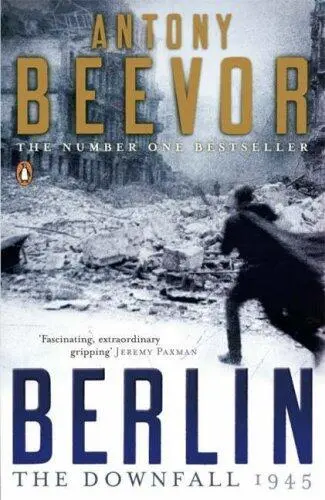
Antony Beevor - Berlin - The Downfall 1945
Здесь есть возможность читать онлайн «Antony Beevor - Berlin - The Downfall 1945» весь текст электронной книги совершенно бесплатно (целиком полную версию без сокращений). В некоторых случаях можно слушать аудио, скачать через торрент в формате fb2 и присутствует краткое содержание. Город: New York, Год выпуска: 2007, ISBN: 2007, Издательство: Penguin Books, Жанр: nonf_military, История, на английском языке. Описание произведения, (предисловие) а так же отзывы посетителей доступны на портале библиотеки ЛибКат.
- Название:Berlin: The Downfall 1945
- Автор:
- Издательство:Penguin Books
- Жанр:
- Год:2007
- Город:New York
- ISBN:978-0-141-90302-6
- Рейтинг книги:3 / 5. Голосов: 1
-
Избранное:Добавить в избранное
- Отзывы:
-
Ваша оценка:
Berlin: The Downfall 1945: краткое содержание, описание и аннотация
Предлагаем к чтению аннотацию, описание, краткое содержание или предисловие (зависит от того, что написал сам автор книги «Berlin: The Downfall 1945»). Если вы не нашли необходимую информацию о книге — напишите в комментариях, мы постараемся отыскать её.
Antony Beevor reconstructs the experiences of those millions caught up in the nightmare of the Third Reich's final collapse, telling a terrible story of pride, stupidity, fanatacism, revenge and savagery, but also one of astonishing endurance, self-sacrifice and survival against all odds.
Berlin: The Downfall 1945 — читать онлайн бесплатно полную книгу (весь текст) целиком
Ниже представлен текст книги, разбитый по страницам. Система сохранения места последней прочитанной страницы, позволяет с удобством читать онлайн бесплатно книгу «Berlin: The Downfall 1945», без необходимости каждый раз заново искать на чём Вы остановились. Поставьте закладку, и сможете в любой момент перейти на страницу, на которой закончили чтение.
Интервал:
Закладка:
That night, a massive katyusha strike destroyed and set light to the village of Wulkow, behind Neuhardenberg. Almost all its houses were crammed with exhausted German soldiers who had fallen asleep. The state of the burned and panic-stricken survivors was terrible. The Nordland reconnaissance battalion also suffered a katyusha strike. They lost more men in a few moments than in all the bitter fighting round Stettin a few weeks earlier.
On 19 April, the Ninth Army began to split up in three main directions, as General Busse had feared. The Red Army’s capture of Wriezen and the 3rd Shock Army’s advance further westward on to the plateau behind Neuhardenberg forced CI Corps back towards Eberswalde and the countryside north of Berlin. Weidling’s LVI Panzer Corps in the centre began to withdraw due west into Berlin. And on the right, the XI SS Panzer Corps began to withdraw south-westwards towards Fürstenwalde. The Kurmark Division had less than a dozen Panther tanks left.
That day, the 1st Guards Tank Army and Chuikov’s 8th Guards Army pushed on from Seelow along Reichstrasse 1 towards the key town of Müncheberg. The remains of the 9th Parachute Division, which had rallied the day before, fled in panic again, shouting, ‘ Der Iwan kommt.’ The reconnaissance battalion of the SS Nordland Division, which had finally reached the front, rounded up some of the paratroopers, gave them ammunition and brought them back into the battle in a temporarily successful counter-attack.
The retreat along Reichstrasse 1 and for quite a distance on either side soon collapsed into chaos and misery. ‘Are you the last?’ everyone asked. And the reply always seemed to be, ‘The Russians are right behind us.’ Soldiers of all arms and services were mixed up together, Wehrmacht and Waffen SS alike. The most exhausted flopped down under a tree and stretched out their legs. The local population, hearing that the front had collapsed, swamped the roads to seek shelter in Berlin. Soldiers passed refugees with carts halted by a broken axle or wheel, often hindering military traffic. Officers stood in their Kübelwagen vehicles to shout at the unfortunates to push their obstruction off the road or to order a group of resting soldiers to do it. In the retreat, officers found that they had to draw their pistol more and more often to have their orders obeyed.
The Feldgendarmerie and SS groups continued to search for deserters. No records were kept of the roadside executions carried out, but anecdotal evidence suggests that on the XI SS Corps sector, many, including a number of Hitler Youth, were hanged from trees on the flimsiest of proof. This was nothing short of murder. Soviet sources claim that 25,000 German soldiers and officers were summarily executed for cowardice in 1945. This figure is almost certainly too high, but it was unlikely to have been lower than 10,000.
Executions by the SS were even more unforgivable since word was being passed round SS formations that they were to pull back ‘with orders to reassemble in Schleswig-Holstein’ near the Danish border, which was not exactly the best place from which to fight the Russians. They did not appear to know that the British Second Army had reached the Elbe at Lauenburg that day, just south-east of Hamburg.
The 19th of April was another beautiful spring day, providing Soviet aviation with perfect visibility. Every time Shturmoviks came over, strafing and bombing, the road emptied as people threw themselves in the ditches. Women and girls from nearby villages, terrified of the Red Army, begged groups of soldiers to take them with them: ‘ Nehmt uns mit, nehmt uns bitte, bitte mit!’ Yet some people living quite close to the front seemed incapable of appreciating the scale of the impending disaster. A Herr Saalborn wrote to the bürgermeister of Woltersdorf on 19 April, demanding confirmation that, in accordance with Article 15 of the Reichsleitungsgesetz (the version of 1 September 1939), he would get back his bicycle, which had been commandeered by the Volkssturm.
The remnants of trainee and officer candidate battalions from the CI Corps found themselves retreating Village by ‘village’ westwards to Bernau, just north of Berlin. Most had lost nearly three-quarters of their strength. They were exhausted, hungry and thoroughly confused. As soon as they halted for a rest, everyone fell heavily asleep and their officers had to kick them awake several times when it was necessary to move on. Nobody knew what was happening on either side or even in front or behind. Radios and field telephones had been abandoned. There was also no hope of re-establishing an effective front line, despite the best efforts of the more experienced officers, who grabbed any stragglers from other units and incorporated them into their own little command.
General Heinrici’s attention now had to focus on the northern part of the Oder defence line between the Baltic coast and the Hohenzollern Canal at the top end of the Oderbruch. General von Manteuffel, who had been flying in a light reconnaissance aircraft over the forward areas of Rokossovsky’s armies, had no difficulty spotting enemy preparations. The 2nd Belorussian Front faced a formidable task. North of Schwedt, the Oder followed two channels, with marshy ground on either side and in between. That night of 19 April, Rokossovsky reported to Stalin that the offensive would start at first light the next morning, preceded by heavy bombing raids and artillery bombardment.
Rokossovsky had had the most difficult time of all Front commanders, redeploying his troops from Danzig and the Vistula estuary. This huge logistic problem had prompted Zhukov to warn Stalin on 29 March of what was involved. ‘Well, we’ll have to start the operation without waiting for Rokossovsky’s Front,’ he had replied. ‘If he’s a few days late, that’s not a great trouble.’ Clearly, Stalin had not been worried then. But now that Rokossovsky’s armies might be needed for Berlin, he was much more concerned.
17. The Führer’s Last Birthday
Friday 20 April was the fourth fine day in a row. It was Adolf Hitler’s fifty-sixth birthday. A beautiful day on this date used to prompt greetings between strangers in the street about ‘Führer weather’ and the miracle that this implied. Now only the most besotted Nazi could still hint at Hitler’s supernatural power. There were still enough diehards left, however, to attempt to celebrate the event. Nazi flags were raised on ruined buildings and placards proclaimed, ‘ Die Kriegsstadt Berlin grüsst den Führer!’
In the past, a mass of birthday greetings flooded the Reich Chancellery on the Führer’s birthday. Six years earlier, Professor Doctor Lutz Heck of the Berlin Zoological Garden had sent the Führer, ‘with heartiest congratulations’, an ostrich egg weighing 1,230 grams to make scrambled eggs. But in 1945, there were very few letters and parcels, and not just because the postal system had collapsed. The Berlin Zoo was also half-destroyed, with many of the animals starving.
American and British bomber forces were well aware of the date. Sirens sounded in the morning as massed squadrons approached to greet the Führer’s birthday with a particularly heavy raid. It was almost a double celebration for the USAAF and RAF bomber crews. With Soviet forces approaching Berlin, this was their second-last raid on the capital of the Reich.
Göring had woken that morning at Karinhall, his country house north of Berlin, to the opening bombardment of Rokossovsky’ offensive. A convoy of Luftwaffe trucks, although desperately needed for more urgent duties, was ready, loaded with his looted treasures. A motorcycle detachment would escort them south. Göring addressed the men briefly and watched them leave. The engineer officer, who had laid the explosives to blow up Karinhall, then escorted the Reichsmarschall over to where the plunger stood ready. Göring had insisted on blowing the place up himself. The explosion blasted vast clouds of dust outwards, then this over-extended monument to vanity collapsed in on itself. Göring, apparently without looking back, walked to his enormous limousine to be driven to Berlin. He needed to be at the Reich Chancellery at noon to congratulate the Führer on his birthday.
Читать дальшеИнтервал:
Закладка:
Похожие книги на «Berlin: The Downfall 1945»
Представляем Вашему вниманию похожие книги на «Berlin: The Downfall 1945» списком для выбора. Мы отобрали схожую по названию и смыслу литературу в надежде предоставить читателям больше вариантов отыскать новые, интересные, ещё непрочитанные произведения.








Обсуждение, отзывы о книге «Berlin: The Downfall 1945» и просто собственные мнения читателей. Оставьте ваши комментарии, напишите, что Вы думаете о произведении, его смысле или главных героях. Укажите что конкретно понравилось, а что нет, и почему Вы так считаете.