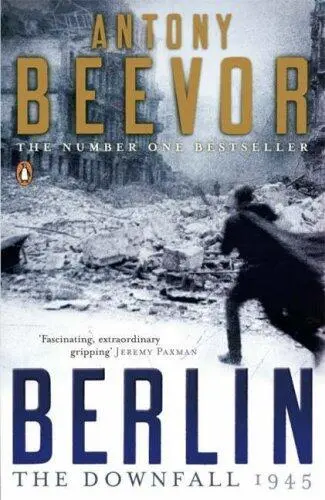
Antony Beevor - Berlin - The Downfall 1945
Здесь есть возможность читать онлайн «Antony Beevor - Berlin - The Downfall 1945» весь текст электронной книги совершенно бесплатно (целиком полную версию без сокращений). В некоторых случаях можно слушать аудио, скачать через торрент в формате fb2 и присутствует краткое содержание. Город: New York, Год выпуска: 2007, ISBN: 2007, Издательство: Penguin Books, Жанр: nonf_military, История, на английском языке. Описание произведения, (предисловие) а так же отзывы посетителей доступны на портале библиотеки ЛибКат.
- Название:Berlin: The Downfall 1945
- Автор:
- Издательство:Penguin Books
- Жанр:
- Год:2007
- Город:New York
- ISBN:978-0-141-90302-6
- Рейтинг книги:3 / 5. Голосов: 1
-
Избранное:Добавить в избранное
- Отзывы:
-
Ваша оценка:
Berlin: The Downfall 1945: краткое содержание, описание и аннотация
Предлагаем к чтению аннотацию, описание, краткое содержание или предисловие (зависит от того, что написал сам автор книги «Berlin: The Downfall 1945»). Если вы не нашли необходимую информацию о книге — напишите в комментариях, мы постараемся отыскать её.
Antony Beevor reconstructs the experiences of those millions caught up in the nightmare of the Third Reich's final collapse, telling a terrible story of pride, stupidity, fanatacism, revenge and savagery, but also one of astonishing endurance, self-sacrifice and survival against all odds.
Berlin: The Downfall 1945 — читать онлайн бесплатно полную книгу (весь текст) целиком
Ниже представлен текст книги, разбитый по страницам. Система сохранения места последней прочитанной страницы, позволяет с удобством читать онлайн бесплатно книгу «Berlin: The Downfall 1945», без необходимости каждый раз заново искать на чём Вы остановились. Поставьте закладку, и сможете в любой момент перейти на страницу, на которой закончили чтение.
Интервал:
Закладка:
In fact, both of Zhukov’s extreme flanks had met with little success. South of Frankfurt, the 33rd Army was still grinding down the defences of the SS 30. Januar Division in the V SS Mountain Corps. And at the extreme northern end of the Oderbruch, the 61st Army and the 1st Polish Army had not been able to advance until Wriezen was taken.
The breakthrough came suddenly just behind Seelow on the Reichstrasse 1. At 9.40 a.m. on 18 April, Colonel Eismann at Army Group Vistula headquarters received a message that ‘leading enemy armoured groups had broken through at Diedersdorf’. They were heading for Müncheberg along the Reichstrasse 1. The infantry was running away. Twenty minutes later, on Heinrici’s insistence, Eismann was ringing Colonel de Maizière at OKH to find out what had happened to the 7th Panzer Division, which he needed to secure the gap between the left of the Ninth Army and the right flank of the Third Panzer Army.
At midday Busse rang Heinrici. ‘Today is the moment of crisis,’ he reported. The two main thrusts were coming from south-east of Wriezen and along the Reichstrasse 1. Busse saw that his army was being broken up. The 3rd Shock Army and the 5th Shock Army were splitting open the front between Wriezen and Seelow. Half a dozen kilometres west of Seelow, near the village of Alt Rosenthal, the Germans launched a counter-attack with infantry and tanks. Major Andreev of the 248th Rifle Division in the 5th Shock Army left two of his companies to hold the thrust, while he led another company round to attack the Germans from the rear. ‘His battalion liquidated 153 soldiers and officers and two tanks.’
It was a pitiless battle. At Hermersdorf, south-west of Neuhardenberg, Soviet infantry advanced past a T-34 still burning from a panzerfaust. A German soldier in a nearby foxhole screamed to them for help. A grenade dropped in the foxhole had blown off his feet and he lacked the strength to pull himself out. But the Red Army soldiers left him there, despite his cries, in revenge for the burned crew.
At 4.20 p.m., Goring, furious at the collapse of the 9th Parachute Division, rang Army Group Vistula headquarters to order that General Bräuer should be stripped of his command immediately. At 6.45 p.m., General Busse rang Heinrici. The split in his army was unavoidable. ‘Which sector,’ he asked, ‘is more important from a command point of view, north or south?’
At 7.50 p.m., the Luftwaffe liaison officer informed the operations staff at Army Group Vistula that their aircraft had destroyed fifty-three enemy planes, forty-three tanks and another nineteen ‘probables’. Somebody on the staff added two exclamation marks in pencil in the war diary to demonstrate their scepticism at these claims. The fighting was violent, but German claims of Red Army losses were highly inflated. The Nazi newspaper Der Angriff stated that ‘426 Soviet tanks’ had been destroyed on that day alone. Nevertheless, Soviet casualties had indeed been much heavier than German losses. Zhukov, in his desperation to capture the Seelow Heights, had lost just over 30,000 men killed, while the Germans lost 12,000 during the battle.
German prisoners sent towards the rear were overawed by the endless columns of tanks, self-propelled guns and other tracked vehicles moving forward. ‘And this is the army,’ some of them thought, ‘which in 1941 was supposed to have been at its last gasp.’ Soviet infantrymen coming up the other side of the road would greet them with cries of ‘ Gitler kapuuutt!’, accompanied by a throat-cutting gesture.
One of the German prisoners was convinced that a number of the dead they passed were ‘Soviet soldiers who had been crushed by their own tanks’. He also saw Russian soldiers trying out some captured panzerfausts by firing them at the wall of a half-ruined house. Others were stripping greatcoats from their own dead, and in one village, he saw a couple of soldiers taking pot shots at nesting storks. Target practice seemed compulsive even after the battle. Some of the prisoners, taken to the magnificent schloss at Neuhardenberg, were alarmed when their escort, spotting a ‘superb chandelier’, raised his sub-machine gun and fired a burst at it. A senior officer reprimanded him, ‘but that seemed to make little impression’.
‘In the town of Gusow’, a detachment of the 5th Shock Army reported, ‘we freed sixteen Soviet women. Soldier Tsynbaluk recognized a girl he knew from home. Her name was Tatyana Shesteryakova. The women told the soldiers of their terrible suffering during their slavery. They also mentioned that before fleeing, their ex-owner, Frau Fischke said, “For us, the Russians are worse than death.”’ Political departments claimed that Red Army soldiers were outraged by the ‘fascist propaganda’ slogans daubed on walls about defending German womanhood from the Bolsheviks.
South of Berlin, Konev had an uneasy moment on 18 April. Field Marshal Schörner, the commander-in-chief of Army Group Centre, alarmed by the breakthrough on the Spree, sent in a counter-attack near Görlitz against the flank of the 52nd Army heading for Dresden. But Schörner’s failure to concentrate his forces — in his haste he sent them into the attack piecemeal — made it comparatively easy for the 52nd Army to fight them off. The 2nd Polish Army at first did not have to halt its advance. But repeated attacks over the next few days slowed them down considerably.
Konev carried on pushing the 13th Army across the Spree behind his two tank armies. All this time, Gordov’s 3rd Guards Army kept the pressure on the Germans round Cottbus and Zhadov’s 5th Guards Army continued to attack Spremberg, thus securing the breach. Konev also instructed his staff to assemble all the trucks they could. The leading formations of the 28th Army, arriving as reinforcements, were now across the Neisse, and he wanted to hurry them forward to support the tank forces advancing on Berlin. By the end of that day, Rybalko’s 3rd Guards Tank Army had advanced thirty-five kilometres beyond the Spree, while Lelyushenko, facing less resistance, had moved forward forty-five.
In the afternoon, General Reymann, the commander of the Berlin Defence Area, had received an order to send all the Volkssturm units out of the city to the Ninth Army to strengthen a new line. Reymann was appalled that the city was to be stripped of its defences. When Goebbels, as Reich Defence Commissar for Berlin, confirmed the order, Reymann warned him that ‘a defence of the capital of the Reich is now unthinkable’. Reymann had not realized that this was just what Speer and Heinrici had wanted in order to save Berlin. In the event, less than ten battalions and a few anti-aircraft guns were sent eastward. They marched out of the city in the early hours of the following morning. News of this order, according to Speer, created a widespread assumption that ‘Berlin would in effect be an open city’.
General Weidling, to his exasperation, found that he had another self-important visitor from Berlin. This time it was Artur Axmann, the head of the Hitler Youth. Weidling tried to persuade him that it was futile to throw fifteen- and sixteen-year-olds armed with panzerfausts into the battle. It was ‘the sacrifice of children for an already doomed cause’. Axmann was prepared only to admit ‘that his youngsters had not received enough training’. Despite an assurance to Weidling that he would not use them, he clearly did nothing to withdraw them from combat. An even more chilling measure of Nazi desperation that day was the beheading of thirty political prisoners in Plötzensee prison.
On the Ninth Army’s northern flank, the CI Corps had retreated less on 18 April than its neighbours. But this meant that many of its regiments soon found that Soviet troops were already well to their rear. One detachment, the remains of an officer candidate regiment, sent a couple of their comrades back to headquarters that evening to find out what had happened to their rations. The two returned out of breath and shaken. ‘The Russians are eating our supper right now,’ they said. Nobody had any idea where the enemy had broken through and where the front line now lay. They grabbed their equipment and marched back through the darkness, bypassing a village ablaze. The billowing black clouds reflected a bright red glow from the flames.
Читать дальшеИнтервал:
Закладка:
Похожие книги на «Berlin: The Downfall 1945»
Представляем Вашему вниманию похожие книги на «Berlin: The Downfall 1945» списком для выбора. Мы отобрали схожую по названию и смыслу литературу в надежде предоставить читателям больше вариантов отыскать новые, интересные, ещё непрочитанные произведения.








Обсуждение, отзывы о книге «Berlin: The Downfall 1945» и просто собственные мнения читателей. Оставьте ваши комментарии, напишите, что Вы думаете о произведении, его смысле или главных героях. Укажите что конкретно понравилось, а что нет, и почему Вы так считаете.