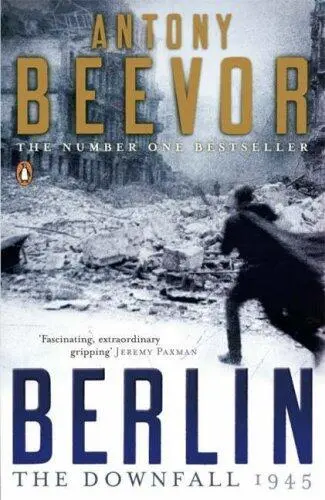
Antony Beevor - Berlin - The Downfall 1945
Здесь есть возможность читать онлайн «Antony Beevor - Berlin - The Downfall 1945» весь текст электронной книги совершенно бесплатно (целиком полную версию без сокращений). В некоторых случаях можно слушать аудио, скачать через торрент в формате fb2 и присутствует краткое содержание. Город: New York, Год выпуска: 2007, ISBN: 2007, Издательство: Penguin Books, Жанр: nonf_military, История, на английском языке. Описание произведения, (предисловие) а так же отзывы посетителей доступны на портале библиотеки ЛибКат.
- Название:Berlin: The Downfall 1945
- Автор:
- Издательство:Penguin Books
- Жанр:
- Год:2007
- Город:New York
- ISBN:978-0-141-90302-6
- Рейтинг книги:3 / 5. Голосов: 1
-
Избранное:Добавить в избранное
- Отзывы:
-
Ваша оценка:
Berlin: The Downfall 1945: краткое содержание, описание и аннотация
Предлагаем к чтению аннотацию, описание, краткое содержание или предисловие (зависит от того, что написал сам автор книги «Berlin: The Downfall 1945»). Если вы не нашли необходимую информацию о книге — напишите в комментариях, мы постараемся отыскать её.
Antony Beevor reconstructs the experiences of those millions caught up in the nightmare of the Third Reich's final collapse, telling a terrible story of pride, stupidity, fanatacism, revenge and savagery, but also one of astonishing endurance, self-sacrifice and survival against all odds.
Berlin: The Downfall 1945 — читать онлайн бесплатно полную книгу (весь текст) целиком
Ниже представлен текст книги, разбитый по страницам. Система сохранения места последней прочитанной страницы, позволяет с удобством читать онлайн бесплатно книгу «Berlin: The Downfall 1945», без необходимости каждый раз заново искать на чём Вы остановились. Поставьте закладку, и сможете в любой момент перейти на страницу, на которой закончили чтение.
Интервал:
Закладка:
In the confused fighting round Seelow, Yushchuk’s tanks were repeatedly attacked with panzerfausts fired at close range. His soldiers responded by grabbing wire-sprung mattresses from nearby houses and fastening them to their turrets and flanks. This improvised spaced armour made the hollow-charge of the panzerfaust detonate before hitting the hull or turret.
The T-34s and Stalin tanks of both Guards Tank Armies ‘ironed’ any trenches which they encountered, although most had by now been abandoned. In the more northerly part of the Oderbruch, the 3rd Shock Army, supported on its right by the 47th Army, pushed back the forward units of the CI Corps, many of whose regiments had been almost entirely composed of young trainees and officer candidates. The ‘Potsdam’ Regiment, which had reassembled near Neutrebbin, pulled back further behind the marshy banks of the Alte Oder, which was nearly ten metres wide at that point. There were only thirty-four boys left on their feet.
Again they heard the noise of tank engines. ‘We infantry were once again the idiots. We were expected to halt the Russian advance when all the other arms were pulling back westwards.’ Only a few self-propelled assault guns were left to take on Soviet tanks. The divisional artillery, having fired the last of their few rounds of ammunition, had blown up their guns and left. Not surprisingly, many of the infantry had slipped off with those withdrawing. Discipline was beginning to disintegrate, accelerated by feverish rumours that a cease-fire with the Western Allies had already begun.
In the centre, the 9th Parachute Division had completely collapsed. Its humiliated commander was General Bruno Bräuer, who had commanded the airborne assault on Heraklion in Crete. Bräuer, an elegant man who used a cigarette holder, had later become the garrison commander on Crete. Yet despite all of Göring’s preposterous boasts about his superhuman warriors, who had been kitted out to look the part with the paratrooper’s rimless helmet, Bräuer was in fact commanding Luftwaffe ground personnel. Most had never jumped from an aircraft in their life, let alone seen action. When the bombardment and assault began, the officers were unable to control their panic-stricken men, especially when subjected to a katyusha rocket attack.
Colonel Menke, the commander of the 27th Parachute Regiment, had been killed when T-34S broke through near his headquarters. Only during the late morning of 17 April did the division rally a little, when armoured support arrived in the form of Panthers, Panzer Mark IVs and half-tracks. But the collapse started again soon afterwards. Wöhlermann, the artillery commander of LVI Corps, came upon Bräuer and found him ‘completely shattered by the flight of his men’. The highly strung Bräuer suffered a nervous collapse and was relieved of his command. He was a truly unfortunate man. Shortly after the war he was tried and convicted in Athens for atrocities committed under another general on Crete and executed in 1947.
At 6.30 p.m., Ribbentrop arrived unannounced at Weidling’s headquarters, demanding to be briefed on the situation. Wöhlermann happened to arrive at that moment. ‘This is my artillery commander, who has just arrived from the front,’ said Weidling. Wöhlermann received a flabby handshake from the foreign minister. ‘He can report on the situation,’ Weidling added. Then, having indicated that his subordinate should hold nothing back, Weidling sat down next to Ribbentrop to listen. Wöhlermann’s ‘report had a devastating effect on the foreign minister’. Ribbentrop asked one or two questions in a hoarse, barely audible voice. All he could do was make evasive references to a possible ‘twelfth-hour’ change in the situation and hint at negotiations with the Americans and the British. It was perhaps this assertion that prompted General Busse to send the signal, ‘Hold on for two more days, then everything will be sorted out’. This suggestion of a deal with the Western Allies was the ultimate lie of the Nazi leadership.
Stragglers from the Oder flood plain pulled back into woods on the steep slope of the Seelow escarpment, often to find Soviet infantry and tank formations ahead of them. Groups of nervous soldiers often fired at their own side and both Soviet artillery and aviation continued to bombard their own men as much as the Germans. The Luftwaffe put up as many Focke-Wulf fighters that day as it could to oppose the onslaught and towards evening German aircraft attacked the pontoon bridges over the Oder, but in vain. A report from an unidentified source claimed that ‘German pilots frequently death-dive into Russian bombers, causing both [to] plunge flaming groundwards’. If true, this would have signified a notable reversal of roles from 1941, when desperately brave Soviet pilots rammed their Luftwaffe attackers on the first day of Operation Barbarossa.
What is even more striking is the reported use of a kamikaze squadron against the Soviet bridges across the Oder. The Luftwaffe appears to have invented its own term — Selbstopfereinsatz, or ‘self-sacrifice mission’. The pilots of the Leonidas squadron, based at Jüterbog and commanded by Lieutenant Colonel Heiner Lange, supposedly signed a declaration which ended with the words, ‘I am above all clear that the mission will end in my death.’ On the evening of 16 April, there was a farewell dance for the pilots on the base with young women from the Luftwaffe signals unit there. The dance ended with a final song. Major General Fuchs, the overall commander, was ‘fighting back his tears’.
The next morning, the first of the so-called ‘total missions’ were flown against the thirty-two ‘over-water and under-water bridges’ repaired or built by Soviet engineers. The Germans used a variety of aircraft — Focke-Wulf 190, Messerschmitt 109 and Junkers 88 — whatever was available. One of the ‘self-sacrifice pilots’ flying the next day was Ernst Beichl, in a Focke-Wulf with a 500-kilogram bomb. His target was the pontoon bridge near Zellin. Air reconnaissance later reported it destroyed, but claims that a total of seventeen bridges were destroyed in the course of three days seem wildly exaggerated. The only other one that genuinely appears to have been hit was the railway bridge at Küstrin. Thirty-five pilots and aircraft were a high price to pay for such a limited and temporary success. This did not stop Major General Fuchs from sending their names in a special birthday message ‘to the Führer on his imminent fifty-sixth birthday’. It was just the sort of present that he appreciated most.
The whole operation had to be abandoned suddenly because Marshal Konev’s tank armies, charging unexpectedly towards Berlin from the south-east, threatened their base at Jüterbog.
The fortunes of war still favoured Konev’s 1st Ukrainian Front after its attack across the Neisse. The 13th Army and the 5th Guards Army had broken open the second line of German defence. Even while heavy fighting continued on either side, Konev sent through his leading tank brigades to race for the River Spree between Cottbus and Spremberg. Large patches of pine forest burned fiercely from the renewed bombardments of both artillery and ground-attack Shturmoviks. These fires were dangerous for tanks which carried their fuel reserves in barrels strapped to the back. But speed was vital, because they had a chance of breaching the Spree barrier before the Fourth Panzer Army could reorganize a new line of defence. Konev’s troops scented victory. There was a feeling in the 4th Guards Tank Army that ‘if the Germans could not hold on to the Neisse, they can’t do anything now’. Commanders carried out a weapon inspection before the assault. A young Communist was found to have a rusty weapon. ‘How are you going to fire it?’ the officer yelled at him. ‘You should be an example to everyone, but your own weapon is dirty!’
Читать дальшеИнтервал:
Закладка:
Похожие книги на «Berlin: The Downfall 1945»
Представляем Вашему вниманию похожие книги на «Berlin: The Downfall 1945» списком для выбора. Мы отобрали схожую по названию и смыслу литературу в надежде предоставить читателям больше вариантов отыскать новые, интересные, ещё непрочитанные произведения.







Обсуждение, отзывы о книге «Berlin: The Downfall 1945» и просто собственные мнения читателей. Оставьте ваши комментарии, напишите, что Вы думаете о произведении, его смысле или главных героях. Укажите что конкретно понравилось, а что нет, и почему Вы так считаете.