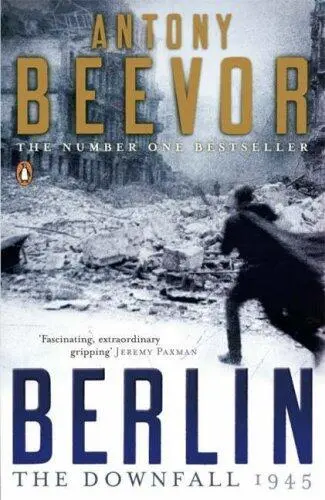
Antony Beevor - Berlin - The Downfall 1945
Здесь есть возможность читать онлайн «Antony Beevor - Berlin - The Downfall 1945» весь текст электронной книги совершенно бесплатно (целиком полную версию без сокращений). В некоторых случаях можно слушать аудио, скачать через торрент в формате fb2 и присутствует краткое содержание. Город: New York, Год выпуска: 2007, ISBN: 2007, Издательство: Penguin Books, Жанр: nonf_military, История, на английском языке. Описание произведения, (предисловие) а так же отзывы посетителей доступны на портале библиотеки ЛибКат.
- Название:Berlin: The Downfall 1945
- Автор:
- Издательство:Penguin Books
- Жанр:
- Год:2007
- Город:New York
- ISBN:978-0-141-90302-6
- Рейтинг книги:3 / 5. Голосов: 1
-
Избранное:Добавить в избранное
- Отзывы:
-
Ваша оценка:
Berlin: The Downfall 1945: краткое содержание, описание и аннотация
Предлагаем к чтению аннотацию, описание, краткое содержание или предисловие (зависит от того, что написал сам автор книги «Berlin: The Downfall 1945»). Если вы не нашли необходимую информацию о книге — напишите в комментариях, мы постараемся отыскать её.
Antony Beevor reconstructs the experiences of those millions caught up in the nightmare of the Third Reich's final collapse, telling a terrible story of pride, stupidity, fanatacism, revenge and savagery, but also one of astonishing endurance, self-sacrifice and survival against all odds.
Berlin: The Downfall 1945 — читать онлайн бесплатно полную книгу (весь текст) целиком
Ниже представлен текст книги, разбитый по страницам. Система сохранения места последней прочитанной страницы, позволяет с удобством читать онлайн бесплатно книгу «Berlin: The Downfall 1945», без необходимости каждый раз заново искать на чём Вы остановились. Поставьте закладку, и сможете в любой момент перейти на страницу, на которой закончили чтение.
Интервал:
Закладка:
Weidling ordered them to counter-attack in the Buckow forest, but this failed. The reconnaissance battalion of Nordland was almost surrounded and badly mauled. The Hitler Youth detachment suffered an even worse fate, cut off from the rest in a part of the forest which had caught fire. The Soviet tanks cautiously stayed out of range of the panzerfausts. ‘Then the tanks began firing into the tree-tops,’ Sturmmann Becker reported, ‘and the splinters from above began hitting us in our positions below.’
The survivors were forced to retreat towards Strausberg along small roads through the pinewoods. Russian infantry followed rapidly along the ditches, with their tanks coming up behind to give them covering fire. The Scandinavian Waffen SS had only infantry weapons and a couple of mortars. A lone German assault gun appeared and attempted to take on the T-34S. It was destroyed immediately. But then a solitary King Tiger appeared through the trees. It blasted the two T-34S and saved the situation.
The remnants of the reconnaissance battalion reassembled in a wood near Strausberg. They bound their wounds, patched up their vehicles and cleaned their weapons. The desolate scene did not stop Sturmbannführer Saalbach from making a speech about the Führer’s birthday and the meaning of the battle against Bolshevism in which they were engaged.
Obersturmbannführer Langendorf, who had been wounded, was taken back to the S S field hospital. He heard Goebbels’s speech for Hitler’s birthday while the surgeon was working on him. The SS surgeon muttered, ‘Now we’ll let them have it.’ The nurses were volunteers from Holland, Flanders, Denmark and especially from Norway. One of the young Norwegian nurses, Langendorf noticed, had discovered her Waffen SS lover among the badly wounded just brought in. ‘She embraced him and laid his head in her lap and stayed with him until he died from a serious head-wound.’ Like all the foreign fascists and National Socialists who had volunteered for the SS, they had lost their countries and now had lost their cause. This, combined with their visceral hatred of Bolshevism, made them formidable fighters in the battle for Berlin.
During the best part of that day, the ‘Danmark’ and ‘Norge’ regiments hung on to Strausberg airfield, defending it against Katukov’s tanks. Obersturmbannführer Klotz, the regimental commander of the ‘Danmark’, was killed when his vehicle received a direct hit. He was laid out by his men in the small chapel of a nearby cemetery. There was no time to bury him. They soon had to withdraw further, south-westwards to the Berlin autobahn ring.
The Nordland avoided the main roads in its withdrawal. Reichstrasse I was in chaos, especially the section near Rüdersdorf, with hundreds of vehicles heading westwards, often blocked by farm carts full of refugees machine-gunned by Shturmovik ground-attack aircraft. Soldiers who had received no rations for five days broke into houses abandoned by their owners. Some were so exhausted that after eating whatever they could find, they collapsed on to a bed, their uniforms still encrusted with mud from their trenches. They then slept so long that in some cases they awoke only with the arrival of the enemy. One Hitler Youth was so exhausted that, after a long and deep sleep, he woke with a start to find that a battle had been fought all around him.
Officers tried to reimpose order at pistol point. A major halted a self-propelled flak gun transporting wounded to the rear. He ordered the driver to take it back towards the enemy. The crew told him that the barrels were shot out and useless. The major still insisted and ordered them to unload the wounded. Some Volkssturm men nearby shouted out, ‘Shoot him! Shoot him!’ The major backed off. An officer’s authority, unless supported by the sub-machine guns of the Feldgendarmerie, carried little weight on such a retreat.
The chaos on the roads was further increased by rumour and panic. There were false cries of ‘Der Iwan Kommt!’, and other occasions when Soviet tanks really did appear, having overtaken them. German soldiers claimed that a ‘Seydlitz traitor’ drove through the retreating troops giving out orders to pull back as far as Potsdam on the far side of Berlin. This may well be true, since the Red Army 7th Department was pushing its ‘anti-fascist’ prisoners to take almost any risk.
Red Army soldiers clearly felt at home fighting through the pine forest east of the capital, even if the warm weather made those still wearing a fur ushanka and padded jacket jealous of those already in summer uniforms. ‘The closer one gets to Berlin,’ one Russian noted, ‘the more the area looks like the country round Moscow.’ But some Red Army habits did not speed their advance. On 20 April, Müncheberg was heavily looted ‘mostly by officers and men of special [i.e. tank and artillery] regiments… More than fifty soldiers were arrested in a day. Some were sent to rifle companies. They were stealing clothes and shoes and other things right in full view of the local population. These men explained that they were looting because they wished to send things home.’
While Weidling’s LVI Panzer Corps was pushed back to the eastern suburbs of Berlin, the remains of the CI Corps had withdrawn north of the city. Part of it pulled back to the area of Bernau during the night of 19 April. The wounded had been abandoned by the side of the road, because there were so few vehicles left with any fuel. Many of them were apparently killed where they lay by further shelling.
Most of the troops in Bernau were trainee officers and technicians from scratch regiments. As soon as they were quartered in schools and houses, they simply collapsed and fell asleep. One group of apprentice signallers found an abandoned barracks. But in the early hours of 20 April, when the 125th Rifle Corps of the 47th Army attacked, a sergeant had to go round, kicking them awake, to force them out to defend the town. ‘It was all senseless,’ commented one of their commanders years later, but at the time the Wehrmacht fought on because nobody had told them that they could stop.
The fighting for Bernau, the last real defensive action before the battle for Berlin began in earnest, was chaotic and short. German officers commanding the young trainees soon realized that they could no longer prevent total disintegration. Many escaped, slipping away alone or in small groups. When the 47th Army captured Bernau, a battery of the 30th Guards Artillery Brigade fired off a victory salute aimed at Berlin. In the meantime, Bogdanov’s 2nd Guards Tank Army pushed on past the north-eastern suburbs of the city, just outside the autobahn ring. Many Soviet soldiers had heard of it as a massive engineering feat, but those who had witnessed Stalinist showpieces professed disdain.
The 7th Department used more and more prisoners as agents to encourage desertion. On the 3rd Shock Army’s front, five soldiers from a Volkssturm battalion were sent back to their comrades on 20 April. ‘They returned the following day with almost the whole battalion.’ But despite the promises of the political department, many Russian soldiers seemed to be obsessed with finding Waffen SS soldiers on whom to take revenge. ‘ Du SS!’ they would shout accusingly. Soldiers who laughed in astonishment were in severe danger of being shot out of hand. Some of those captured by NKVD troops and accused by SMERSH of being members of Werwolf were forced into confessing that they had been ‘given chemical substances to poison wells and rivers’.
General Busse, with the larger half of the Ninth Army — the XI S S Panzer Corps, the V SS Mountain Corps and the garrison of Frankfurt an der Oder — soon began to withdraw south-westwards towards the Spreewald, despite orders from the Führer bunker that the line of defence on the Oder must never be abandoned.
Читать дальшеИнтервал:
Закладка:
Похожие книги на «Berlin: The Downfall 1945»
Представляем Вашему вниманию похожие книги на «Berlin: The Downfall 1945» списком для выбора. Мы отобрали схожую по названию и смыслу литературу в надежде предоставить читателям больше вариантов отыскать новые, интересные, ещё непрочитанные произведения.






Обсуждение, отзывы о книге «Berlin: The Downfall 1945» и просто собственные мнения читателей. Оставьте ваши комментарии, напишите, что Вы думаете о произведении, его смысле или главных героях. Укажите что конкретно понравилось, а что нет, и почему Вы так считаете.