Antony Beevor - Berlin - The Downfall 1945
Здесь есть возможность читать онлайн «Antony Beevor - Berlin - The Downfall 1945» весь текст электронной книги совершенно бесплатно (целиком полную версию без сокращений). В некоторых случаях можно слушать аудио, скачать через торрент в формате fb2 и присутствует краткое содержание. Город: New York, Год выпуска: 2007, ISBN: 2007, Издательство: Penguin Books, Жанр: nonf_military, История, на английском языке. Описание произведения, (предисловие) а так же отзывы посетителей доступны на портале библиотеки ЛибКат.
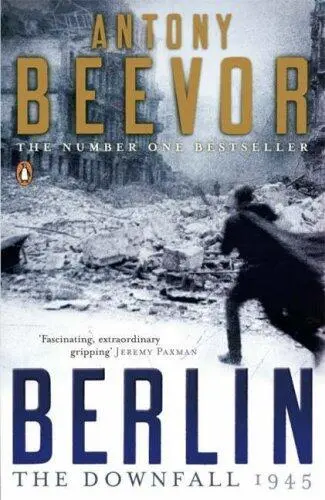
- Название:Berlin: The Downfall 1945
- Автор:
- Издательство:Penguin Books
- Жанр:
- Год:2007
- Город:New York
- ISBN:978-0-141-90302-6
- Рейтинг книги:3 / 5. Голосов: 1
-
Избранное:Добавить в избранное
- Отзывы:
-
Ваша оценка:
Berlin: The Downfall 1945: краткое содержание, описание и аннотация
Предлагаем к чтению аннотацию, описание, краткое содержание или предисловие (зависит от того, что написал сам автор книги «Berlin: The Downfall 1945»). Если вы не нашли необходимую информацию о книге — напишите в комментариях, мы постараемся отыскать её.
Antony Beevor reconstructs the experiences of those millions caught up in the nightmare of the Third Reich's final collapse, telling a terrible story of pride, stupidity, fanatacism, revenge and savagery, but also one of astonishing endurance, self-sacrifice and survival against all odds.
Berlin: The Downfall 1945 — читать онлайн бесплатно полную книгу (весь текст) целиком
Ниже представлен текст книги, разбитый по страницам. Система сохранения места последней прочитанной страницы, позволяет с удобством читать онлайн бесплатно книгу «Berlin: The Downfall 1945», без необходимости каждый раз заново искать на чём Вы остановились. Поставьте закладку, и сможете в любой момент перейти на страницу, на которой закончили чтение.
Интервал:
Закладка:
Hitler took the Soviet bombardment of Berlin as a personal affront, which, considering the slogans daubed on the Soviet shells, it was intended to be. His instinctive reaction was to blame the Luftwaffe for allowing this to happen. He threatened General Koller with execution, not for the first time. The fact that the Luftwaffe had few serviceable aircraft left and even less aviation fuel did not concern him. Anger, he was convinced, lent him inspiration. The Soviet attempt to encircle the city from the north exposed their right flank. He would order a counter-attack and cut them to ribbons. He remembered from the situation map the III SS Germanische Corps, commanded by Obergrup-penführer Felix Steiner, north-west of Eberswalde. Hitler refused to accept that Heinrici had already allocated most of its divisions to help the Ninth Army. Steiner’s corps, according to Army Group Vistula headquarters, consisted of no more than ‘three battalions and a few tanks’.
Hitler, oblivious of reality, began to talk about ‘Army Detachment Steiner’, an inflation which was grandiose even by his own standards. He argued that it could in any case be reinforced with all the units from CI Corps which had retreated north of Berlin. He even thought of Göring’s Luftwaffe bodyguard at Karinhall, but they had already departed. Every soldier, sailor and airman who could be scraped together would be thrown into battle and any commander who held back his men faced execution within five hours. Hitler had always taken as gospel the remark of Frederick the Great, ‘Whoever throws his last battalion into the struggle will be the winner.’ It bolstered his fantasy that reckless gambling with the lives of others was the mark of greatness.
Steiner, when he received the telephone call from the Führer bunker, was dumbfounded by Hitler’s order to attack. After collecting his thoughts, he rang Krebs back to remind him of the true situation, but Krebs was standing almost next to Hitler. By then it was too late. Steiner received an official order to launch a counter-attack against the right flank of the 1st Belorussian Front. He and his officers were also threatened with execution if they failed to obey. When Heinrici was informed a little later, he rang the Reich Chancellery to protest at this lunacy. Krebs told him that the decision had been made and that he could not speak to the Führer, who was too busy to talk to him.
Hitler, during the course of that night of madness, also sacked General Reymann as commander for the defence of Berlin. General Burgdorf had convinced Hitler that he was no good. And Goebbels had taken against him ever since he refused to move his headquarters into the Zoo bunker alongside his own, as Reich Commissioner for the Defence of Berlin. Reymann was made commandant of a weak division in Potsdam instead, which received the title Army Group Spree. Two replacements were considered and rejected. Hitler then chose a Colonel Käther, whose main qualification for the task was that he happened to be the chief National Socialist Führungsoffizier, the Nazi copy of the Soviet military commissar. Käther was promoted to major general and then lieutenant general, but the appointment was cancelled the following day. Berlin was without a commander just as the Red Army was entering the suburbs.
For Zhukov the pace of advance was still far too slow. Sunday 22 April had been the target date for capturing Berlin, yet his leading divisions were still on the periphery. On that morning he signalled to his army commanders: ‘The defence of Berlin is weakly organized, but the operation of our troops is progressing very slowly.’ He ordered a ‘twenty-four-hour-a-day advance’. But the fact of its being Lenin’s birthday still encouraged political departments to distribute more symbolic red banners to be raised over prominent buildings.
The Russians were unimpressed by the Spree. One officer described it as ‘a dirty, swampy little river’. But just as Zhukov had underestimated the defensive strength of the Seelow Heights, he had also overlooked the networks of rivers, canals and lakes in this forested area of Brandenburg. It was thanks only to the great experience of reconnaissance companies in swimming attacks across rivers during the two-year advance and the bridging skills and bravery of Soviet sappers that the advance did not take longer. The 1st Guards Tank Army prepared to build a pontoon bridge across the Spree near Köpenick, even though still some way off.
The 8th Guards Army, working with the tanks, was forcing Weidling’s LVI Corps back into the city without realizing it. On their right, the 5th Shock Army pushed into the eastern suburbs, and further round, the 3rd Shock Army was ordered to advance into the central northern suburbs and then down towards the centre. On its right, the 2nd Guards Tank Army was to enter the city via Siemensstadt and head for Charlottenburg. Finally, the 47th Army, after astonishing French prisoners of war in Oranienburg with their carts and bowsers towed by camels, moved further westwards to finish the encirclement of the northern half of the city.
Early that Sunday morning, General Weidling summoned his divisional commanders to discuss the situation with them. They all, with one exception, wanted to fight their way through southwards to join up with General Busse and the other two corps of the Ninth Army. The exception was Brigadeführer Ziegler of the SS Nordland Division, who, to Weidling’s fury, made no secret of wanting to rejoin Steiner. Nobody knows whether this was prompted entirely by SS tribalism, or was also a way of pulling his Scandinavian volunteers back into an SS stronghold near the Danish border.
The Nordland continued to defend Mahlsdorf and the entrance to Berlin along Reichstrasse 1. In Friedrichsfelde, one of its detachments rounded up French prisoners of war and forced them to dig trenches at gunpoint. After heavy attacks in the middle of the day, the division pulled back into Karlshorst. One of its detachments dug in beside the track for trotting races, setting up mortar positions. But it was not long before they themselves came under heavy fire, with ‘Soviet shells exploding in the stands and stable-blocks’.
It was by now almost a week since soldiers had seen the last of their iron rations, which often consisted of no more than a tin of processed cheese, a Dauerbrot, or long-life bread, and a waterbottle full of coffee or tea. Now the best they could hope for was a tin of pork left on the shelf of an abandoned house which they stabbed open with their bayonet. They were filthy, bearded and had bloodshot eyes.
Conditions for the bulk of the Ninth Army to their south-east were even worse. Hitler’s orders to hold on to the line of the Oder were senseless. The remnants of the XISS Panzer Corps, the VSS Mountain Corps and the Frankfurt garrison began to pull back into the Spreewald from different directions. Men moved singly or in groups. There were few formed units left and hardly any capable of taking orders from Busse’s headquarters. Vehicles were abandoned as they ran out of fuel along the way.
Odd detachments were left behind as a covering force, but their resistance did not last long. Reinhard Appel, one of the Hitler Youth trained at the Olympic Stadium, formed part of a group detailed to replace SS troops from the 30. fanuar Division not far from Müllrose. His life was saved by an old sergeant, highly decorated from the Eastern Front. As the Soviet soldiers advanced, Appel, in a desperate attempt to sell his life dearly, raised himself ready to throw a grenade. The sergeant grabbed his arm and prised the grenade from his grasp. He yelled at the boy that it was mad to try to be brave in a hopeless position. The Russians would just wipe out everyone in the bunker. He had a white handkerchief attached to a stick and raised his arms in surrender as the Soviet soldiers appeared with their sub-machine guns. With cries of ‘ Voina kaputt! ’ (‘the war’s had it’) and ‘ Gitler kaputt!’, the Russians rushed forward to strip the young soldiers of weapons, which they threw to one side, then grabbed their watches. The boys and the old sergeant were ordered to march eastwards towards the Oder.
Читать дальшеИнтервал:
Закладка:
Похожие книги на «Berlin: The Downfall 1945»
Представляем Вашему вниманию похожие книги на «Berlin: The Downfall 1945» списком для выбора. Мы отобрали схожую по названию и смыслу литературу в надежде предоставить читателям больше вариантов отыскать новые, интересные, ещё непрочитанные произведения.









Обсуждение, отзывы о книге «Berlin: The Downfall 1945» и просто собственные мнения читателей. Оставьте ваши комментарии, напишите, что Вы думаете о произведении, его смысле или главных героях. Укажите что конкретно понравилось, а что нет, и почему Вы так считаете.