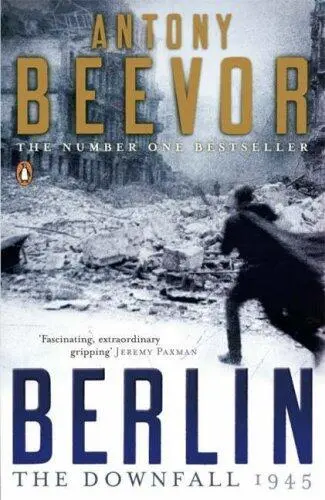
Antony Beevor - Berlin - The Downfall 1945
Здесь есть возможность читать онлайн «Antony Beevor - Berlin - The Downfall 1945» весь текст электронной книги совершенно бесплатно (целиком полную версию без сокращений). В некоторых случаях можно слушать аудио, скачать через торрент в формате fb2 и присутствует краткое содержание. Город: New York, Год выпуска: 2007, ISBN: 2007, Издательство: Penguin Books, Жанр: nonf_military, История, на английском языке. Описание произведения, (предисловие) а так же отзывы посетителей доступны на портале библиотеки ЛибКат.
- Название:Berlin: The Downfall 1945
- Автор:
- Издательство:Penguin Books
- Жанр:
- Год:2007
- Город:New York
- ISBN:978-0-141-90302-6
- Рейтинг книги:3 / 5. Голосов: 1
-
Избранное:Добавить в избранное
- Отзывы:
-
Ваша оценка:
Berlin: The Downfall 1945: краткое содержание, описание и аннотация
Предлагаем к чтению аннотацию, описание, краткое содержание или предисловие (зависит от того, что написал сам автор книги «Berlin: The Downfall 1945»). Если вы не нашли необходимую информацию о книге — напишите в комментариях, мы постараемся отыскать её.
Antony Beevor reconstructs the experiences of those millions caught up in the nightmare of the Third Reich's final collapse, telling a terrible story of pride, stupidity, fanatacism, revenge and savagery, but also one of astonishing endurance, self-sacrifice and survival against all odds.
Berlin: The Downfall 1945 — читать онлайн бесплатно полную книгу (весь текст) целиком
Ниже представлен текст книги, разбитый по страницам. Система сохранения места последней прочитанной страницы, позволяет с удобством читать онлайн бесплатно книгу «Berlin: The Downfall 1945», без необходимости каждый раз заново искать на чём Вы остановились. Поставьте закладку, и сможете в любой момент перейти на страницу, на которой закончили чтение.
Интервал:
Закладка:
Apart from broadcasts heard on battery-operated radios and a few announcements on posters about rations, most news now came by word of mouth. Rumour and fact became even more difficult to disentangle. A sense of nightmare unreality pervaded the city as it awaited its doom on that day of bright spring sunshine and heavy showers. Comparisons with its recent status as the imperial capital of occupied Europe were inescapable. Once grandiose buildings were reduced to mere façades, with the sky visible through the upper windows. And the decline from mechanized military power was underlined by the sight of German soldiers driving hay wagons drawn by small Polish horses.
The constant background of Kazakov’s artillery bombardment set nerves on edge. People found that the phrase ‘the thunder of guns’ was not one of those bombastic clichés of war but an entirely accurate description. The sound rolled and echoed, especially in courtyards behind buildings, just like a storm. Everyone was afraid, but women had most to fear. An anonymous diarist recorded that although women in ration queues discussed every advance of the enemy, there was an unspoken agreement. ‘Not a single woman talked about “it”.’
‘These are strange times,’ she added in the large sales ledger which she used as her diary. ‘One experiences history in the making, things which one day will fill the history books. But while living through it, everything dissolves into petty worries and fears. History is very tiresome. Tomorrow I’m going to look for nettles and try to find some coal.’
Hitler, on the other hand, had by now realized that history was all that was left to him — except that his notion of history was fatally dominated by an obsessive desire for immortality. Unlike Himmler, he did not try to change his image with concessions. If anything, his addiction to bloodshed and destruction intensified. One of the main reasons for his decision to stay on in Berlin was quite simple. The Fall of Berchtesgaden did not have quite the same ring as the Fall of Berlin. Nor did it offer the same spectacular images of smashed monuments and blazing buildings.
During the night of 21 April, Hitler had almost collapsed after ordering the Steiner counter-attack. His doctor, Morell, found him in such low spirits that he suggested an injection to revive him. Hitler went into a frenzy. He was convinced that the generals wanted to drug him with morphine and put him on a plane to Salzburg. It appears that he spent most of his days and nights in the bunker, when not in situation conferences, sitting in his room, lost in thought, often gazing at the portrait of Frederick the Great. It had become his icon.
For most of the morning of 22 April, Hitler feverishly demanded news of Steiner’s attack from the north. He told General Koller, the Luftwaffe chief of staff, to send up aircraft to see if Steiner’s troops had yet started to move. He contacted Himmler to ask him. The Reichsführer SS had not the slightest idea of what was going on. He and his chameleon eminence Gruppenführer Walter Schellenberg were still preoccupied with the idea of secret overtures to the Western Allies through Count Bernadotte. Himmler just made a guardedly optimistic reply, which Hitler seized upon as fact.
At the midday situation conference, however, Hitler heard for certain that Steiner had not moved. Soviet forces had also broken the perimeter defence ring in the north of the city. He began to scream and yell. The SS was betraying him now as well as the army. This rage was far worse than any of his rows with Guderian. Eventually he collapsed into an armchair, drained and weeping. He said quite openly for the first time that the war was lost. Keitel, Jodl, Krebs and Burgdorf were shaken. Hitler went on to say that because he could not die fighting, because he was too weak, he would simply shoot himself to avoid falling into the hands of the enemy. They tried to persuade him to leave for Berchtesgaden, but he had clearly made up his mind. He ordered Keitel, Jodl and Bormann to leave for the south, but they refused. Anyone else who wanted to go could go, he told them, but he was staying in Berlin to the end. He wanted an announcement made to that effect.
Goebbels was summoned to the Reich Chancellery to help persuade him to leave, but he was the worst choice, since he was already determined to stay himself. He spoke alone with Hitler in his room for some time, trying to calm him down. When Goebbels came out, he told those waiting outside that the Führer had asked him to bring his family into the bunker. It would appear that Goebbels had told Hitler during this conversation that he and his wife, Magda, had already decided to kill their six children and then themselves.
Hitler, to the surprise of his distraught entourage, re-emerged in calmer mood. Jodl had suggested that General Wenck’s Twelfth Army could be turned around from facing the Americans on the Elbe and ordered to relieve Berlin. Hitler seized on this idea. ‘General Field Marshal Keitel,’ wrote Jodl, ‘was ordered to coordinate the actions of the Twelfth Army and the Ninth Army, which was breaking out of its encirclement.’ Keitel offered to leave immediately, but Hitler insisted that he first sat down while servants brought him a meal as well as sandwiches for his journey, and half a bottle of cognac and chocolate as iron rations. Keitel then left for Wenck’s headquarters and Jodl for the new OKW base at Krampnitz, north of Potsdam.
The debate over Hitler’s degree of sanity or madness can never be resolved. But Colonel de Maizière, who was there on that evening of Sunday 22 April and who had observed him closely during numerous situation conferences, was convinced that ‘his mental sickness consisted of a hypertrophic self-identification with the German people’. This may well explain why he felt that the population of Berlin should share his suicide. But he also seemed to experience real pleasure in casualties among his own men as well as those of the enemy. ‘Losses can never be too high!’ he had exclaimed to Field Marshal von Reichenau in 1942, when informed of heavy casualties in the SS Leibstandarte Adolf Hitler. ‘They sow the seeds of future glory.’
Operation Seraglio, the evacuation to Berchtesgaden, was accelerated. A party prepared to leave early the next day. Admiral von Puttkammer, Hitler’s naval aide, had been given the task of destroying all Hitler’s public papers at the Berghof. Julius Schaub, Hitler’s personal adjutant, who had dealt with all the papers in the Reich Chancellery and bunker, was to destroy all his private correspondence. Two of the four secretaries had already been sent southwards. Dr Morell, who was apparently trembling with fear, managed to attach himself to the party. He took with him a German Army footlocker full of Hitler’s medical records.
Allied intelligence services heard far more extravagant rumours of escape from Berlin. The State Department in Washington, DC, was warned by its embassy in Madrid that ‘the chiefs plan to get to Japan by way of Norway. Heinkel 177s will take them to Norway, and there, already waiting, are planes — probably Vikings — for the non-stop flight to Japan.’ This was no doubt the wishful thinking of Nazis in Spain, who also talked of U-boats being provisioned to take food to Germany and perhaps to bring out Nazi leaders. ‘There exist in Switzerland several hospitals where, under cover of wounds or illness, Germans are hospitalized. In reality these are important personalities to be saved.’ The claim that ‘camouflaged German planes continue to bring in notables [to Spain]’ was, however, much closer to the truth. Pierre Laval, the former prime minister of Vichy France, was among those flown out of Germany to Barcelona in unmarked Junkers transports. Franco felt obliged to return Laval to France, but a number of Nazis obtained sanctuary.
Читать дальшеИнтервал:
Закладка:
Похожие книги на «Berlin: The Downfall 1945»
Представляем Вашему вниманию похожие книги на «Berlin: The Downfall 1945» списком для выбора. Мы отобрали схожую по названию и смыслу литературу в надежде предоставить читателям больше вариантов отыскать новые, интересные, ещё непрочитанные произведения.








Обсуждение, отзывы о книге «Berlin: The Downfall 1945» и просто собственные мнения читателей. Оставьте ваши комментарии, напишите, что Вы думаете о произведении, его смысле или главных героях. Укажите что конкретно понравилось, а что нет, и почему Вы так считаете.