Antony Beevor - Berlin - The Downfall 1945
Здесь есть возможность читать онлайн «Antony Beevor - Berlin - The Downfall 1945» весь текст электронной книги совершенно бесплатно (целиком полную версию без сокращений). В некоторых случаях можно слушать аудио, скачать через торрент в формате fb2 и присутствует краткое содержание. Город: New York, Год выпуска: 2007, ISBN: 2007, Издательство: Penguin Books, Жанр: nonf_military, История, на английском языке. Описание произведения, (предисловие) а так же отзывы посетителей доступны на портале библиотеки ЛибКат.
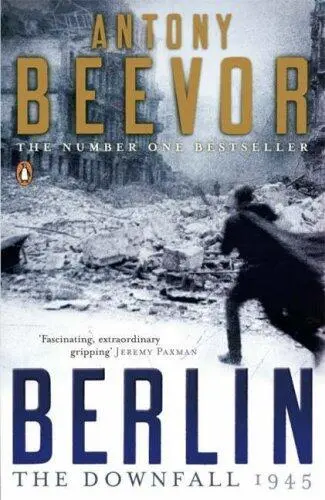
- Название:Berlin: The Downfall 1945
- Автор:
- Издательство:Penguin Books
- Жанр:
- Год:2007
- Город:New York
- ISBN:978-0-141-90302-6
- Рейтинг книги:3 / 5. Голосов: 1
-
Избранное:Добавить в избранное
- Отзывы:
-
Ваша оценка:
Berlin: The Downfall 1945: краткое содержание, описание и аннотация
Предлагаем к чтению аннотацию, описание, краткое содержание или предисловие (зависит от того, что написал сам автор книги «Berlin: The Downfall 1945»). Если вы не нашли необходимую информацию о книге — напишите в комментариях, мы постараемся отыскать её.
Antony Beevor reconstructs the experiences of those millions caught up in the nightmare of the Third Reich's final collapse, telling a terrible story of pride, stupidity, fanatacism, revenge and savagery, but also one of astonishing endurance, self-sacrifice and survival against all odds.
Berlin: The Downfall 1945 — читать онлайн бесплатно полную книгу (весь текст) целиком
Ниже представлен текст книги, разбитый по страницам. Система сохранения места последней прочитанной страницы, позволяет с удобством читать онлайн бесплатно книгу «Berlin: The Downfall 1945», без необходимости каждый раз заново искать на чём Вы остановились. Поставьте закладку, и сможете в любой момент перейти на страницу, на которой закончили чтение.
Интервал:
Закладка:
A Norwegian journalist, describing the atmosphere in the city, claimed that boys and girls in uniform simply gave in ‘to their impulses’ in ‘a hectic search for pleasure’. But this showed a lack of understanding, especially for the girls facing the prospect of rape. In any case, apart from those coupling round the Zoo bunker and in the Tiergarten’s rhododendron bushes, which were just coming into flower amid the wreckage, many others simply cuddled each other in a desperate need for reassurance.
The other instinct of the moment was to hoard like a squirrel. Gerda Petersohn, a nineteen-year-old secretary with Lufthansa, was at home in Neukölln, not far from an S-Bahn station, when word spread in the neighbourhood that a Luftwaffe rations wagon was stranded on the track. Women rushed down to loot it. They plunged into boxes and crates to grab at anything. Gerda saw a woman nearby with her arms full of lavatory paper just as Russian planes attacked, strafing with machine-gun fire and dropping small bombs. Gerda rolled under a wagon. The woman with lavatory paper in her arms was killed. ‘What a thing to die for,’ Gerda thought. The last thing she grabbed before running back to their apartment building was a packet of pilot’s emergency rations, containing Schoka-Cola and small malt tablets. These tablets were to prove very useful in an unexpected way.
There has been a dramatic account of the looting of the Karstadt department store in the Hermannplatz, where queuing shoppers had been blown to pieces during the first artillery bombardment on 21 April. According to this story, SS troops allowed civilians to take what they wanted before they blew the place up. The explosion was said to have killed many over-eager looters. But in fact when the SS Nordland Division took over the store several days later, they did not want to blow it up. They needed Karstadt’s twin towers as observation posts to watch the Soviet advance on Neukölln and the Tempelhof aerodrome.
Once the electricity supply failed and wirelesses ceased working, the rumour mill became the only news available. More false stories than true ran around Berlin. One claimed that Field Marshal Model had not committed suicide, he had been secretly arrested by the Gestapo. The regime’s own smokescreen of lies made almost anything believable, however inaccurate.
The 7th Department of the 1st Belorussian Front launched a propaganda blitz on Berlin with air-dropped leaflets telling German soldiers that it was ‘hopeless to fight on’. A Soviet prison was the only way to save their lives, which were not worth losing for the fascist government. Others were ‘safe-conduct passes’ to be shown to Red Army soldiers when surrendering. The department claimed success because ‘almost 50 per cent of Germans who surrendered in Berlin’ had one of the leaflets and showed it to their Soviet captors. Altogether ninety-five different leaflets, almost 50 million copies in all, were dropped. Others — around 1.66 million — were distributed by German civilians and soldiers who were sent back across the lines. During the Berlin operation 2,365 civilians were sent back to infiltrate the city. Also 2,130 German prisoners of war were sent back, of whom 1,845 returned bringing a further 8,340 prisoners. This tactic was deemed to be such a success that the commander of the 3rd Shock Army ordered the mass release of German prisoners of war under the supervision of political officers.
Indoctrinated former prisoners of war — ‘ Seydlitz-truppen’ as the German authorities termed them — were sent through the lines to Berlin with letters written to families by recently captured prisoners. Corporal Max S., for example, wrote to his parents, ‘My beloved relatives. Yesterday I became a prisoner of the Russians. We had been told that Russians shoot their prisoners, but this isn’t true. The Russians are treating their prisoners very well. They fed me, and warmed me up. I am feeling well. The war will end soon and I’ll see you again soon, my dear ones. Don’t worry about me. I am alive and healthy.’ The phrasing and formulae in the letter suggest that it was dictated by a Russian officer, but even so the word-of-mouth effect of such missives was worth far more than tens of thousands of leaflets.
One leaflet dropped over the capital itself was addressed to the women of Berlin. ‘Because the fascist clique is afraid of punishment, it is hoping to prolong the war. But you women have nothing to be afraid of. No one will touch you.’ It then urged them to persuade German officers and soldiers to capitulate. Since the political officers must have known the trail of mass violation in the wake of the advance through German territory, this was a breathtaking reassurance, even by most standards of wartime propaganda. Soviet propagandists also organized radio broad-casts by ‘women, actors, priests and professors’ to reassure their listeners that they would not be harmed in any way.
A more effective message came in a ‘letter from the inhabitants of Friedrichshafen to the Berlin Garrison’. ‘The day after the arrival of the Red Army life returned to normal,’ it read. ‘Food supplies recommenced. The inhabitants of Friedrichshafen tell you not to believe the false propaganda of Goebbels about the Red Army.’ The fear of starvation, above all the starvation of children, seems to have represented a greater fear for many women than the danger of rape.
Field Marshal Keitel, who had left the Führer bunker the evening before with the sandwiches, chocolate and cognac provided by a solicitous Hitler, had driven south-westwards from the capital. He was fortunate not to encounter any of Lelyushenko’s tanks. Keitel headed first to the headquarters of XX Corps at Wiesenburg, only thirty kilometres short of the American bridgehead at Zerbst. General Köhler’s corps consisted mainly of so-called ‘Young’ divisions, largely those called up for pre-military training in the Reich Labour Service. They were far from fully trained, but they certainly did not lack spirit, as General Wenck had soon found.
In the early hours of 23 April, Keitel moved to the nearby headquarters of the Twelfth Army in a forestry station. He was met by General Wenck and his chief of staff, Colonel Reichhelm. There could not have been a greater contrast between the field marshal and the general. Keitel was pompous, vain, stupid, brutal and obsequious to his Führer. Wenck, who looked young, despite his silver hair, was extremely intelligent and greatly liked by both colleagues and his soldiers. Colonel Reichhelm, his chief of staff, said of their visitor that he was ‘an outstanding sergeant, but no field marshal’. This was a mild criticism. Keitel, of all the generals who sided unconditionally with Hitler, was hated as the chief ‘gravedigger of the army’.
Keitel began lecturing Wenck and Reichhelm on the need for the Twelfth Army to save the Führer in Berlin. He ranted as if addressing a Nazi Party rally and waved his field marshal’s baton. ‘We let him talk and we let him leave,’ Reichhelm said later. But Wenck already had another idea. He would indeed attack towards Berlin, as ordered, but not to save Hitler. He wanted to force open a corridor from the Elbe, to allow soldiers and civilians to escape both the senseless fighting and the Red Army. It was to be a Rettungsaktion — a rescue operation.
Hitler, not trusting any general, insisted that his Führer order to the Twelfth Army should be broadcast over the radio addressed to the ‘Soldaten der Armee Wenck!’ It was probably the only time in history that military orders were deliberately made public in the middle of a battle. This was immediately followed by the Werwolfsender radio station, which announced that ‘the Führer has issued orders from Berlin that units fighting [the] Americans rapidly be transferred east to defend Berlin. Sixteen divisions [are] already moving and can be expected [to] arrive [in] Berlin [at] any hour’. The whole purpose was to deceive the population of Berlin into believing that the Americans were now supporting the Germans against the Red Army. By chance, that day American air activity over the central Elbe suddenly halted. It was a huge relief for Twelfth Army soldiers.
Читать дальшеИнтервал:
Закладка:
Похожие книги на «Berlin: The Downfall 1945»
Представляем Вашему вниманию похожие книги на «Berlin: The Downfall 1945» списком для выбора. Мы отобрали схожую по названию и смыслу литературу в надежде предоставить читателям больше вариантов отыскать новые, интересные, ещё непрочитанные произведения.









Обсуждение, отзывы о книге «Berlin: The Downfall 1945» и просто собственные мнения читателей. Оставьте ваши комментарии, напишите, что Вы думаете о произведении, его смысле или главных героях. Укажите что конкретно понравилось, а что нет, и почему Вы так считаете.