Antony Beevor - Berlin - The Downfall 1945
Здесь есть возможность читать онлайн «Antony Beevor - Berlin - The Downfall 1945» весь текст электронной книги совершенно бесплатно (целиком полную версию без сокращений). В некоторых случаях можно слушать аудио, скачать через торрент в формате fb2 и присутствует краткое содержание. Город: New York, Год выпуска: 2007, ISBN: 2007, Издательство: Penguin Books, Жанр: nonf_military, История, на английском языке. Описание произведения, (предисловие) а так же отзывы посетителей доступны на портале библиотеки ЛибКат.
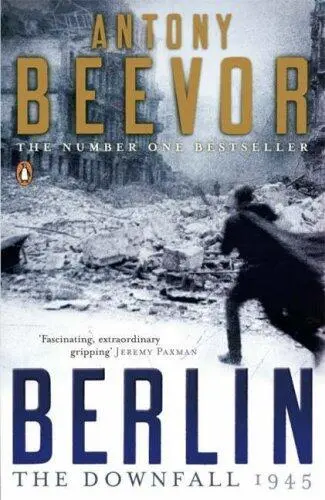
- Название:Berlin: The Downfall 1945
- Автор:
- Издательство:Penguin Books
- Жанр:
- Год:2007
- Город:New York
- ISBN:978-0-141-90302-6
- Рейтинг книги:3 / 5. Голосов: 1
-
Избранное:Добавить в избранное
- Отзывы:
-
Ваша оценка:
Berlin: The Downfall 1945: краткое содержание, описание и аннотация
Предлагаем к чтению аннотацию, описание, краткое содержание или предисловие (зависит от того, что написал сам автор книги «Berlin: The Downfall 1945»). Если вы не нашли необходимую информацию о книге — напишите в комментариях, мы постараемся отыскать её.
Antony Beevor reconstructs the experiences of those millions caught up in the nightmare of the Third Reich's final collapse, telling a terrible story of pride, stupidity, fanatacism, revenge and savagery, but also one of astonishing endurance, self-sacrifice and survival against all odds.
Berlin: The Downfall 1945 — читать онлайн бесплатно полную книгу (весь текст) целиком
Ниже представлен текст книги, разбитый по страницам. Система сохранения места последней прочитанной страницы, позволяет с удобством читать онлайн бесплатно книгу «Berlin: The Downfall 1945», без необходимости каждый раз заново искать на чём Вы остановились. Поставьте закладку, и сможете в любой момент перейти на страницу, на которой закончили чтение.
Интервал:
Закладка:
After a strafing attack by a Soviet fighter, which killed one man, and on hearing artillery fire in the middle distance, Krukenberg directed the vehicles along small roads which he had known as an officer in Berlin before the war. Taking advantage of the pine forests, which hid them from enemy aviation, they came closer to the city. The route, however, became increasingly difficult with barricades and blown bridges, so Krukenberg ordered the trucks to return to Neustrelitz. He retained the two armoured personnel carriers, but the vast majority of the French volunteers had to continue on foot for another twenty kilometres.
They reached the area of the Reichssportfeld, next to the Olympic stadium, at 10 p.m. The exhausted men discovered a Luftwaffe supply store, but most of them drank a special pilot’s cocoa laced with benzedrine. Few managed to sleep. Krukenberg, accompanied by his adjutant, Captain Pachur, then set out across an apparently deserted Berlin to report to Fegelein in the Reich Chancellery. A rumour spread among the French volunteers that Hitler himself was coming out to review them there.
Their more direct chief, Himmler, who had driven past that morning, had finally crossed his Rubicon. The ‘faithful Heinrich’, as Himmler had been known with amusement at the Führer’s court, was doomed as a conspirator. He had little talent for plotting and lacked conviction for his cause. His only advantage was that Hitler never imagined that the Reichsführer, who had proudly invented the SS motto, ‘My honour is loyalty’, would turn out a traitor.
According to Speer, Himmler was still furious over Hitler’s order to strip the Waffen SS divisions in Hungary of their armband titles. Yet if Hitler had summoned him to his side or given some indication that he appreciated him above Martin Bormann, then his eyes would have filled with tears and he would have renewed his pledge of devotion to the Führer on the spot. As a result he was paralysed by indecision. Yet Himmler’s greatest miscalculation, in his attempt to open negotiations with the enemy, was his belief that he was vital to the Western Allies, ‘since he alone could maintain order’.
At the first two meetings with Count Bernadotte, Himmler had not dared take the conversation beyond the release of concentration camp prisoners. ‘The Reichsführer is no longer in touch with reality,’ Bernadotte had told Schellenberg after the meeting which followed Hitler’s birthday. Himmler refused to follow the advice of Schellenberg, who urged him to depose or even murder the man to whom he had been so faithful.
Schellenberg managed to persuade Himmler not to return to the bunker to see Hitler on 22 April after they had heard from Fegelein of the Führer’s frenzy that afternoon. Schellenberg was afraid that the moment his chief saw the Führer again, his resolve would weaken. Himmler offered his SS guard battalion for the defence of Berlin through an intermediary. Hitler accepted immediately and showed on the map where the battalion should be deployed, in the Tiergarten close to the Reich Chancellery. He also gave orders for the important prisoners — the Prominenten — to be moved so that they could be slaughtered at the moment of defeat.
On the night of 23 April, Himmler and Schellenberg met Bernadotte at Lübeck. Himmler, aware now of Hitler’s determination to kill himself in Berlin, was finally resolved to take his place and start negotiations in earnest. He now formally requested Bernadotte to approach the Western Allies on his behalf to arrange a cease-fire on the Western Front. He promised that all Scandinavian prisoners would be sent to Sweden. It was typical of Himmler’s strange relationship with reality that his immediate preoccupation was whether he should bow to General Eisenhower or shake hands when meeting him.
For the last Jews left in captivity in Berlin, the coming of the Red Army signified either the end to a dozen years of nightmare or execution at the last moment. Hans Oskar Löwenstein, who had been arrested in Potsdam, was taken to the Schulstrasse transit camp, based on Berlin’s Jewish hospital in the northern district of Wedding. Around 600 of them packed into two floors were fed on potato peelings and raw beetroot, with a little Wassersuppe or ‘water soup’. Among them were many half-Jews like Löwenstein himself, termed ‘ Mischling’ by the Nazis. There were also members of the privileged category of Jews protected by the Nazis, the Schutzjuden, who included, for example, those who had organized the Berlin Olympic Games. Foreign Jews of neutral nationality still held there, particularly South Americans, had been kept alive by relatives at home sending coffee beans to the SS administration.
The camp commander, SS Obersturmbannführer Doberke, had received the order to shoot all his prisoners, but he was clearly nervous. A spokesman from the prisoners approached him with a simple deal. ‘The war is over,’ he told Doberke. ‘If you save our lives, we will save yours.’ The prisoners then prepared a huge form, signed by them all, saying that Obersturmbannführer Doberke had saved their lives. Two hours after the form had been taken from them, they saw that the gates were open and the SS guards had disappeared. But liberation did not prove such a joyous occasion. Soviet soldiers raped the Jewish girls and women in the camp, not knowing that they had been persecuted by the Nazis.
While Soviet armies were advancing into Berlin they were cheered by ‘a real International’ of ‘Soviet, French, British, American and Norwegian prisoners of war’, together with women and girls who had been taken to Germany as slave labourers, all coming in the other direction. Marshal Konev, reaching Berlin from the south, was impressed to see that they walked in the ruts made by tank tracks, knowing that these at least would be clear of mines.
Grossman, arriving from the east, also saw ‘hundreds of bearded Russian peasants with women and children’. He noted ‘an expression of grim despair on these faces of bearded “uncles” and devout village elders. These are starosty [village leaders appointed by the Germans] and police villains who had run all the way to Berlin and now have no choice but to be “liberated” ’
‘An old woman is walking away from Berlin,’ Grossman jotted in his notebook. ‘She is wearing a little shawl over her head, looking exactly as if she were on a pilgrimage, a pilgrim in the vast spaces of Russia. She’s holding an umbrella on her shoulder, with a huge aluminium saucepan hanging from its handle.’
Although Hitler still could not fully accept the idea of transferring troops from the Western Front to face the Red Army, Keitel and Jodl acknowledged that there was now no alternative. The Wehrmacht operations staff issued orders accordingly. Stalin’s suspicions, combined with the Soviet policy of revenge, had become something of a self-fulfilling prophecy.
Stalin was also preoccupied with his bête noire of Poland. He had absolutely no intention of backing down over the composition of the provisional government. As far as he was concerned, the matter was self-evident, and the wishes of the Polish people counted for nothing. ‘The Soviet Union,’ he wrote to President Truman on 24 April, ‘has a right to make efforts that there should exist in Poland a government friendly towards the Soviet Union.’ This of course meant completely under Soviet control. ‘It is also necessary to take into account the fact that Poland borders with the Soviet Union, which cannot be said of Great Britain and the United States.’ With Berlin now virtually surrounded, and the Western Allies boxed out, Stalin saw no reason to be emollient. Despite all the earlier Soviet accusations against the US Air Force, there was no hint of apology when two American aircraft were attacked and one of them destroyed that afternoon by six Soviet fighters.
Читать дальшеИнтервал:
Закладка:
Похожие книги на «Berlin: The Downfall 1945»
Представляем Вашему вниманию похожие книги на «Berlin: The Downfall 1945» списком для выбора. Мы отобрали схожую по названию и смыслу литературу в надежде предоставить читателям больше вариантов отыскать новые, интересные, ещё непрочитанные произведения.






Обсуждение, отзывы о книге «Berlin: The Downfall 1945» и просто собственные мнения читателей. Оставьте ваши комментарии, напишите, что Вы думаете о произведении, его смысле или главных героях. Укажите что конкретно понравилось, а что нет, и почему Вы так считаете.