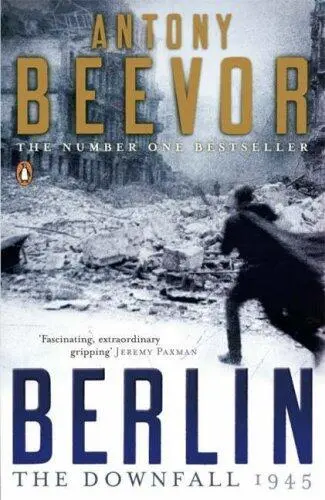
Antony Beevor - Berlin - The Downfall 1945
Здесь есть возможность читать онлайн «Antony Beevor - Berlin - The Downfall 1945» весь текст электронной книги совершенно бесплатно (целиком полную версию без сокращений). В некоторых случаях можно слушать аудио, скачать через торрент в формате fb2 и присутствует краткое содержание. Город: New York, Год выпуска: 2007, ISBN: 2007, Издательство: Penguin Books, Жанр: nonf_military, История, на английском языке. Описание произведения, (предисловие) а так же отзывы посетителей доступны на портале библиотеки ЛибКат.
- Название:Berlin: The Downfall 1945
- Автор:
- Издательство:Penguin Books
- Жанр:
- Год:2007
- Город:New York
- ISBN:978-0-141-90302-6
- Рейтинг книги:3 / 5. Голосов: 1
-
Избранное:Добавить в избранное
- Отзывы:
-
Ваша оценка:
Berlin: The Downfall 1945: краткое содержание, описание и аннотация
Предлагаем к чтению аннотацию, описание, краткое содержание или предисловие (зависит от того, что написал сам автор книги «Berlin: The Downfall 1945»). Если вы не нашли необходимую информацию о книге — напишите в комментариях, мы постараемся отыскать её.
Antony Beevor reconstructs the experiences of those millions caught up in the nightmare of the Third Reich's final collapse, telling a terrible story of pride, stupidity, fanatacism, revenge and savagery, but also one of astonishing endurance, self-sacrifice and survival against all odds.
Berlin: The Downfall 1945 — читать онлайн бесплатно полную книгу (весь текст) целиком
Ниже представлен текст книги, разбитый по страницам. Система сохранения места последней прочитанной страницы, позволяет с удобством читать онлайн бесплатно книгу «Berlin: The Downfall 1945», без необходимости каждый раз заново искать на чём Вы остановились. Поставьте закладку, и сможете в любой момент перейти на страницу, на которой закончили чтение.
Интервал:
Закладка:
Wenck and his staff knew that Keitel was as much of a fantasist as Hitler. Any suggestion of tackling two Soviet tank armies when they lacked battle-worthy tanks was grotesque. ‘So we made up our own orders,’ said Colonel Humboldt, the chief operations officer. Wenck planned to drive on Potsdam with one force while the bulk of the army would advance eastwards, south of Berlin, to join up with Busse and help his Ninth Army escape. ‘We were in radio contact with Busse and knew where he was.’ Only a light screen of troops would be left facing the Americans.
Detailed orders were issued rapidly, and later that day, General Wenck drove in a Kübelwagen to address the young soldiers, both those who were to attack north-eastwards towards Potsdam and those who were to attack towards Treuenbrietzen and Beelitz, where the hospital complex was threatened. ‘Boys, you’ve got to go in once more,’ Wenck told them. ‘It’s not about Berlin any more, it’s not about the Reich any more.’ Their task was to save people from the fighting and the Russians. Hans-Dietrich Genscher, a young sapper with the Twelfth Army, described their emotions as ‘a feeling of loyalty, a sense of responsibility and comradeship’.
Wenck’s leadership struck a powerful chord, even if reactions varied between those who believed in a humanitarian operation and those keener to take on the Russians instead of the Western Allies. ‘So about turn!’ wrote Peter Rettich, the battalion commander of the Scharnhorst Division, which had taken such a hammering from the Americans. ‘And now it’s quick march to the east against the Ivans.’
The other key German general in the battle for Berlin to emerge at this time was General Helmuth Weidling, the commander of the LVI Panzer Corps. Weidling looked rather like a professorial version of Erich von Stroheim, only with hair.
On the morning of 23 April, Weidling rang the Führer bunker to report. General Krebs replied ‘with conspicuous coldness’ and informed him that he had been condemned to death. Demonstrating a remarkable moral and physical courage, he turned up at the Führer bunker that afternoon. Hitler was clearly impressed, so much so that he decided that the man he had wanted to execute for cowardice was the man to command the defence of the Reich capital. It was, as Colonel Refior observed, a ‘tragi-comedy’ typical of the regime.
Weidling’s LVI Panzer Corps was considerably reduced. Only fragments remained of the 9th Parachute Division. The Müncheberg Panzer Division was reduced to remnants, and although the 20th Panzergrena-dier Division was in better shape, its commander, Major General Scholz, had committed suicide shortly after entering Berlin. Only the Nordland and the 18th Panzergrenadier Division remained in a relatively battle-worthy condition. Weidling decided to hold back the 18th Panzer-grenadier Division in reserve for counter-attack. The other formations were distributed around the different defence sectors to act as ‘ Korsett-stangen’ — ‘corset-stiffeners’.
The defence of the city had been organized into eight sectors, designated by the letters A to H. Each was commanded by a general or colonel, but few of them had any front experience. Inside the perimeter defence line, an inner defence ring followed the circular track of the S-Bahn city railway. The innermost area was bound by the Landwehr Canal on the south and the River Spree on the north side. The only real strongpoints were the three concrete flak towers — the Zoobunker, the Humboldthain and the Friedrichshain. They had plenty of ammunition for their 128mm and 20mm guns, as well as good communications with underground telephone cables. Their greatest problem was to be overfilled with wounded and civilians in their thousands.
Weidling found that he was supposed to defend Berlin from 1.5 million Soviet troops with around 45,000 Wehrmacht and SS troops, including his own corps, and just over 40,000 Volkssturm. Almost all the sixty tanks in the city came from his own formations. There was also supposed to be a Panzerjagd battalion equipped with Volkswagens, each of which was fitted with a rack for six anti-tank rockets, but nobody could find any trace of it. In the central government district, Brigadeführer Mohnke commanded over 2,000 men from his base in the Reich Chancellery. [3] Soviet estimates put the German strength at 180,000. This was because the Red Army included all those they took prisoner afterwards, including unarmed Volkssturm, city police, railway officials and members of the Reich Labour Service. Propaganda naturally played a part too.
The most immediate threat which Weidling faced on the afternoon of 23 April was the assault on the east and south-east of the city from the 5th Shock Army, the 8th Guards Army and the 1st Guards Tank Army. That night, armoured vehicles which were still battle-worthy were ordered back to Tempelhof aerodrome to refuel. There, amid an expanse of wrecked Luftwaffe fighter planes, mainly Focke-Wulfs, the armoured vehicles filled up at a depot by the huge administration building. They received an order to prepare to counter-attack south-eastwards towards Britz. They were reinforced with a few King Tiger tanks and some Nebelwerfer rocket launchers, but the main anti-tank weapon of this force was the ‘Stuka on foot’, a joke name for the panzerfaust.
After his visit to the Twelfth Army, Keitel returned to the Reich Chancellery at 3 p.m. He and Jodl went to see Hitler for the last time. On their return to the temporary OKW headquarters at Krampnitz, they heard that Russian forces were approaching from the north — this was the 47th Army — and the camp was abandoned in the early hours of the morning.
It continued to be a busy afternoon in the Führer bunker after Weidling’s departure. Hitler, seizing on Keitel’s report on his visit to the Twelfth Army, gave himself another injection of optimistic fantasy. A hopeless addict, he felt a renewed conviction that the Red Army could be defeated. Then Albert Speer, to everyone’s surprise — and to a certain degree his own — returned to Berlin to see Hitler for the very last time. The leave-taking on Hitler’s birthday had been unsatisfactory for him when surrounded by so many others. Despite changing feelings about his Führer and patron, he evidently still experienced an egotistical charge from this extraordinary friendship, which some have termed homoerotic.
Speer had driven from Hamburg, trying to avoid roads clogged with refugees, then found that his way was blocked. The Red Army had reached Nauen. He went back to a Luftwaffe airfield, where he commandeered a two-seater Focke-Wulf trainer, and then flew to Gatow airfield on the western edge of Berlin. From there, a Fieseler Storch spotter plane had brought him into the centre, landing at dusk short of the Brandenburg Gate on the east-west axis. Eva Braun, who had always adored Speer, was overjoyed to see him, partly because she had predicted that he would return. Even Bormann, who loathed Speer out of jealousy, seemed pleased to see him, and greeted him at the bottom of the stairs. Speer was probably the only person capable of persuading Hitler at this late hour to leave Berlin. For Bormann, who did not share the fascination with suicide of those around him, especially Goebbels, this was the only hope of saving his own neck.
Hitler, Speer found, was calm, like an old man resigned to death. He asked questions about Grand Admiral Dönitz and Speer sensed immediately that Hitler intended to nominate him as his successor. Hitler also asked his opinion about flying to Berchtesgaden or staying in Berlin. Speer said that he thought it would be better to end it all in Berlin rather than at his country retreat, where ‘the legends would be hard to create’. Hitler seemed reassured that Speer agreed with his decision. He then discussed suicide and Eva Braun’s determination to die with him.
Читать дальшеИнтервал:
Закладка:
Похожие книги на «Berlin: The Downfall 1945»
Представляем Вашему вниманию похожие книги на «Berlin: The Downfall 1945» списком для выбора. Мы отобрали схожую по названию и смыслу литературу в надежде предоставить читателям больше вариантов отыскать новые, интересные, ещё непрочитанные произведения.







Обсуждение, отзывы о книге «Berlin: The Downfall 1945» и просто собственные мнения читателей. Оставьте ваши комментарии, напишите, что Вы думаете о произведении, его смысле или главных героях. Укажите что конкретно понравилось, а что нет, и почему Вы так считаете.