Antony Beevor - Berlin - The Downfall 1945
Здесь есть возможность читать онлайн «Antony Beevor - Berlin - The Downfall 1945» весь текст электронной книги совершенно бесплатно (целиком полную версию без сокращений). В некоторых случаях можно слушать аудио, скачать через торрент в формате fb2 и присутствует краткое содержание. Город: New York, Год выпуска: 2007, ISBN: 2007, Издательство: Penguin Books, Жанр: nonf_military, История, на английском языке. Описание произведения, (предисловие) а так же отзывы посетителей доступны на портале библиотеки ЛибКат.
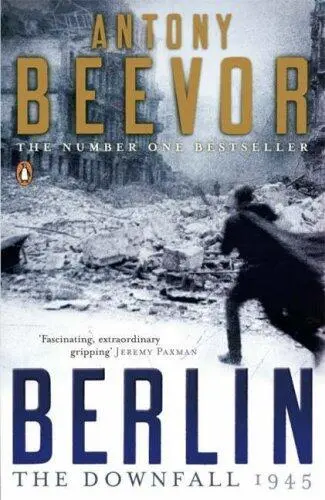
- Название:Berlin: The Downfall 1945
- Автор:
- Издательство:Penguin Books
- Жанр:
- Год:2007
- Город:New York
- ISBN:978-0-141-90302-6
- Рейтинг книги:3 / 5. Голосов: 1
-
Избранное:Добавить в избранное
- Отзывы:
-
Ваша оценка:
Berlin: The Downfall 1945: краткое содержание, описание и аннотация
Предлагаем к чтению аннотацию, описание, краткое содержание или предисловие (зависит от того, что написал сам автор книги «Berlin: The Downfall 1945»). Если вы не нашли необходимую информацию о книге — напишите в комментариях, мы постараемся отыскать её.
Antony Beevor reconstructs the experiences of those millions caught up in the nightmare of the Third Reich's final collapse, telling a terrible story of pride, stupidity, fanatacism, revenge and savagery, but also one of astonishing endurance, self-sacrifice and survival against all odds.
Berlin: The Downfall 1945 — читать онлайн бесплатно полную книгу (весь текст) целиком
Ниже представлен текст книги, разбитый по страницам. Система сохранения места последней прочитанной страницы, позволяет с удобством читать онлайн бесплатно книгу «Berlin: The Downfall 1945», без необходимости каждый раз заново искать на чём Вы остановились. Поставьте закладку, и сможете в любой момент перейти на страницу, на которой закончили чтение.
Интервал:
Закладка:
Speer was still in the bunker on that evening of 23 April when Bormann rushed in with a signal from Goring in Bavaria. Göring had received from General Koller a third-hand account of Hitler’s breakdown the day before and his pronouncement that he would stay in Berlin and shoot himself. Göring was still the legal successor, and he must have feared that Bormann, Goebbels or Himmler would stake a rival claim. He clearly did not know that Dönitz had been chosen as the unanointed heir. Göring spent over half a day discussing the situation with advisers and with General Koller, who had flown down from Berlin that morning with the inaccurate version of what had been said in the Führer bunker. He then drafted the text which was transmitted to Berlin that night. ‘My Führer! — In view of your decision to remain at your post in the fortress of Berlin, do you agree that I take over, at once, the total leadership of the Reich, with full freedom of action at home and abroad, as your deputy, in accordance with your decree of 29 June 1941? If no reply is received by ten o’clock tonight, I shall take it for granted that you have lost your freedom of action, and shall consider the conditions of your decree as fulfilled, and shall act for the best interests of our country and our people. You know what I feel for you in this gravest hour of my life. Words fail me to express myself. May God protect you, and speed you quickly here in spite of all. Your loyal Hermann Göring.’
It cannot have been hard for Bormann to have roused Hitler’s suspicions. A second telegram from Göring to Ribbentrop, summoning him for discussions, helped convince Hitler that this was outright treason. Bormann immediately offered to draft a reply. A stinging rebuke stripped Göring of all his responsibilities, titles and powers of command. He was, however, offered the option of retirement from all his posts on health grounds. This would save him from far graver charges. Göring had little option but to agree. Even so, on Bormann’s orders, an SS guard surrounded the Berghof and Göring effectively became a prisoner. As a further humiliation, the kitchens were locked, supposedly to prevent the disgraced Reichsmarschall from poisoning himself.
After this drama, Speer visited Magda Goebbels. He found her pale from an angina attack, lying on a bed in a tiny concrete room. Goebbels would not leave them alone together for a moment. Later, when Hitler had retired about midnight, an orderly arrived with a message from Eva Braun asking Speer to visit her. She ordered champagne and cakes for the two of them and they chatted about the past: Munich, skiing holidays together and life at the Berghof. Speer had always liked Eva Braun — ‘a simple Munich girl, a nobody’ — whom he now admired for her ‘dignity, and almost a kind of gay serenity’. The orderly returned at 3 a.m., to say that Hitler had risen again. Speer left her to make his final farewell to the man who had made him famous. It lasted only a few moments. Hitler was both brusque and distant. Speer, his former favourite, had ceased to exist in his mind.
At some time during the course of that evening, Eva Braun wrote her last letter to Gretl Fegelein, her sister. ‘Hermann is not with us,’ she wrote of Gretl’s husband. ‘He left for Nauen to gather a battalion or something of the sort.’ She did not know that Fegelein’s journey to reach Nauen was in fact an aborted secret meeting with Himmler which was part of the plot to make peace with the Western Allies. ‘He wants to fight his way out in order to continue the resistance in Bavaria, anyway for a time.’ She was clearly mistaken. Her brother-in-law had risen too far to want to be reduced to a mere partisan.
Eva Braun, practical within her unworldliness, then proceeded to concentrate on business matters. She wanted Gretl to destroy all her private correspondence. ‘On no account must Heise’s bills be found.’ Heise was her dressmaker and she did not want the public to know how extravagant she had been at the Führer’s expense. Once again, she was concerned with the disposal of her jewellery. ‘My diamond watch is unfortunately being repaired,’ she wrote. Gretl was to track down SS Unterscharfführer Stegemann, who had apparently arranged to have it repaired by a watchmaker, almost certainly Jewish, ‘evacuated’ from Oranienburg concentration camp in one of the last death marches.
20. False Hopes
Frightened Berliners could not resist believing Goebbels when he promised that Wenck’s army was coming to save them. They were also encouraged to believe in the rumour that the Americans were joining in the battle against the Russians. Many heard aircraft fly over the city during the night of 23 April without dropping bombs. These planes, they told each other, must have been American, and perhaps they were dropping paratroops. But the two US Airborne divisions had never emplaned.
Just about the only troops coming to Berlin at this time were neither American nor German, but French. At 4 a.m. on Tuesday 24 April, Brigadeführer Krukenberg was woken in the SS training camp near Neustrelitz, where remnants of the ‘Charlemagne’ Division had been based since the Pomeranian disaster. The telephone call was from Army Group Vistula headquarters. Evidently, General Weidling had informed Heinrici that he insisted on removing Brigadeführer Ziegler from command of the Nordland. Krukenberg was told that he was to move to Berlin immediately. No reason was given. He was simply told to report to Gruppenführer Fegelein in the Reich Chancellery. The staff officer also advised him to take an escort, as he might have trouble getting through to Berlin.
Henri Fenet, the surviving battalion commander, was woken immediately and he roused his men. Krukenberg was dressed in the long grey leather greatcoat of a Waffen SS general when he addressed the assembled officers and men. He asked for volunteers to accompany him to Berlin. Apparently, the vast majority wanted to go. Krukenberg and Fenet chose ninety, because that was all that the vehicles available could carry. Many were officers, including the divisional chaplain, Monsignor Count Mayol de Lupé. After the war, Krukenberg claimed that none of them were National Socialists. This may well have been true in the strict sense of the term, but French fascism was probably closer to Nazism than to the Italian or Spanish varieties. In any case, these volunteers ready to die in the ruins of the Third Reich were all fanatical anti-Bolsheviks, whether they believed in New Europe or ‘ vieille France’.
The volunteers selected filled their pockets and haversacks with ammunition and took the battalion’s remaining panzerfausts. At 8.30 a.m., as they formed up by the road to climb into their vehicles, they suddenly saw the Reichsführer SS driving himself in an open Mercedes. Himmler passed right through them without even acknowledging his troops. He had no guards and no escort. Only several years later did Krukenberg realize that Himmler must have been returning to his retreat at Hohenlychen from Lübeck. He had met Count Bernadotte, the Swedish Red Cross representative, the night before.
The column of two armoured personnel carriers and three heavily laden trucks set off for Berlin. They had heard that Soviet tanks had already reached Oranienburg, so Krukenberg decided to take a more westerly route. It was not going to be easy to reach Berlin. Everyone was going in the other direction, whether formed detachments, stragglers, refugees or foreign workers. Many Wehrmacht soldiers jeered at the ‘Charlemagne’ volunteers, telling them that they were headed in the wrong direction. Some tapped their temples to indicate that they were crazy. Others shouted that the war was as good as over. They even encountered the signals detachment of the Nordland Division. Its commander claimed that he had received orders to move to Schleswig-Holstein. Krukenberg, having been out of touch, had no way of verifying this. Also he knew nothing of the row between Ziegler and Weidling.
Читать дальшеИнтервал:
Закладка:
Похожие книги на «Berlin: The Downfall 1945»
Представляем Вашему вниманию похожие книги на «Berlin: The Downfall 1945» списком для выбора. Мы отобрали схожую по названию и смыслу литературу в надежде предоставить читателям больше вариантов отыскать новые, интересные, ещё непрочитанные произведения.








Обсуждение, отзывы о книге «Berlin: The Downfall 1945» и просто собственные мнения читателей. Оставьте ваши комментарии, напишите, что Вы думаете о произведении, его смысле или главных героях. Укажите что конкретно понравилось, а что нет, и почему Вы так считаете.