Antony Beevor - Berlin - The Downfall 1945
Здесь есть возможность читать онлайн «Antony Beevor - Berlin - The Downfall 1945» весь текст электронной книги совершенно бесплатно (целиком полную версию без сокращений). В некоторых случаях можно слушать аудио, скачать через торрент в формате fb2 и присутствует краткое содержание. Город: New York, Год выпуска: 2007, ISBN: 2007, Издательство: Penguin Books, Жанр: nonf_military, История, на английском языке. Описание произведения, (предисловие) а так же отзывы посетителей доступны на портале библиотеки ЛибКат.
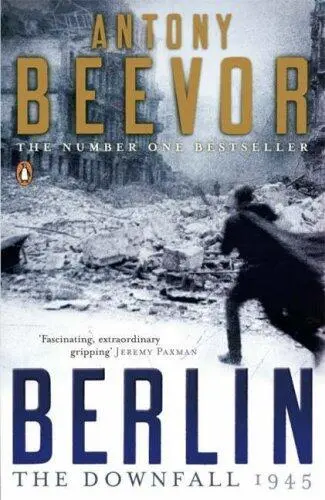
- Название:Berlin: The Downfall 1945
- Автор:
- Издательство:Penguin Books
- Жанр:
- Год:2007
- Город:New York
- ISBN:978-0-141-90302-6
- Рейтинг книги:3 / 5. Голосов: 1
-
Избранное:Добавить в избранное
- Отзывы:
-
Ваша оценка:
Berlin: The Downfall 1945: краткое содержание, описание и аннотация
Предлагаем к чтению аннотацию, описание, краткое содержание или предисловие (зависит от того, что написал сам автор книги «Berlin: The Downfall 1945»). Если вы не нашли необходимую информацию о книге — напишите в комментариях, мы постараемся отыскать её.
Antony Beevor reconstructs the experiences of those millions caught up in the nightmare of the Third Reich's final collapse, telling a terrible story of pride, stupidity, fanatacism, revenge and savagery, but also one of astonishing endurance, self-sacrifice and survival against all odds.
Berlin: The Downfall 1945 — читать онлайн бесплатно полную книгу (весь текст) целиком
Ниже представлен текст книги, разбитый по страницам. Система сохранения места последней прочитанной страницы, позволяет с удобством читать онлайн бесплатно книгу «Berlin: The Downfall 1945», без необходимости каждый раз заново искать на чём Вы остановились. Поставьте закладку, и сможете в любой момент перейти на страницу, на которой закончили чтение.
Интервал:
Закладка:
The exodus meant that rooms in the bunker and Reich Chancellery were liberated. Major Freytag von Loringhoven, who had moved into the bunker with General Krebs, found that the ventilation system worked well. But in the tiny conference room, with fifteen to twenty people in there, the air became almost unbreathable. Hitler was the only one to sit. The others were almost asleep on their feet. The bombing and shelling began to create cracks in the walls, and dust seeped out into the air. Since smoking was strictly forbidden in the lower Führer bunker, those desperate for a cigarette had to creep up a floor to the upper bunker. Despite these inconveniences, the bunker and the Reich Chancellery cellars were ‘superbly stocked’ with food and alcohol. The generous supplies of drink did not contribute to clear thinking. ‘In the bunker,’ Colonel de Maizière noted, ‘an atmosphere of disintegration reigned. One saw drunkenness and dejection, yet also men of all ranks acting in a frantic manner. Discipline had ceased to exist.’ This dissipation appeared to provide a striking contrast with the Nazi notion of family values when Frau Goebbels arrived, leading her six children. And yet both contained exactly the same currents of sentimentality, self-pity and brutality.
Freytag von Loringhoven was at the bottom of the stairs when he suddenly saw Magda Goebbels descend the concrete stairs, followed by her six children. She looked ‘ sehr damenhaff ’ — ‘very ladylike’. The six children behind ranged from twelve years old down to five: Helga, Hilde, Helmut, Holde, Hedda and Heide. Their first names, all beginning with the same letter, had not been chosen like a class of warships, but to honour the place in the alphabet marked by the Führer’s name. They descended the stairs like a school crocodile. Their pale faces stood out against their dark coats. Helga, the oldest, looked very sad, but she did not cry. Hitler knew and approved of the decision by Joseph and Magda Goebbels to kill their children before they killed themselves. This proof of total loyalty prompted him to present her with his own gold Nazi Party badge, which he always wore on his tunic. The arrival of the children in the bunker had a momentarily sobering effect. Everyone who saw them enter knew that they would be murdered by their parents as part of a Führerdämmerung.
After his terrible emotional storm in the early afternoon, Hitler rested in his small bunker sitting room with Eva Braun. He summoned his two remaining secretaries, Gerda Christian and Traudl Junge, his Austrian dietician, Constanze Manzialy, and Bormann’s secretary, Elsa Krüger. Hitler told the women that they must prepare to leave for the Berghof like the others. Eva Braun smiled and went to him. ‘You know that I am never going to leave you,’ she said. ‘I will stay by your side.’ He pulled her head down to him and, in front of everybody, kissed her full on the lips. This act astonished all who knew him. Traudl Junge and Gerda Christian said that they would stay too. Hitler looked at them fondly. ‘If only my generals had been as brave as you,’ he said. He dispensed cyanide pills to them as a farewell present.
It was presumably soon after this that Eva Braun went to type a last letter to her best friend, Herta Ostermayr. This was to accompany all her jewels. One of the men about to fly south was waiting to take the package for her. She told Herta in the letter that the jewels were to be distributed according to her will. Their value would help friends and family keep their heads ‘above water’ in the days to come. ‘Forgive me if this is a bit confused,’ she wrote, ‘but I am surrounded by the six children of G[oebbels] and they are not being quiet. What should I say to you? I cannot understand how it should have all come to this, but it is impossible to believe any more in a God.’
19. The Bombarded City
On 23 April, the Nazi-controlled radio station in Prague claimed that the Führer’s decision to stay in the capital of the Reich gave ‘the battle a European significance’. The same morning, the headline of the newspaper of the 3rd Shock Army read, ‘Motherland Rejoice! We are on the streets of Berlin!’ National Socialism had laid claim to an international cause, while international Communism had become unashamedly patriotic.
For the civilians of Berlin, ideological causes made little difference any more. Survival was what counted under the bombardment. Worse was to come. General Kazakov was bringing in 600mm siege guns on specially widened tracks along the line leading to the Schlesicher Bahnhof in the east of the city. Each shell weighed half a ton.
Apart from the three flak towers, one of the largest refuges in Berlin was the Anhalter Bahnhof bunker, next to the main station. Built in ferro-concrete, with three storeys above ground and two below, its walls were up to four and a half metres thick. Pine seats and tables had been provided by the authorities, as well as emergency supplies of tinned sardines, but neither lasted long when both fuel and food were in such short supply. The Anhalter bunker’s great advantage was its direct link to the U-Bahn tunnels, even though the trains were not running. People could walk the five kilometres to the Nordbahnhof, without ever being exposed.
The conditions in the bunker became appalling, with up to 12,000 people crammed into 3,600 square metres. The crush was so great that nobody could have reached the lavatory even if it had been open. One woman described how she spent six days on the same step. For hygienic Germans, it was a great ordeal, but with water supplies cut, drinking water was a far higher priority. There was a pump which still worked outside the station, and young women near the entrance took the risk of running with a pail to fetch water. Many were killed, because the station was a prime target for Soviet artillery. But those who made it back alive earned eternal gratitude from those too weak to fetch it for themselves, or they bartered sips for food from those who lacked the courage to run the gauntlet themselves.
At the anti-tank barriers set up at major intersections, the Feldgendarmerie checked papers, ready to arrest and execute any deserters. In cellars, a growing trickle of German officers and soldiers began to appear in civilian clothes. ‘Desertion suddenly seems quite natural, almost creditable,’ a woman diarist noted on that morning of Monday 23 April. She thought of Leonidas’s 300 Spartans at Thermopylae, about whom they had heard so much at school. ‘Maybe here and there 300 German soldiers would behave in the same way: 3 million would not. The greater the crowd, the less the chance for schoolbook heroism. By nature, we women don’t appreciate it much either. We’re sensible, practical, opportunistic. We prefer men alive.’
When she went in search of coal later that morning along the S-Bahn tracks, she found that the tunnel to the south was already blocked against the Russians on the southern rim of the city. She heard from bystanders that a man accused of desertion had been hanged at the other end of the tunnel. Apparently he had been hanged with his feet not very far off the ground and some boys had been amusing themselves by twisting the corpse round and making it spin back.
On her way home she was horrified by the sight of ‘soft-faced children under huge steel helmets… so tiny and thin in uniforms far too large for them’. She wondered why she was so outraged by ‘this abuse of children’, when if they had been just a few years older, she would have been far less upset. She concluded that some rule of nature, which protected the survival of the species, was being broken by throwing immature humans into battle. To take that step was ‘a symptom of madness’.
Perhaps as a side-effect of this law linking death with sexual maturity, the arrival of the enemy at the edge of the city made young soldiers desperate to lose their virginity. Girls, well aware of the high risk of rape, preferred to give themselves to almost any German boy first than to a drunken and probably violent Soviet soldier. In the broadcasting centre of the Grossdeutscher Rundfunk on the Masurenallee, two-thirds of the 500-strong staff were young women — many little more than eighteen. There, in the last week of April, a ‘real feeling of disintegration’ spread, with heavy drinking and indiscriminate copulation amid the stacks of the sound archive. There was also a good deal of sexual activity between people of various ages in unlit cellars and bunkers. The aphrodisiac effect of mortal danger is hardly an unknown historical phenomenon.
Читать дальшеИнтервал:
Закладка:
Похожие книги на «Berlin: The Downfall 1945»
Представляем Вашему вниманию похожие книги на «Berlin: The Downfall 1945» списком для выбора. Мы отобрали схожую по названию и смыслу литературу в надежде предоставить читателям больше вариантов отыскать новые, интересные, ещё непрочитанные произведения.









Обсуждение, отзывы о книге «Berlin: The Downfall 1945» и просто собственные мнения читателей. Оставьте ваши комментарии, напишите, что Вы думаете о произведении, его смысле или главных героях. Укажите что конкретно понравилось, а что нет, и почему Вы так считаете.