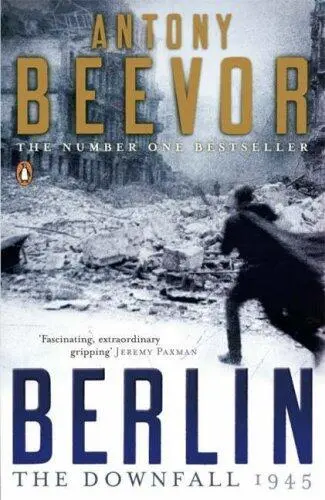
Antony Beevor - Berlin - The Downfall 1945
Здесь есть возможность читать онлайн «Antony Beevor - Berlin - The Downfall 1945» весь текст электронной книги совершенно бесплатно (целиком полную версию без сокращений). В некоторых случаях можно слушать аудио, скачать через торрент в формате fb2 и присутствует краткое содержание. Город: New York, Год выпуска: 2007, ISBN: 2007, Издательство: Penguin Books, Жанр: nonf_military, История, на английском языке. Описание произведения, (предисловие) а так же отзывы посетителей доступны на портале библиотеки ЛибКат.
- Название:Berlin: The Downfall 1945
- Автор:
- Издательство:Penguin Books
- Жанр:
- Год:2007
- Город:New York
- ISBN:978-0-141-90302-6
- Рейтинг книги:3 / 5. Голосов: 1
-
Избранное:Добавить в избранное
- Отзывы:
-
Ваша оценка:
Berlin: The Downfall 1945: краткое содержание, описание и аннотация
Предлагаем к чтению аннотацию, описание, краткое содержание или предисловие (зависит от того, что написал сам автор книги «Berlin: The Downfall 1945»). Если вы не нашли необходимую информацию о книге — напишите в комментариях, мы постараемся отыскать её.
Antony Beevor reconstructs the experiences of those millions caught up in the nightmare of the Third Reich's final collapse, telling a terrible story of pride, stupidity, fanatacism, revenge and savagery, but also one of astonishing endurance, self-sacrifice and survival against all odds.
Berlin: The Downfall 1945 — читать онлайн бесплатно полную книгу (весь текст) целиком
Ниже представлен текст книги, разбитый по страницам. Система сохранения места последней прочитанной страницы, позволяет с удобством читать онлайн бесплатно книгу «Berlin: The Downfall 1945», без необходимости каждый раз заново искать на чём Вы остановились. Поставьте закладку, и сможете в любой момент перейти на страницу, на которой закончили чтение.
Интервал:
Закладка:
In the Ninth Army’s centre, the remnants of Weidling’s LVI Panzer Corps were also pushed back against and across the eastern side of the Berlin autobahn ring. Corpses lay in the ditches on either side of the obvious highways. Most were the victims of Shturmovik low-level strafing attacks.
Side roads and main routes alike were encumbered by civilians with handcarts, prams and teams of farm horses. Soldiers were surrounded by civilians desperate for news of the enemy’s advance, but often had no clear idea themselves. Pickets of Feldgendarmerie at each crossroads again grabbed stragglers to form scratch companies. There were also men hanged from roadside trees, with a card on their chest stating, ‘I was a coward.’ Soldiers sent to defend houses either side of the road were the luckiest. The inhabitants gave them food and some hot water to shave and wash in, the first for many days.
In Petershagen, a company of the Nordland under Sturmbannführer Lorenz, supported by a few reconnaissance vehicles, prepared to make a stand against the 8th Guards Army, but they were suddenly devastated by a massive katyusha strike. One account claims that the Soviet troops had filled the warheads with an improvised napalm. The reconnaissance vehicles apparently burst into flame and in some cases exploded. The panic-stricken survivors jumped into the vehicles left undamaged and drove off, leaving the injured, many with terrible burns, to their fate. Only Lorenz and his radio operator stayed to care for them. They loaded the ones most likely to survive on to the only remaining half-track and drove them back to the dressing station. It had been set up in a barn within a hollow next to a command post. Lorenz had ‘a very bad feeling’. A few moments later the Soviet Guards artillery landed another accurate katyusha strike. Hardly anybody survived unscathed. Lorenz himself received shrapnel in the right shoulder.
Close by, Gerhard Tillery, one of the survivors of a trainee officer battalion, saw a colonel from their division outside a racing stable at Hoppegarten. ‘See that you all get home safe and sound,’ the colonel told the surprised soldier. ‘There’s no more point to any of this.’ But Tillery could not follow this advice straight away. Their new scratch company was commanded by a very determined young artillery officer with no infantry experience at all. He pulled them back to Mahlsdorf, where they took up defensive positions in a cemetery. In the lull before the fighting began again, Tillery and a couple of others were sent to collect food offered by local civilians. They brought it back in a couple of milk churns. Tillery saw that there were some Volkssturm and a police battalion on their right. They all knew that it would not be long before the Russians appeared, feeling their way forward and firing mortars at any likely defensive position.
There, on the eastern side of Berlin, the German remnants of the Ninth Army faced the 5th Shock Army and Chuikov’s 8th Guards Army. But then Zhukov pushed the 8th Guards Army further south towards the Spree. He wanted Chuikov and Katukov’s 1st Guards Tank Army, still working closely together, to enter Berlin from the south-west. This, he hoped, would pre-empt Konev’s attempt to attack Berlin from that direction. On 21 April, some of Katukov’s tank brigades advanced with the infantry of 8th Guards Army and captured Erkner, just south of Rüdersdorf.
To encircle the northern flank of Berlin, Zhukov had sent the 47th Army round towards Spandau and the 2nd Guards Tank Army to Oranienburg. Pressure from Stalin prompted the signal: ‘Due to the slowness of our advance, the Allies are approaching Berlin and will soon take it.’ The leading tank brigades, which were supposed to have reached the city the night before, were only at the outskirts by the evening of 21 April. Zhukov refused to acknowledge that a headlong advance with tanks in such surroundings involved heavy losses. Every house by the side of the road, every allotment or garden, almost every bush could contain a Hitler Youth or Volkssturmer armed with a panzerfaust. Rifle regiments from the 3rd Shock Army and the 5th Shock Army also reached the north-eastern suburbs of Malchow and Hohenschönhausen that night.
Twenty kilometres south of Berlin in the huge underground headquarters at Zossen there was a mood of profound anxiety. The day before, when the threat of Soviet tanks coming up from the south had arisen, General Krebs had sent off the OKH’s small defence detachment in reconnaissance vehicles to investigate. At 6 a.m. on 21 April, Krebs’s second aide, Captain Boldt, was woken by a telephone call. Senior Lieutenant Kränkel, commanding the defence detachment, had just seen forty Soviet tanks coming up the Baruth road towards Zossen. He was about to engage them. Boldt knew that Kränkel’s light armoured vehicles stood no chance against T-34S. He informed Krebs, who rang the Reich Chancellery to ask permission to relocate the headquarters. Hitler refused. Shortly before the 11 a.m. situation conference, tank guns could be heard clearly in the distance. One staff officer observed that the Russians could reach Zossen in half an hour. Another message arrived from Kränkel. His attack had failed with heavy losses. There was nothing left to stop the enemy tanks.
General Krebs appeared from his office. ‘If you’re ready, gentlemen,’ he said, and thus began the very last conference of German general staff officers. It was hard to keep their minds off their imminent capture by Soviet armoured forces and the prison camps which awaited them in Russia. But there was no more shooting. The tanks had halted north of Baruth because they were out of diesel. And finally, at 1 p.m., General Burgdorf rang from the Reich Chancellery. The OKH was to move its headquarters to a Luftwaffe base at Eiche near Potsdam. Their companions in the adjoining OKW bunker system were to move to the nearby tank base at Krampnitz. The decision was taken only just in time.
A larger convoy of vehicles and non-essential personnel left Zossen on a hazardous journey to the south-west and then on down to Bavaria. They knew nothing of Lelyushenko’s tank brigades crossing their path ahead, but instead they were hit by one of the last Luftwaffe sorties. The German pilots misidentified their vehicles. The smaller party, meanwhile, headed for Potsdam, on a parallel route to Lelyushenko’s tanks.
Late that afternoon, Soviet soldiers entered the concealed camp at Zossen with caution and amazement. The two complexes, known as Maybach I and Maybach II, lay side by side, hidden under trees and camouflage nets. It was not the mass of papers blowing about inside the low, zigzag-painted concrete buildings which surprised them, but the resident caretaker’s guided tour. He led them down into a maze of galleried underground bunkers, with generators, plotting maps, banks of telephones and teleprinters. Its chief wonder was the telephone exchange, which had linked the two supreme headquarters with Wehrmacht units in the days when the Third Reich had stretched from the Volga to the Pyrenees and from the North Cape to the Sahara. Apart from the caretaker, the only defenders left were four soldiers. Three of them had surrendered immediately. The fourth could not because he was dead drunk.
A telephone suddenly rang. One of the Russian soldiers answered it. The caller was evidently a senior German officer asking what was happening. ‘Ivan is here,’ the soldier replied in Russian, and told him to go to hell.
Just as Krebs’s staff officers were transferring with unseemly haste to the western side of Berlin, a rumour started that General Weidling had also moved his headquarters to Döberitz, just north of Potsdam. This was to lead to a black comedy two days later, when Hitler first wanted to execute Weidling for treason and cowardice, but then appointed him commander of the defence of Berlin.
Читать дальшеИнтервал:
Закладка:
Похожие книги на «Berlin: The Downfall 1945»
Представляем Вашему вниманию похожие книги на «Berlin: The Downfall 1945» списком для выбора. Мы отобрали схожую по названию и смыслу литературу в надежде предоставить читателям больше вариантов отыскать новые, интересные, ещё непрочитанные произведения.








Обсуждение, отзывы о книге «Berlin: The Downfall 1945» и просто собственные мнения читателей. Оставьте ваши комментарии, напишите, что Вы думаете о произведении, его смысле или главных героях. Укажите что конкретно понравилось, а что нет, и почему Вы так считаете.