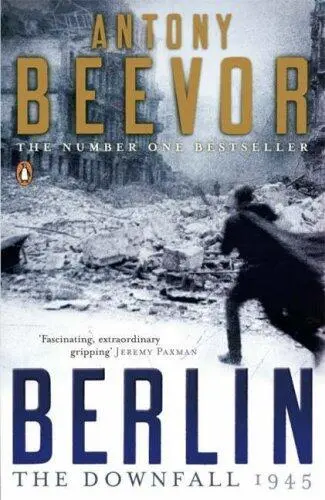
Antony Beevor - Berlin - The Downfall 1945
Здесь есть возможность читать онлайн «Antony Beevor - Berlin - The Downfall 1945» весь текст электронной книги совершенно бесплатно (целиком полную версию без сокращений). В некоторых случаях можно слушать аудио, скачать через торрент в формате fb2 и присутствует краткое содержание. Город: New York, Год выпуска: 2007, ISBN: 2007, Издательство: Penguin Books, Жанр: nonf_military, История, на английском языке. Описание произведения, (предисловие) а так же отзывы посетителей доступны на портале библиотеки ЛибКат.
- Название:Berlin: The Downfall 1945
- Автор:
- Издательство:Penguin Books
- Жанр:
- Год:2007
- Город:New York
- ISBN:978-0-141-90302-6
- Рейтинг книги:3 / 5. Голосов: 1
-
Избранное:Добавить в избранное
- Отзывы:
-
Ваша оценка:
Berlin: The Downfall 1945: краткое содержание, описание и аннотация
Предлагаем к чтению аннотацию, описание, краткое содержание или предисловие (зависит от того, что написал сам автор книги «Berlin: The Downfall 1945»). Если вы не нашли необходимую информацию о книге — напишите в комментариях, мы постараемся отыскать её.
Antony Beevor reconstructs the experiences of those millions caught up in the nightmare of the Third Reich's final collapse, telling a terrible story of pride, stupidity, fanatacism, revenge and savagery, but also one of astonishing endurance, self-sacrifice and survival against all odds.
Berlin: The Downfall 1945 — читать онлайн бесплатно полную книгу (весь текст) целиком
Ниже представлен текст книги, разбитый по страницам. Система сохранения места последней прочитанной страницы, позволяет с удобством читать онлайн бесплатно книгу «Berlin: The Downfall 1945», без необходимости каждый раз заново искать на чём Вы остановились. Поставьте закладку, и сможете в любой момент перейти на страницу, на которой закончили чтение.
Интервал:
Закладка:
The Führer’s compulsion to launch counter-attacks for their own sake returned on the evening of 20 April, just when Zhukov and Konev were forcing their own tank army commanders to advance more rapidly. Hitler told General Krebs to launch an attack from the west of Berlin against Konev’s armies to prevent encirclement. The force expected to ‘hurl back’ the 3rd and 4th Guards Tank Armies consisted of the Friedrich Ludwig Jahn Division, made up of boys in Reich Labour Service detachments, and the so-called ‘Wünsdorf Panzer formation’, a batch of half a dozen tanks from the training school there.
A police battalion was sent to the Strausberg area that day ‘to catch deserters and execute them and shoot any soldiers found retreating without orders’. But even those detailed as executioners began to desert on their way forward. One of those who gave themselves up to the Russians told his Soviet interrogator that ‘about 40,000 deserters were hiding in Berlin even before the Russian advance. Now this number is rapidly increasing.’ He went on to say that the police and the Gestapo could not control the situation.
18. The Flight of the Golden Pheasants
On the morning of Saturday 21 April, just after the last Allied air raid had finished, General Reymann’s headquarters on the Hohenzollerndamm swarmed with brown uniforms. Senior Nazi Party officials had rushed there to obtain the necessary authorization to leave Berlin. For once the ‘Golden Pheasants’ had to request permission from the army. Goebbels, as Reich Commissioner for Berlin, had ordered that ‘no man capable of bearing arms may leave Berlin’. Only the headquarters for the Defence of Berlin could issue an exemption.
‘The rats are leaving the sinking ship’ was the inevitable reaction of Colonel von Refior, Reymann’s chief of staff. Reymann and his staff officers received a fleeting satisfaction from the sight. Over 2,000 passes were signed for the Party ‘armchair warriors’, who had always been so ready to condemn the army for retreating. Reymann said openly that he was happy to sign them since it was better for the defence of the city to be rid of such cowards.
This idea was echoed strongly two days later by the Werwolfsender, Goebbels’s special transmitter at Königs Wusterhausen, when it broadcast appeals to the ‘ Werwölfe of Berlin and Brandenburg’ to rise against the enemy. It claimed that all the cowards and traitors had left Berlin. ‘The Führer did not flee to southern Germany. He stands in Berlin and with him are all those whom he has found worthy to fight beside him in this historic hour… Now, soldiers and officers of the front, you are not only waging the final and greatest decisive battle of the Reich, but by your fight you are also completing the National Socialist revolution. Only the uncompromising revolutionary fighters have remained.’ This deliberately ignored the far larger numbers of reluctant Volkssturm and conscripts forced to fight on with the threat of a noose or a firing squad.
An intensive artillery bombardment of Berlin began at 9.30 a.m., a couple of hours after the end of the last Allied air raid. Hitler’s SS adjutant, Otto Günsche, reported that the Führer, a few minutes after having been woken, emerged unshaven and angry in the bunker corridor which served as an anteroom. ‘What’s going on?’ he shouted at General Burgdorf, Colonel von Below and Günsche. ‘Where’s this firing coming from?’
Burgdorf answered that central Berlin was under fire from Soviet heavy artillery. ‘Are the Russians already so near?’ asked Hitler, clearly shaken.
General Kazakov had pushed forward his breakthrough artillery divisions and all the other heavy gun batteries with 152mm and 203mm howitzers. More messages had been daubed on the shells — ‘For the rat Goebbels’, ‘For Stalingrad’, ‘For the fat belly of Göring’ and ‘For orphans and widows!’ The gun crews were encouraged into a frenzied rate of fire by political officers. Senior artillery officers felt especially proud and made self-satisfied remarks about ‘the bloody god of war’, which had become an almost universal euphemism for Soviet gunnery. From that morning until 2 May, they were to fire 1.8 million shells in the assault on the city.
The casualties among women especially were heavy as they still queued in the drizzling rain, hoping for their ‘crisis rations’. Mangled bodies were flung across the Hermannplatz in south-west Berlin as people queued outside the Karstadt department store. Many others were killed in the queues at the water pumps. Crossing a street turned into a dash from one insecure shelter to another. Most gave up and returned to their cellars. Some, however, took what seemed like the last opportunity to bury silver and other valuables in their garden or a nearby allotment. But the relentlessness of the bombardment and the random fall of shells soon forced the majority of the population back underground.
In the cellars and air-raid shelters distinctive subcultures had grown up during two years of heavy air raids from ‘ die Amis?’ by day and ‘ die Tommys’ by night. The ‘cellar tribe’, as one diarist called these curious microcosms of society, produced a wide variety of characters, whether in markedly rich or poor districts. Each cellar always seemed to have at least one crashing bore, usually a Nazi trying to justify his belief in the Führer and final victory. A number of Berliners, for some reason, had suddenly started to refer to Hitler as ‘that one’, and it was not necessarily a term of abuse.
People clung to lucky charms or talismans. One mother brought with her the spare artificial leg of a son still trapped in the siege of Breslau. Many cellar tribes developed a particular superstition or theory of survival. For example, some believed that they would survive an almost direct hit by wrapping a towel round their head. Others were convinced that if they bent forward at the first explosion, this would prevent their lungs from tearing. Every eccentricity of German hypochondria seems to have received full expression. When the all-clear sounded after a bombing raid, cellars and shelters echoed with nervous laughter and compulsive jokes. A favourite among older, more raucous women was, ‘Better a Russki on the belly than an Ami on the head.’
During the course of the day, while shattered German units and stragglers fell back, Hitler still insisted that Busse hold a line which had been disintegrating for two days. The remnants of Busse’s left wing, the CI Corps, had been forced out of the Bernau area. Wolfram Kertz of the Grossdeutschland guard regiment was wounded near the Blumberg autobahn junction north-east of Berlin. Of the 1,000 or so men of the guard regiment, only forty reached Berlin. So much depended on ‘ Soldatenglück’, or ‘soldier’s luck’. Kertz was propped up against a church wall when Russian soldiers found him. They saw the Knight’s Cross at his neck. ‘ Du General?’ they asked. They called up a horse-drawn cart and took him to a headquarters for interrogation. A senior officer asked him whether Hitler was still alive and what he knew about any plans for a German counter-stroke with the Americans against the Red Army.
This no doubt reflected the paranoia in the Kremlin. In fact, the Americans were still fighting the Germans everywhere, including on the Berlin axis. Their ground troops and US Air Force Mustangs were launching continual attacks against the Scharnhorst Division of the Twelfth Army north of Dessau. This was a response to the unexpected Luftwaffe attacks against the Elbe crossings and bridgeheads. Peter Rettich, commanding a battalion in the Scharnhorst, had only fifty men left on 21 April.
Читать дальшеИнтервал:
Закладка:
Похожие книги на «Berlin: The Downfall 1945»
Представляем Вашему вниманию похожие книги на «Berlin: The Downfall 1945» списком для выбора. Мы отобрали схожую по названию и смыслу литературу в надежде предоставить читателям больше вариантов отыскать новые, интересные, ещё непрочитанные произведения.








Обсуждение, отзывы о книге «Berlin: The Downfall 1945» и просто собственные мнения читателей. Оставьте ваши комментарии, напишите, что Вы думаете о произведении, его смысле или главных героях. Укажите что конкретно понравилось, а что нет, и почему Вы так считаете.