Antony Beevor - Berlin - The Downfall 1945
Здесь есть возможность читать онлайн «Antony Beevor - Berlin - The Downfall 1945» весь текст электронной книги совершенно бесплатно (целиком полную версию без сокращений). В некоторых случаях можно слушать аудио, скачать через торрент в формате fb2 и присутствует краткое содержание. Город: New York, Год выпуска: 2007, ISBN: 2007, Издательство: Penguin Books, Жанр: nonf_military, История, на английском языке. Описание произведения, (предисловие) а так же отзывы посетителей доступны на портале библиотеки ЛибКат.
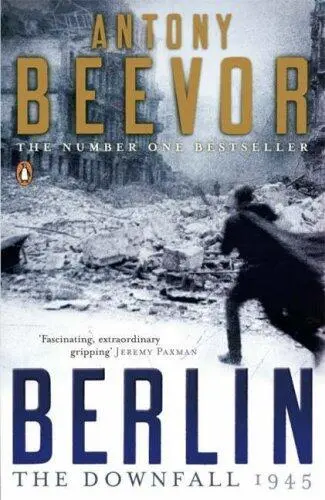
- Название:Berlin: The Downfall 1945
- Автор:
- Издательство:Penguin Books
- Жанр:
- Год:2007
- Город:New York
- ISBN:978-0-141-90302-6
- Рейтинг книги:3 / 5. Голосов: 1
-
Избранное:Добавить в избранное
- Отзывы:
-
Ваша оценка:
Berlin: The Downfall 1945: краткое содержание, описание и аннотация
Предлагаем к чтению аннотацию, описание, краткое содержание или предисловие (зависит от того, что написал сам автор книги «Berlin: The Downfall 1945»). Если вы не нашли необходимую информацию о книге — напишите в комментариях, мы постараемся отыскать её.
Antony Beevor reconstructs the experiences of those millions caught up in the nightmare of the Third Reich's final collapse, telling a terrible story of pride, stupidity, fanatacism, revenge and savagery, but also one of astonishing endurance, self-sacrifice and survival against all odds.
Berlin: The Downfall 1945 — читать онлайн бесплатно полную книгу (весь текст) целиком
Ниже представлен текст книги, разбитый по страницам. Система сохранения места последней прочитанной страницы, позволяет с удобством читать онлайн бесплатно книгу «Berlin: The Downfall 1945», без необходимости каждый раз заново искать на чём Вы остановились. Поставьте закладку, и сможете в любой момент перейти на страницу, на которой закончили чтение.
Интервал:
Закладка:
At the first rumble, some German conscripts in their trenches awoke thinking that it was just another ‘ Morgenkonzert,’ as the early-morning harassing fire was called. But soldiers with real experience of the Eastern Front had acquired a ‘ Landserinstinkt’ which told them that this was the great attack. NCOs screamed orders to take position immediately: ‘Alarm! sofort Stellung beZiehen!’ Survivors remember the feeling in their guts and their mouths going dry. ‘Now we’re in for it,’ they muttered to themselves.
Those few trapped in trenches in the target area who somehow survived the terrifying bombardment could describe the experience afterwards only in terms of’hell’ or ‘inferno’, or an ‘earthquake’. Many lost all sense of hearing. ‘In a matter of a few seconds,’ Gerd Wagner in the 27th Parachute Regiment recorded, ‘all my ten comrades were dead.’ When Wagner recovered consciousness, he found himself lying wounded in a smoking shell crater. He was only just able to struggle back to the second line. Few escaped alive from the artillery barrage which smashed trenches and buried their occupants, both alive and dead. Bodies are still being discovered well over half a century later.
Those to the rear who could feel the earth trembling grabbed their binoculars or trench periscopes. The commander of SS Heavy Panzer Battalion 502 gazed out through the periscope of his Tiger tank. ‘In the field of view the eastern sky was in flames.’ Another observer noted ‘burning farmhouses, villages, banks of smoke as far as the eye could see’. A headquarters clerk could only mutter, ‘Christ, the poor bastards up front.’
The days of the hearty German warrior — ‘ Krieg ist Krieg und Schnaps ist Schnaps’ — were well and truly past. Survivors were often not just completely disorientated, but shattered emotionally and psychologically. After the bombardment, a war correspondent with an SS propaganda company found a dazed soldier wandering in a wood, having thrown away his weapon. Apparently this was his first experience of the Eastern Front, having spent the best part of the war ‘shaving officers in Paris’.
Yet even though almost every square metre of the German positions in front of the Seelow was churned up by shellfire, casualties were not nearly as high as they might have been. General Heinrici, helped by the interrogation of the Red Army soldier south of Küstrin, had pulled the bulk of Ninth Army’s troops back to the second line of trenches. On the sector south of Frankfurt an der Oder, facing the Soviet 33rd Army, some were less fortunate. Volkssturm and Hungarian detachments were sent to occupy the forward positions of the SS Division 30. Januar. ‘These men were sacrificed by headquarters as cannon fodder,’ Ober-sturmführer Helmuth Schwarz wrote later, to preserve the regular units. Most of the Volkssturm were veterans of the First World War. Many of them had no uniforms and no weapons.
Zhukov was so encouraged by the lack of resistance shown that he assumed the Germans were crushed. ‘It seemed that not a living soul was left on the enemy side after thirty minutes of bombardment,’ he wrote later. He gave the order to start the general attack. ‘Thousands of flares of many colours shot up into the air.’ This was the signal to the young women soldiers operating the 143 searchlights — one every 200 metres.
‘Along the whole length of the horizon it was as bright as daylight,’ a Russian sapper colonel wrote home that night. ‘On the German side, everything was covered with smoke and thick fountains of earth in clumps flying up. There were huge flocks of scared birds flying around in the sky, a constant humming, thunder, explosions. We had to cover our ears to prevent our eardrums breaking. Then tanks began roaring, searchlights were lit along all of the front line in order to blind the Germans. Then people started shouting everywhere, “ Na Berlin!” ’
Some German soldiers, no doubt over-influenced by Wunderwaffen propaganda, thought that the searchlights were a new weapon to blind them. On the Soviet side, attacking detachments may even have suspected for a moment that the lights were a new form of blocking detachment to prevent retreat. Captain Sulkhanishvili in the 3rd Shock Army found that ‘the light was so blinding one couldn’t turn around, one could only move forward’. Yet this invention, of which Zhukov was so proud, did more to disorientate the attackers than dazzle the defenders, because the light reflected back off the smoke and dust from the bombardment. Commanders with the forward troops passed back orders to turn off the lights, then a counter-order switched them back on, causing even more night blindness among the troops. Yet Zhukov had made a far greater mistake. His intensive bombardment against the first line had been pummelling mostly abandoned trenches. He does not admit this in his memoirs, nor that he was unpleasantly surprised by the intensity of German fire once the advance began in earnest. It must have been doubly galling for him, since during the main briefing conference several of his senior officers had recommended concentrating the fire on the second line.
The advance from the main Küstrin bridgehead began with Chuikov’s 8th Guards Army on the left and Berzarin’s 5th Shock Army on the right. Four days before, Zhukov had changed the Stavka plan, with Stalin’s permission, to keep Katukov’s 1st Guards Tank Army in support of Chuikov. They were then to force their way through to the southern suburbs of Berlin. On Berzarin’s right was the 2nd Guards Tank Army, the 3rd Shock Army and the 47th Army.
On Zhukov’s far right flank, the 1st Polish Army and the 61st Army had little in the way of bridgeheads. They had to cross the Oder under fire. Their leading battalions used amphibious vehicles — American DUKWs driven by young women soldiers, but most of the troops crossed in ordinary boats. Casualties were heavy in the crossing. Assault boats leaked and a number sank, ‘producing losses’. The German resistance was also strong. When one battalion of the 12th Guards Rifle Division made the crossing, ‘only eight men reached the west bank of the Oder’. One can deduce that there must have been a good deal of panic by the comment that ‘some political officers showed indecisiveness when crossing the river’. The coded phrase implies that they should have used their pistols more.
On the extreme left flank, the 33rd Army, in its bridgehead south of Frankfurt an der Oder, and the 69th Army, north of it, were to advance to cut off the town with its fortress garrison.
Once the coloured signal flares streaked up into the overcast sky, the Soviet riflemen rose from the ground to move forward. Zhukov, the least sentimental of generals, sent the infantry through minefields which had to be cleared before he unleashed his tank armies. ‘Oh, what a terrible sight it is to see a person blown up by an anti-tank mine,’ a captain remembered. But the advance of the 8th Guards Army progressed well at first. The troops were encouraged by the lack of resistance. The ground-attack Shturmoviks of the 16th Air Army screamed in low over their heads to attack positions on the escarpment and heavier bomber regiments of the 18th Air Army flew to raid other targets and communications centres further back. There were 6,500 sorties that day on the 1st Belorussian Front sector, but the bad visibility, with river mist, thick smoke and dirt from explosions, concealed their targets. As a result, comparatively little damage to defensive positions was achieved by bombing and strafing. Unfortunately for the Ninth Army, whose ammunition situation was already disastrous, a main stockpile of shells at Alt Zeschdorf, west of Lebus, was hit and blown up.
Читать дальшеИнтервал:
Закладка:
Похожие книги на «Berlin: The Downfall 1945»
Представляем Вашему вниманию похожие книги на «Berlin: The Downfall 1945» списком для выбора. Мы отобрали схожую по названию и смыслу литературу в надежде предоставить читателям больше вариантов отыскать новые, интересные, ещё непрочитанные произведения.








Обсуждение, отзывы о книге «Berlin: The Downfall 1945» и просто собственные мнения читателей. Оставьте ваши комментарии, напишите, что Вы думаете о произведении, его смысле или главных героях. Укажите что конкретно понравилось, а что нет, и почему Вы так считаете.