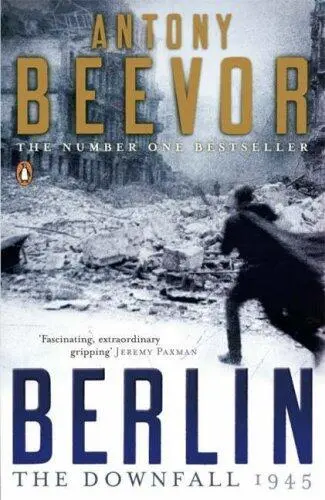
Antony Beevor - Berlin - The Downfall 1945
Здесь есть возможность читать онлайн «Antony Beevor - Berlin - The Downfall 1945» весь текст электронной книги совершенно бесплатно (целиком полную версию без сокращений). В некоторых случаях можно слушать аудио, скачать через торрент в формате fb2 и присутствует краткое содержание. Город: New York, Год выпуска: 2007, ISBN: 2007, Издательство: Penguin Books, Жанр: nonf_military, История, на английском языке. Описание произведения, (предисловие) а так же отзывы посетителей доступны на портале библиотеки ЛибКат.
- Название:Berlin: The Downfall 1945
- Автор:
- Издательство:Penguin Books
- Жанр:
- Год:2007
- Город:New York
- ISBN:978-0-141-90302-6
- Рейтинг книги:3 / 5. Голосов: 1
-
Избранное:Добавить в избранное
- Отзывы:
-
Ваша оценка:
Berlin: The Downfall 1945: краткое содержание, описание и аннотация
Предлагаем к чтению аннотацию, описание, краткое содержание или предисловие (зависит от того, что написал сам автор книги «Berlin: The Downfall 1945»). Если вы не нашли необходимую информацию о книге — напишите в комментариях, мы постараемся отыскать её.
Antony Beevor reconstructs the experiences of those millions caught up in the nightmare of the Third Reich's final collapse, telling a terrible story of pride, stupidity, fanatacism, revenge and savagery, but also one of astonishing endurance, self-sacrifice and survival against all odds.
Berlin: The Downfall 1945 — читать онлайн бесплатно полную книгу (весь текст) целиком
Ниже представлен текст книги, разбитый по страницам. Система сохранения места последней прочитанной страницы, позволяет с удобством читать онлайн бесплатно книгу «Berlin: The Downfall 1945», без необходимости каждый раз заново искать на чём Вы остановились. Поставьте закладку, и сможете в любой момент перейти на страницу, на которой закончили чтение.
Интервал:
Закладка:
14. Eve of Battle
The Red Army, despite all its efforts and talent for camouflage, could not hope to conceal the huge attack about to be unleashed on the Oder and Neisse fronts. Zhukov’s 1st Belorussian Front and Konev’s 1st Ukrainian Front were to attack on 16 April. To the north, Rokossovsky’s 2nd Belorussian Front would follow on soon afterwards across the lower Oder. Soviet forces amounted to 2.5 million men. They were backed by 41,600 guns and heavy mortars as well as 6,250 tanks and self-propelled guns and four air armies. It was the greatest concentration of firepower ever amassed.
On 14 April, a fighting reconnaissance from the Küstrin bridgehead proved most successful. Chuikov’s 8th Guards Army managed to push the 20th Panzergrenadier Division back between two and five kilometres in places. Hitler is said to have been so angry that he gave orders to strip medals from all members of the division until they had been won back.
This extension of the bridgehead also helped the build-up of forces. That night the 1st Guards Tank Army began moving its brigades across the Oder under the cover of darkness. ‘During the night there was a constant flow of tanks, guns, Studebakers loaded with ammunition, and columns of soldiers.’ Young women traffic controllers waved their discs desperately, urging the tanks into the line marked by white tapes. Loud music and propaganda exhortations reverberated from 7th Department loudspeakers in an attempt to cover the noise of tank engines, but the Germans knew what was happening.
For the whole of 15 April, Red Army soldiers watched the German positions ‘until our eyes ached’, in case last-minute reinforcements were brought up or changes made. In the Oderbruch, April flowers had appeared on hillocks, but large chunks of ice still floated down the river, as well as branches and weed which caught on a wrecked railway bridge. In pine forests on the east bank, ‘mysteriously quiet’ by day, chopped branches camouflaged thousands of armoured vehicles and guns.
On the Neisse front, to the south, the 1st Ukrainian Front organized relentless political activity up to the last moment. ‘Active Komsomol members were teaching young soldiers to love their tanks and to try to use the whole potential of this powerful weapon.’ The Aleksandrov message had evidently not been digested, even by political departments. The message of revenge was clear in the latest slogan: ‘There will be no pity. They have sown the wind and now they are harvesting the whirlwind.’
The 1st Ukrainian Front was more preoccupied by bad radio discipline. Even NKVD regiments had recently been ‘transmitting in clear, using out-of-date codes and not answering signals’. No sub-units were allowed to use the radio: their sets had to be on receive and never on send. Concern about lapses of security was even greater on the night of 15 April, because the new wavelengths and codes up to the end of May 1945 were issued to headquarters.
Even though officers were told not to give out orders more than three hours before the attack, SMERSH was determined that there should be no last-minute desertions by Red Army soldiers who might warn the enemy. The SMERSH representative with the 1st Belorussian Front ordered all political officers to check every man in the front line and identify any who seemed suspicious or ‘morally and politically unstable’. In an earlier round-up, SMERSH had arrested those denounced for making negative comments about collective farms. A special cordon was put in place ‘so that our men will not manage to flee to the Germans’ and to prevent the Germans from seizing ‘tongues’. But all their efforts were in vain. On 15 April, a Red Army soldier south of Küstrin told his German captors that the great offensive was starting early the next morning.
Considering the proximity of defeat, the Germans had even stronger reasons to fear that their soldiers would desert or surrender at the first opportunity. Army Group Vistula issued orders signed by Heinrici that men from the same region should be split up, because they seldom did anything to prevent a comrade from home deserting. An officer of the Grossdeutschland guard regiment commanding a scratch battalion observed that his young soldiers had little intention of fighting for National Socialism. ‘Many wanted to be wounded so that they could be sent back to the field hospital.’ They stayed at their posts only out of a ‘corpse-like obedience’ inspired by fear of summary execution. After a Soviet loudspeaker broadcast across the lines, officers were appalled when soldiers began shouting back asking for details. Would they be sent to Siberia? How were civilians treated in the occupied areas of Germany?
Several German commanders in the Fourth Panzer Army facing Konev’s 1st Ukrainian Front confiscated white handkerchiefs to prevent their men using them as a sign of surrender. Soldiers caught trying to desert were, in some cases, forced to dig trenches in the open in no man’s land. Many longed to slip away into thick woodland to surrender out of sight to save their families from punishment decreed in Hitler’s order.
German company commanders tried almost any means to persuade their soldiers to hold fast. Some informed them of Roosevelt’s death on the evening of 14 April. This meant, they told them, that American tanks would no longer attack. In fact, they claimed, relations between the Western Allies and the Soviet Union had become so bad that the Americans and British would now join Germany in throwing back the Russians. Reservists in the 391st Security Division near Guben found SS troops from the 30. Januar Division coming over to lecture them on the connection between the death of Roosevelt and the miracle that saved Frederick the Great as though this were holy scripture. They were not convinced at all, but many German soldiers still held on because they expected a massive counter-attack on the Führer’s birthday, 20 April, with new secret ‘wonder weapons’.
Some angry and embittered officers managed to remind veterans of the horrors of the Eastern Front and what it would mean if the Russians broke through to Berlin. ‘You can’t imagine,’ a senior lieutenant wrote to his wife, ‘what a terrible hatred is aroused here. I can promise you that we’ll sort them out one day. The rapists of women and children will discover another experience. It is hard to believe what these beasts have done. We have sworn an oath that each man must kill ten Bolsheviks. God will help us achieve this.’
The bulk of the ill-trained young conscripts recently marched out to the front were far less likely to be persuaded. They just wanted to survive. In the 303rd Döberitz Infantry Division, a regimental commander gave one of his battalion commanders some advice. ‘We have to hold the front at any cost. You’re responsible. If a few soldiers start to run away, then you must shoot them. If you see many soldiers taking off, and you can’t stop them and the situation is hopeless, then you’d better shoot yourself.’
On the Seelow Heights, apart from some strafing attacks, it was ‘almost peaceful just before the storm’. German soldiers sent back from the front line checked and cleaned weapons, ate and washed. Some sat down to write home, just in case the Feldpost began to work again. For many, their homes were already occupied by the enemy, and others did not know where their families were.
Senior Lieutenant Wust sent his Luftwaffe trainee technicians back in batches to the field kitchen — or ‘Gulaschkanone’ — in a village just behind their second line of trenches. He remained in a fire trench with his company sergeant major, gazing down over the trees to the Oderbruch and the Soviet positions from which the attack would come. Wust suddenly shivered. ‘Tell me,’ he said, turning to his Kompanie-truppführer. ‘Are you also cold?’
Читать дальшеИнтервал:
Закладка:
Похожие книги на «Berlin: The Downfall 1945»
Представляем Вашему вниманию похожие книги на «Berlin: The Downfall 1945» списком для выбора. Мы отобрали схожую по названию и смыслу литературу в надежде предоставить читателям больше вариантов отыскать новые, интересные, ещё непрочитанные произведения.








Обсуждение, отзывы о книге «Berlin: The Downfall 1945» и просто собственные мнения читателей. Оставьте ваши комментарии, напишите, что Вы думаете о произведении, его смысле или главных героях. Укажите что конкретно понравилось, а что нет, и почему Вы так считаете.