Antony Beevor - Berlin - The Downfall 1945
Здесь есть возможность читать онлайн «Antony Beevor - Berlin - The Downfall 1945» весь текст электронной книги совершенно бесплатно (целиком полную версию без сокращений). В некоторых случаях можно слушать аудио, скачать через торрент в формате fb2 и присутствует краткое содержание. Город: New York, Год выпуска: 2007, ISBN: 2007, Издательство: Penguin Books, Жанр: nonf_military, История, на английском языке. Описание произведения, (предисловие) а так же отзывы посетителей доступны на портале библиотеки ЛибКат.
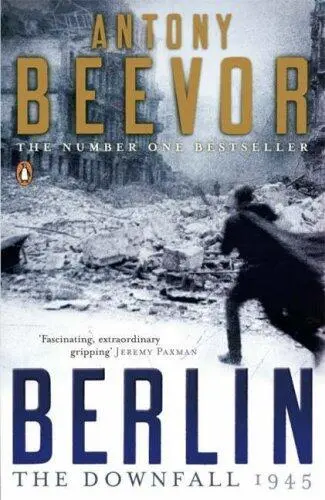
- Название:Berlin: The Downfall 1945
- Автор:
- Издательство:Penguin Books
- Жанр:
- Год:2007
- Город:New York
- ISBN:978-0-141-90302-6
- Рейтинг книги:3 / 5. Голосов: 1
-
Избранное:Добавить в избранное
- Отзывы:
-
Ваша оценка:
Berlin: The Downfall 1945: краткое содержание, описание и аннотация
Предлагаем к чтению аннотацию, описание, краткое содержание или предисловие (зависит от того, что написал сам автор книги «Berlin: The Downfall 1945»). Если вы не нашли необходимую информацию о книге — напишите в комментариях, мы постараемся отыскать её.
Antony Beevor reconstructs the experiences of those millions caught up in the nightmare of the Third Reich's final collapse, telling a terrible story of pride, stupidity, fanatacism, revenge and savagery, but also one of astonishing endurance, self-sacrifice and survival against all odds.
Berlin: The Downfall 1945 — читать онлайн бесплатно полную книгу (весь текст) целиком
Ниже представлен текст книги, разбитый по страницам. Система сохранения места последней прочитанной страницы, позволяет с удобством читать онлайн бесплатно книгу «Berlin: The Downfall 1945», без необходимости каждый раз заново искать на чём Вы остановились. Поставьте закладку, и сможете в любой момент перейти на страницу, на которой закончили чтение.
Интервал:
Закладка:
Moscow radio broadcast Aleksandrov’s article and Krasnaya Zvezda reprinted it. A devastated Ehrenburg found himself in a political limbo. His letter to Stalin appealing against the injustice was never answered. But Ehrenburg probably did not realize that he had been denounced for other criticisms of the Red Army and the inability of officers to control their men. He had reported how when a Soviet general reproved a soldier for cutting a patch of leather from a sofa, saying that it could be used by some family in the Soviet Union, the soldier had retorted, ‘Your wife may get it, but definitely not mine’, and carried on attacking the sofa. Abakumov’s most serious charge, however, was that Ehrenburg had also said to the officers at the Frunze academy, ‘Russians returning from “slavery” look well. Girls are well fed and dressed. Our articles in papers on the enslavement of persons who had been taken to Germany are not convincing.’ If Ehrenburg had not enjoyed such a passionate following in the Red Army, he might easily have disappeared into a Gulag camp.
At the front, meanwhile, political departments were clearly uneasy about the situation. They reported how some officers supported Ehrenburg and still believed ‘that we should be ruthless with the Germans and those Western Allies who start flirting with the Germans’. The Party line was, however, clear. ‘We are no longer chasing Germans from our country, a situation in which the slogan, “Kill a German whenever you see one”, seemed entirely fair. Instead, the time has now come to punish the enemy correctly for all his evil deeds.’ Yet even though the political officers quoted Stalin’s dictum that ‘Hitlers come and go…’, this did not seem to carry much weight with the soldiers. ‘Many soldiers asked me,’ one political officer reported, ‘if Ehrenburg still continued to write and they told me that they are looking for his articles in every newspaper that they see.’
The change in policy just before the great offensive came far too late for soldiers imbued with the personal and propaganda hatreds of the last three years. One of the most unintentionally revealing remarks was made by one of Zhukov’s divisional commanders, General Maslov. He described German children crying as they searched desperately for their parents in a blazing town. ‘What was surprising,’ wrote Maslov, ‘was that they were crying in exactly the same way as our children cry.’ Few Soviet soldiers or officers had imagined Germans as human beings. After Nazi propaganda had dehumanized the Slavs into Untermenschen, Soviet revenge propaganda had convinced its citizens that all Germans were ravening beasts.
The Soviet authorities had another reason for concern at the advance of the Western Allies. They were afraid that the majority of the 1st and 2nd Polish Armies would want to join the Polish forces which owed allegiance to the government in exile in London. On 14 April, Beria passed to Stalin the report from General Serov, the NKVD chief with Zhukov’s 1st Belorussian Front. ‘In connection with the rapid advance of the Allies on the Western Front,’ Serov wrote, ‘unhealthy moods developed among the soldiers and officers of the Ist Polish Army.’ SMERSH had gone into action, carrying out mass arrests.
‘Intelligence organs of the Ist Polish Army,’ he reported, ‘have discovered and taken under control [sic] nearly 2,000 ex-soldiers of the Anders army and members of the Armia Krajowa and soldiers who have close relatives in Anders’s army.’ The ‘hostile attitude’ of these Poles to the Soviet Union was underlined by the fact that they had concealed their real addresses from the Soviet authorities to prevent reprisals against their families. Serov also failed to mention the fact that since 43,000 members of the Polish Communist forces had been transferred straight from Gulag camps, their feelings towards the Soviet Union were unlikely to be entirely fraternal. And in Poland, members of the Armia Krajowa arrested by NKVD troops were given the choice of a labour camp in Siberia or the Communist army — ‘ W Sibir ili w Armiju? ’
SMERSH informers had warned their controllers that Polish soldiers were listening regularly to the ‘London radio’. Informers also reported that Polish troops were convinced that ‘Anders’s army is coming to Berlin from the other side with the English army’. ‘When the Polish troops meet up,’ an officer unwittingly told an informer, ‘the majority of our soldiers and officers will pass over to the Anders army. We’ve suffered enough from the Soviets in Siberia.’ ‘After the war, when Germany is finished,’ a battalion chief of staff apparently told another informer, ‘we’ll still be fighting Russia. We have 3 million of Anders’s men with the English.’ ‘They are pushing their “democracy” into our faces,’ said a commander in the 2nd Artillery Brigade. ‘As soon as our troops meet up with Anders’s men, you can say goodbye to the [Soviet-controlled] provisional government. The London government will take power again and Poland will once more be what it was before 1939. England and America will help Poland get rid of the Russians.’ Serov blamed commanders of the Ist Polish Army ‘for not strengthening their political explanatory work’.
While the American Third and Ninth Armies were charging forward to the Elbe, Field Marshal Model’s Army Group B in the Ruhr pocket was being ground down, largely by air attack. Model was one of the very few army commanders to be trusted completely by Hitler. His fellow generals, however, considered him to be ‘extremely rude and unscrupulous’. Model was known to the troops as ‘ der Katastrophengeneral ’ because of his habit of turning up in a sector when things were going very badly. The Ruhr, in any case, was Model’s last catastrophe. He refused to fly out. On 21 April, when his troops began to surrender en masse, he shot himself, which was exactly what Hitler expected of his commanders.
Well before the end, Colonel Günther Reichhelm, the chief operations officer of Army Group B, was flown out of the Ruhr encirclement along with many other key personnel. Out of seventeen aircraft, only three reached Jüterbog, the airfield south of Berlin. Reichhelm was driven to OKH headquarters at Zossen, where he collapsed from exhaustion. He awoke only when Guderian’s former deputy, General Wenck, sat on his bed. Wenck, brought back to operations before he had completely recovered from his car crash during Operation Sonnenwende, had just been appointed the commander-in-chief of the Twelfth Army. Wenck suspected that this new army existed more on paper than in reality, despite its task of holding the line of the Elbe against the Americans.
‘You’re coming as my chief of staff,’ Wenck told him. But first of all Reichhelm had to report on the situation of Army Group B in the Ruhr pocket. Jodl ordered him to come to the Reich Chancellery bunker. There he found Hitler with Göring and Grand Admiral Dönitz. He told Hitler that Army Group B had no more ammunition, and its remaining tanks could not move because they had no more fuel. Hitler paused for a long time. ‘Field Marshal Model was my best Field Marshal,’ he said at last. Reichhelm thought that Hitler finally understood that it was all over, but he did not. Hitler said, ‘You are to be chief of staff of the Twelfth Army. You must free yourself from the stupid guidelines of the general staff. You must learn from the Russians, who by sheer willpower overcame the Germans who stood before Moscow.’
Hitler then went on to say that the German Army must chop down trees in the Harz mountains to stop Patton’s advance and launch a partisan war there. He demanded I:25,000 scale maps, the sort which company commanders used, to prove his point. Jodl tried to disabuse him, but Hitler insisted that he knew the Harz well. Jodl, who was usually very controlled, replied sharply. ‘I do not know the area at all,’ he said, ‘but I know the situation.’ Göring, Reichhelm noticed, had meanwhile gone to sleep in a chair with a map over his face. He wondered whether he was full of drugs. Hitler finally told Reichhelm to join the Twelfth Army, but first he should go via the camp at Döberitz, where he could obtain 200 Volkswagen cross-country Kübelwagen jeeps for the Twelfth Army.
Читать дальшеИнтервал:
Закладка:
Похожие книги на «Berlin: The Downfall 1945»
Представляем Вашему вниманию похожие книги на «Berlin: The Downfall 1945» списком для выбора. Мы отобрали схожую по названию и смыслу литературу в надежде предоставить читателям больше вариантов отыскать новые, интересные, ещё непрочитанные произведения.








Обсуждение, отзывы о книге «Berlin: The Downfall 1945» и просто собственные мнения читателей. Оставьте ваши комментарии, напишите, что Вы думаете о произведении, его смысле или главных героях. Укажите что конкретно понравилось, а что нет, и почему Вы так считаете.