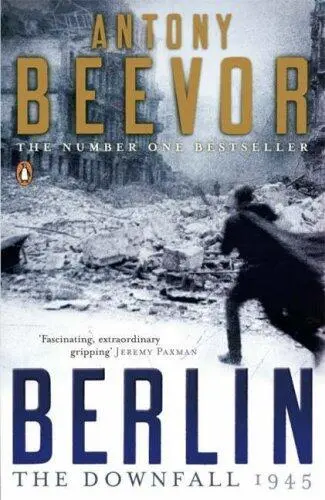
Antony Beevor - Berlin - The Downfall 1945
Здесь есть возможность читать онлайн «Antony Beevor - Berlin - The Downfall 1945» весь текст электронной книги совершенно бесплатно (целиком полную версию без сокращений). В некоторых случаях можно слушать аудио, скачать через торрент в формате fb2 и присутствует краткое содержание. Город: New York, Год выпуска: 2007, ISBN: 2007, Издательство: Penguin Books, Жанр: nonf_military, История, на английском языке. Описание произведения, (предисловие) а так же отзывы посетителей доступны на портале библиотеки ЛибКат.
- Название:Berlin: The Downfall 1945
- Автор:
- Издательство:Penguin Books
- Жанр:
- Год:2007
- Город:New York
- ISBN:978-0-141-90302-6
- Рейтинг книги:3 / 5. Голосов: 1
-
Избранное:Добавить в избранное
- Отзывы:
-
Ваша оценка:
Berlin: The Downfall 1945: краткое содержание, описание и аннотация
Предлагаем к чтению аннотацию, описание, краткое содержание или предисловие (зависит от того, что написал сам автор книги «Berlin: The Downfall 1945»). Если вы не нашли необходимую информацию о книге — напишите в комментариях, мы постараемся отыскать её.
Antony Beevor reconstructs the experiences of those millions caught up in the nightmare of the Third Reich's final collapse, telling a terrible story of pride, stupidity, fanatacism, revenge and savagery, but also one of astonishing endurance, self-sacrifice and survival against all odds.
Berlin: The Downfall 1945 — читать онлайн бесплатно полную книгу (весь текст) целиком
Ниже представлен текст книги, разбитый по страницам. Система сохранения места последней прочитанной страницы, позволяет с удобством читать онлайн бесплатно книгу «Berlin: The Downfall 1945», без необходимости каждый раз заново искать на чём Вы остановились. Поставьте закладку, и сможете в любой момент перейти на страницу, на которой закончили чтение.
Интервал:
Закладка:
The city was so enveloped in smoke the next day that only the fire-streaks of katyusha rockets were visible. Any civilians left alive hung sheets from windows in a signal of surrender and even tried to take rifles from German soldiers. Lasch knew that the end had come. He could expect no help from the Reich and did not want to impose any more useless suffering on the refugees and townsfolk. Only the SS wanted to fight on, but their attempts were useless. On the morning of 10 April, Lasch and other German officers acting as parliamentaries reached Marshal Vasilevsky’s headquarters. The surviving garrison of just over 30,000 troops marched out to imprisonment. Their watches and any useful items were promptly grabbed by Red Army soldiers, who had managed to find stores of alcohol. The rape of women and girls went unchecked in the ruined city.
Inozemstev toured the smoking capital of East Prussia. ‘A bronze Bismarck is gazing with one eye — part of his head had been knocked off by a shell — at the Soviet girl conducting the traffic, at the passing Red Army vehicles and at the mounted patrols. It looked as if he were asking, “Why are there Russians here? Who allowed that?” ’
The end of East Prussia and Pomerania was underlined in a terrible fashion. On the night of 16 April, the hospital ship Goya, packed with nearly 7,000 refugees, was sunk by a Soviet submarine. Only 165 people were saved.
The attack on Berlin was expected at any moment. On 6 April, Army Group Vistula headquarters noted in its war diary: ‘On Ninth Army front, lively enemy activity — sounds of engines and tank tracks both on the Reitwein sector south-west of Küstrin and to the north-east near Kienitz.’ They estimated that the attack would come in two days’ time.
Five days later, however, they were still waiting. General Krebs at Zossen signalled to Heinrici on 11 April, ‘Führer expects the Russian offensive against Army Group Vistula on 12 or 13 April.’ Next day, Hitler told Krebs to telephone Heinrici to insist ‘the Führer is instinctively convinced that the attack would really come in one to two days, that is to say on the 13 or 14 April’. Hitler had tried to predict the exact date of the Normandy invasion the year before, but failed. Now he again wanted to amaze his admirers with a show of uncanny foresight. It seemed to be one of the few ways left to him in which he could attempt to demonstrate some sort of control over events.
On the evening of 12 April, the Berlin Philharmonic gave its last performance. Albert Speer, who organized it, had invited Grand Admiral Dönitz and also Hitler’s adjutant, Colonel von Below. The hall was properly lit for the occasion, despite the electricity cuts. ‘The concert took us back to another world,’ wrote Below. The programme included Beethoven’s Violin Concerto, Bruckner’s 8th Symphony — (Speer later claimed that this was his warning signal to the orchestra to escape Berlin immediately after the performance to avoid being drafted into the Volkssturm) — and the finale to Wagner’s Götterdämmerung. Even if Wagner did not bring the audience back to present reality, the moment of escapism did not last long. It is said that, after the performance, the Nazi Party had organized Hitler Youth members to stand in uniform with baskets of cyanide capsules and offer them to members of the audience as they left.
On 14 April, when the attack had still not materialized, Hitler issued an ‘Order of the Day’ to Army Group Vistula. Predictably, it emphasized that ‘whoever does not fulfil his duty will be treated as a traitor to our people’. It continued with a rambling distortion of history, and a reference to the repulse of the Turks before Vienna: ‘The Bolshevik will this time experience the ancient fate of Asiatics.’ Vienna had in fact just fallen to the eastern hordes and there was no hope of retaking it.
The following day, a sixteen-year-old Berliner called Dieter Borkovsky described what he witnessed in a crowded S-Bahn train from the Anhalter Bahnhof. ‘There was terror on the faces of people. They were full of anger and despair. I had never heard such cursing before. Suddenly someone shouted above the noise, “Silence!” We saw a small dirty soldier with two Iron Crosses and the German Cross in Gold. On his sleeve he had a badge with four metal tanks, which meant that he had destroyed four tanks at close quarters. “I’ve got something to tell you,” he shouted, and the carriage fell silent. “Even if you don’t want to listen to me, stop whingeing. We have to win this war. We must not lose our courage. If others win the war, and if they do to us only a fraction of what we have done in the occupied territories, there won’t be a single German left in a few weeks.” It became so quiet in that carriage that one could have heard a pin drop.’
13. Americans on the Elbe
As the allied armies approached the heart of Germany from both directions, Berliners claimed that optimists were ‘learning English and pessimists learning Russian’. The Nazi foreign minister, Joachim von Ribbentrop, who had no sense of humour, announced at a diplomatic dinner that ‘Germany had lost the war but still had it in her power to decide to whom she lost’. It was this idea that disturbed Stalin so profoundly at the beginning of April.
Once Model’s Army Group B with over 300,000 men was encircled in the Ruhr on 2 April, the divisions in Simpson’s US Ninth Army began racing for the Elbe opposite Berlin. They and their army commander were convinced that their objective was the Nazis’ capital. After the row with the British, Eisenhower had left open the capture of Berlin as a distinct possibility. In the second part of the orders to Simpson, the Ninth Army was told to ‘exploit any opportunity for seizing a bridgehead over the Elbe and be prepared to continue the advance on Berlin or to the north-east’.
Its 2nd Armored Division — dubbed ‘Hell on Wheels’ — was the strongest in the US Army. It contained a large number of tough southerners who had joined during the Depression. Its commander, Major General Isaac D. White, had planned his route to Berlin well in advance. His idea was to cross the Elbe near Magdeburg. The US Ninth Army would use the autobahn to the capital as its centre-line. His closest rival in the race was the 83rd Infantry Division, known as the ‘Rag-Tag Circus’ because of its extraordinary assortment of captured vehicles and equipment sprayed olive green and given a white star. Both divisions reached the River Weser on 5 April.
To their north the 5th Armored Division headed for Tangermünde, and on the extreme left of Simpson’s front, the 84th and 102nd Infantry Divisions pushed towards the Elbe on either side of its confluence with the Havel. The momentum of the advance was slowed momentarily by pockets of resistance, usually SS detachments, but most German troops surrendered in relief. The American crews stopped only to replenish or repair their vehicles. They remained dirty and unshaven. The adrenalin of the advance had almost replaced their need for sleep. The 84th Division was held up when ordered to take Hanover, but forty-eight hours later, it was ready to move on again. Eisenhower visited its commander, Major General Alexander Boiling, in Hanover on Sunday 8 April.
‘Alex, where are you going next?’ Eisenhower said to him.
‘General, we’re going to push on ahead. We have a clear go to Berlin and nothing can stop us.’
‘Keep going,’ the supreme commander told him, putting a hand on his shoulder. ‘I wish you all the luck in the world and don’t let anybody stop you.’ Boiling took this as clear confirmation that their objective was Berlin.
On the US Ninth Army’s left, the British Second Army of General Dempsey had reached Celle and was close to liberating Belsen concentration camp. Meanwhile, on Simpson’s right, General Hodges’s First Army headed for Dessau and Leipzig. General George Patton’s Third Army forced its way ahead the furthest, into the Harz mountains, bypassing Leipzig to the south. On Thursday 5 April, Martin Bormann jotted in his diary, ‘Bolsheviks near Vienna. Americans in the Thüringer Wald.’ No further comment was needed on the disintegration of Greater Germany.
Читать дальшеИнтервал:
Закладка:
Похожие книги на «Berlin: The Downfall 1945»
Представляем Вашему вниманию похожие книги на «Berlin: The Downfall 1945» списком для выбора. Мы отобрали схожую по названию и смыслу литературу в надежде предоставить читателям больше вариантов отыскать новые, интересные, ещё непрочитанные произведения.








Обсуждение, отзывы о книге «Berlin: The Downfall 1945» и просто собственные мнения читателей. Оставьте ваши комментарии, напишите, что Вы думаете о произведении, его смысле или главных героях. Укажите что конкретно понравилось, а что нет, и почему Вы так считаете.