Antony Beevor - Berlin - The Downfall 1945
Здесь есть возможность читать онлайн «Antony Beevor - Berlin - The Downfall 1945» весь текст электронной книги совершенно бесплатно (целиком полную версию без сокращений). В некоторых случаях можно слушать аудио, скачать через торрент в формате fb2 и присутствует краткое содержание. Город: New York, Год выпуска: 2007, ISBN: 2007, Издательство: Penguin Books, Жанр: nonf_military, История, на английском языке. Описание произведения, (предисловие) а так же отзывы посетителей доступны на портале библиотеки ЛибКат.
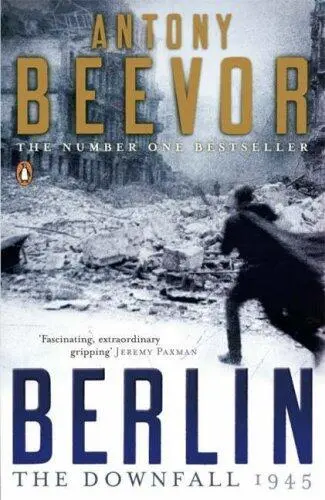
- Название:Berlin: The Downfall 1945
- Автор:
- Издательство:Penguin Books
- Жанр:
- Год:2007
- Город:New York
- ISBN:978-0-141-90302-6
- Рейтинг книги:3 / 5. Голосов: 1
-
Избранное:Добавить в избранное
- Отзывы:
-
Ваша оценка:
Berlin: The Downfall 1945: краткое содержание, описание и аннотация
Предлагаем к чтению аннотацию, описание, краткое содержание или предисловие (зависит от того, что написал сам автор книги «Berlin: The Downfall 1945»). Если вы не нашли необходимую информацию о книге — напишите в комментариях, мы постараемся отыскать её.
Antony Beevor reconstructs the experiences of those millions caught up in the nightmare of the Third Reich's final collapse, telling a terrible story of pride, stupidity, fanatacism, revenge and savagery, but also one of astonishing endurance, self-sacrifice and survival against all odds.
Berlin: The Downfall 1945 — читать онлайн бесплатно полную книгу (весь текст) целиком
Ниже представлен текст книги, разбитый по страницам. Система сохранения места последней прочитанной страницы, позволяет с удобством читать онлайн бесплатно книгу «Berlin: The Downfall 1945», без необходимости каждый раз заново искать на чём Вы остановились. Поставьте закладку, и сможете в любой момент перейти на страницу, на которой закончили чтение.
Интервал:
Закладка:
From the regional headquarters for the Berlin district, a solid building on the Hohenzollerndamm, Reymann and his staff tried to find out how many soldiers and how many weapons could be counted on. Colonel Refior rapidly discovered that the ‘Berlin Defence Area’ carried no significance. It was just another phrase, like ‘Fortress’, coined in Führer headquarters which people were still supposed to defend to the death. He found that dealing with such ‘short-sightedness, bureaucracy and bloody-mindedness, was enough to turn anybody’s hair white’.
To defend the outer perimeter alone, ten divisions were needed. In fact, the Berlin Defence Area possessed in theory only a flak division, nine companies of the Grossdeutschland guard regiment, a couple of police battalions, a couple of pioneer battalions and twenty Volkssturm battalions which had been called up, but not trained. Another twenty would be called up if the city were surrounded. But although the Berlin Volkssturm amounted to 60,000 men on paper, it included both ‘Volkssturm I’, who had some weapons, and ‘Volkssturm II’, who had no weapons at all. In many cases, a former regular officer would send his unarmed Volkssturm soldiers home when the Red Army approached the city, but commanders who were Party functionaries seldom showed even the most basic humanity. One of the Nazi Kreisleiters was convinced that the only thing to do was to keep the men away from the influence of their wives, from the ‘ Muttis ’, who might undermine their will to resist. But this was doomed to failure. No rations had been allocated for the Volkssturm, so they had to be fed by their families. In any case, commanders in charge of the defence soon found that only veterans of the First World War showed ‘a sense of duty’. Most of the rest slipped away whenever the opportunity presented itself.
The most heavily armed force in Berlin was the 1st Flak Division, and yet it did not come under Reymann’s command until the battle started. Based on the three vast concrete flak towers — the Zoobunker in the Tiergarten, the Humboldthain and the Friedrichshain — this Luftwaffe division had an impressive arsenal of 128mm, 88mm and 20mm guns, as well as the necessary ammunition to go with them. Reymann’s artillery otherwise consisted of obsolete guns of various calibres taken earlier in the war from the French, Belgians and Yugoslavs. There were seldom more than half a dozen rounds per gun, often less. The only guideline on conducting a defence of the city was a pre-war instruction, which Refior described as a ‘masterpiece of German bureaucratic art’.
The Nazi Party in Berlin talked of mobilizing armies of civilians to work on defences — both an ‘obstacle ring’ thirty kilometres out and a perimeter ring. But the maximum workforce ever achieved on one day was 70,000; it was usually no more than 30,000. Transport and a shortage of tools were the main problems, apart from the fact that most Berlin factories and offices continued to work as if nothing were amiss.
Reymann appointed Colonel Lohbeck, an engineer officer, to take over the Party-led chaos of defence works and he called on the school of military engineering at Karlshorst to provide demolition teams. Army officers were nervous about Speer’s attempts to save the bridges within Berlin. They could not forget the execution of the officers over the bridge at Remagen. Reymann’s sappers supervised the Todt Organization and the Reich Labour Service, both of which were far better equipped than the civilian corvée, but they found it impossible to obtain fuel and spare parts for the mechanical diggers. Most of the 17,000 French prisoners of war from Stalag III D were put to work in the city, creating barricades and digging foxholes in pavements at street corners. How much they achieved is open to question, however, especially since French prisoners round Berlin were those most regularly accused of being ‘Arbeitsunlustig ’ — reluctant to work — and of escaping from their camps, usually to visit German women.
Attempts to liaise with the field commanders, who were supposed to provide fighting troops for the defence of the city, were far from successful. When Refior went to visit Heinrici’s chief of staff, Lieutenant General Kinzel, at Army Group Vistula headquarters, Kinzel simply glanced at the plans he presented for the defence of Berlin and said, ‘Those madmen in Berlin should stew in their own juice.’ The Ninth Army’s chief of staff, Major General Hölz, regarded the plans as irrelevant for other reasons. ‘The Ninth Army,’ said Hölz, in a manner which Refior found rather too theatrical, ‘stands and stays on the Oder. If it should be necessary, we will fall there, but we will not retreat.’
Neither Reymann nor Refior realized fully at the time that General Heinrici and his staff at Army Group Vistula had a very different plan from the Nazi leadership. They were hoping to prevent a last-ditch defence of the capital for the sake of the civil population. Albert Speer had suggested to Heinrici that the Ninth Army should withdraw from the Oder, bypassing Berlin entirely. Heinrici agreed in principle. In his view, the best way to avoid fighting in the city would be to order Reymann to send all his troops forward to the Oder at the last moment to strip Berlin of its defenders.
Another strong reason for avoiding a battle in the city was the Nazis’ resort to boys as young as fourteen as cannon fodder. So many houses had a framed photograph on the wall of a son killed in Russia that a silent prayer arose that the regime would collapse before these children were sent into battle. Some did not shrink from openly calling it infanticide, whether it was exploiting the fanaticism of deluded Hitler Youth or forcing frightened boys into uniform through threat of execution. Older teachers in schools risked denunciation by advising their pupils on how to avoid being called up. The sense of bitterness was even greater after Goebbels’s speech a few weeks before. ‘The Führer once coined the phrase,’ he reminded them, ‘ “Each mother who has given birth to a child has struck a blow for the future of our people.” ’ But it was now clear that Hitler and Goebbels were about to throw those children’s lives away for a cause which had no possible future.
The fourteen-year-old Erich Schmidtke in Prenzlauerberg had been called up as a ‘flak helper’ to man anti-aircraft guns and ordered to report to the Hermann Göring barracks in Reinickendorf. His mother, whose husband was trapped with the army in Courland, was understandably upset and accompanied him to the barracks with his little suitcase. He felt more awed than afraid. After three days in the barracks, they were ordered to join the division being assembled at the Reichssportsfeld in the west of the city, next to the Olympic stadium. But on his way there, he thought of his father’s words when on leave from the Eastern Front, telling him that he was now responsible for the family. He decided to desert and went into hiding until the war was over. Most of his contemporaries who joined the division were killed.
The so-called Hitler Youth Division raised by the Reich Youth Leader, Artur Axmann, was also being trained at the Reichssportsfeld on the use of the panzerfaust. Axmann lectured them on the heroism of Sparta and tried to inspire an unwavering hatred of the enemy and an unwavering loyalty to Adolf Hitler. ‘There is only victory or defeat,’ he told them. Some of the young found their suicidal task ahead deeply stirring. Reinhard Appel thought of Rilke’s Cornet charging out against the Turks, just as the lost generation of 1914 had when they volunteered. The fact that a detachment of ‘ Blitzmädel’ girls was also billeted on the Reichssportsfeld no doubt heightened the romantic appeal.
Читать дальшеИнтервал:
Закладка:
Похожие книги на «Berlin: The Downfall 1945»
Представляем Вашему вниманию похожие книги на «Berlin: The Downfall 1945» списком для выбора. Мы отобрали схожую по названию и смыслу литературу в надежде предоставить читателям больше вариантов отыскать новые, интересные, ещё непрочитанные произведения.









Обсуждение, отзывы о книге «Berlin: The Downfall 1945» и просто собственные мнения читателей. Оставьте ваши комментарии, напишите, что Вы думаете о произведении, его смысле или главных героях. Укажите что конкретно понравилось, а что нет, и почему Вы так считаете.