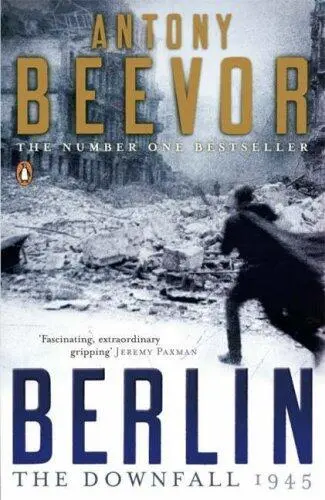
Antony Beevor - Berlin - The Downfall 1945
Здесь есть возможность читать онлайн «Antony Beevor - Berlin - The Downfall 1945» весь текст электронной книги совершенно бесплатно (целиком полную версию без сокращений). В некоторых случаях можно слушать аудио, скачать через торрент в формате fb2 и присутствует краткое содержание. Город: New York, Год выпуска: 2007, ISBN: 2007, Издательство: Penguin Books, Жанр: nonf_military, История, на английском языке. Описание произведения, (предисловие) а так же отзывы посетителей доступны на портале библиотеки ЛибКат.
- Название:Berlin: The Downfall 1945
- Автор:
- Издательство:Penguin Books
- Жанр:
- Год:2007
- Город:New York
- ISBN:978-0-141-90302-6
- Рейтинг книги:3 / 5. Голосов: 1
-
Избранное:Добавить в избранное
- Отзывы:
-
Ваша оценка:
Berlin: The Downfall 1945: краткое содержание, описание и аннотация
Предлагаем к чтению аннотацию, описание, краткое содержание или предисловие (зависит от того, что написал сам автор книги «Berlin: The Downfall 1945»). Если вы не нашли необходимую информацию о книге — напишите в комментариях, мы постараемся отыскать её.
Antony Beevor reconstructs the experiences of those millions caught up in the nightmare of the Third Reich's final collapse, telling a terrible story of pride, stupidity, fanatacism, revenge and savagery, but also one of astonishing endurance, self-sacrifice and survival against all odds.
Berlin: The Downfall 1945 — читать онлайн бесплатно полную книгу (весь текст) целиком
Ниже представлен текст книги, разбитый по страницам. Система сохранения места последней прочитанной страницы, позволяет с удобством читать онлайн бесплатно книгу «Berlin: The Downfall 1945», без необходимости каждый раз заново искать на чём Вы остановились. Поставьте закладку, и сможете в любой момент перейти на страницу, на которой закончили чтение.
Интервал:
Закладка:
‘These men were important to the army,’ the political department of the 1st Ukrainian Front wrote, ‘because they were full of burning hatred for the enemy, and because they longed for revenge for all the atrocities and abuses they had suffered. At the same time they were not yet accustomed to strict military order.’ This acknowledged that released prisoners tended to go in for rape, murder, looting, drunkenness and desertion. Like many of the Gulag criminals, they had been thoroughly brutalized by their experiences.
In the 5th Shock Army, the 94th Guards Rifle Division received a batch of forty-five former prisoners of war just five days before the Oder operation was due to take place. Political officers clearly did not trust them. ‘Each day,’ one of them wrote, ‘I spent two hours talking to them about the Motherland, about the atrocities of Germans, and about the law concerning betrayal of the Motherland. We distributed them among different regiments to exclude the possibility of having two people in the same company who might have been in Germany together or who came from the same region. Every day and every hour we were informed of their morale and behaviour. To make them hate the Germans we used photographs of Germans abusing our civilian population, including children, and we showed them the mutilated corpse of one of our soldiers.’
The distrust of former prisoners of war was based on the Stalinist fear that anybody who had spent time outside the Soviet Union, whatever the circumstances, had been exposed to anti-Soviet influences. The fact of being in a German prison camp meant that they had been ‘constantly influenced by Goebbels propaganda’: ‘They did not know the real situation in the Soviet Union and Red Army.’ This suggests that the authorities feared that memories of the catastrophe of 1941 and any association of it with the leadership of Comrade Stalin had to be eliminated at all costs. Political officers were also appalled by a question apparently ‘often asked’ by former prisoners of war: ‘Is it true that all the equipment used by the Red Army has been bought from the USA and England and that that’s the job of Comrade Stalin?’
The NKVD was also concerned. ‘Bad supervision and the unserious attitude of commanders’ had failed to control cases of indiscipline, the breaking of state laws and ‘immoral behaviour’. Even officers had been involved: ‘The territory liberated by the Soviet Army is full of enemy elements, saboteurs and other agents.’ The unserious attitude of commanders had extended to installing curtains which covered the side windows of staff cars. This presumably was done to conceal the presence of a senior officer’s ‘campaign wife’, a mistress usually selected from the signals or medical unit attached to their headquarters. Even though Stalin had tacitly permitted the institution of ‘campaign wives’, the NKVD ordered that ‘these [curtains] must be removed by checkpoints’.
Indoctrination was the highest priority, both for political officers and for the NKVD, which was in charge of ‘Checking Fighting Fitness for Battle’. ‘Political preparation’, according to this criterion, was the most important of all categories. Special propaganda seminars were arranged for non-Russian-speaking nationalities in the 1st Belorussian Front, following the arrival at the end of March of a new draft. These included Poles from the ‘western Ukraine’ and ‘western Belorussia’ and Moldavians. Many of these conscripts, however, had seen the mass arrests and deportations of 1939–41 by the NKVD and resisted their indoctrination, which concentrated on the Communist-inspired self-sacrifice of Red Army soldiers. ‘They regarded it quite sceptically,’ one political department reported with alarm. ‘After the conversation on the feat of Hero of the Soviet Union Sergeant Varlamov, who blocked the embrasure of an enemy firepoint with his body, there were comments that this cannot be possible.’
The quality of military training clearly left much to be desired. ‘A large number of non-operational losses are due to the ignorance of officers and their bad training of soldiers,’ an NKVD report stated. In one division alone, twenty-three soldiers were killed and sixty-seven wounded in a single month solely due to the mishandling of sub-machine guns: ‘This happens because they are piled or hung up with loaded magazines still on.’ Other soldiers were wounded when messing around with unfamiliar weapons and anti-tank grenades. Ill-informed soldiers put the wrong detonators into grenades, and some ‘hit mines and shells with hard objects’.
Red Army sappers, on the other hand, needed to take risks, often to make up for the shortage of supplies. They took pride in recycling the contents of unexploded shells and German mines lifted by night. Their private motto remained ‘One mistake and no more dinners.’ They used to extract the explosive, then warm it up and roll it out on the inside of their thighs, like girls in a Cuban cigar factory, and finally feed it into one of their own wooden mine cases, which could not be picked up by German mine detectors. The degree of danger depended on the stability of the explosive which they extracted. Their courage and skills were highly respected by both rifle units and tankists, who never usually conceded anything to another arm or service.
The programme of hatred of the enemy had started in the late summer of 1942, at the time of the withdrawal to Stalingrad and Stalin’s ‘Not one step back’ order. It had also been the time of Anna Akhmatova’s poem ‘The Hour of Courage has Struck’. But in February 1945, the Soviet authorities adapted her words: ‘Red Army soldier: You are now on German soil. The hour of revenge has struck!’ It was, in fact, Ilya Ehrenburg who first changed her words, he who had written in 1942, ‘Do not count days; do not count miles. Count only the number of Germans you have killed. Kill the German — this is your mother’s prayer. Kill the German — this is the cry of your Russian earth. Do not waver. Do not let up. Kill.’
Every opportunity had been taken to drum in the scale of German atrocities in the Soviet Union. According to a French informant, the Red Army authorities exhumed the bodies of some 65,000 Jews massacred near Nikolayev and Odessa, and ordered them to be placed alongside the road most used by troops. Every 200 metres a sign declared, ‘Look how the Germans treat Soviet citizens.’
Liberated slave labourers were used as another example of German atrocities. The predominantly Ukrainian and Belorussian women were made to tell soldiers how badly they had been misused. ‘Our soldiers got very angry,’ a political officer remembered. But then he added, ‘To be fair, some Germans treated their workers quite well, but they were a minority and in the mood of the time, the worst examples were the ones we remembered.’
‘We were constantly trying to step up hatred towards Germans,’ the political department of the 1st Ukrainian Front reported, ‘and to stir up a passion for revenge.’ Messages from forced labourers found in villages were printed and circulated to the troops. ‘They put us in a camp,’ one such letter read, ‘in a grey dark barracks and force us to work from morning to night and feed us on turnip soup and a tiny piece of bread. They are constantly insulting us. This is how we have spent our youth. They took all the young people from the village — even the boys who were only thirteen years old — to their accursed Germany and we are all suffering here, barefoot and hungry. There are rumours that “our people” are getting close. We can hardly wait. Maybe we’ll soon see our brothers and our suffering will end. The girls came to see me. We all sat down together to discuss it. Will we survive this terrible time? Will we ever see our families? We cannot stand it any more. It is terrible here in Germany. Zhenya Kovakchuk.’ Another letter from her gave the words of what she called ‘the song of the girl slaves’.
Читать дальшеИнтервал:
Закладка:
Похожие книги на «Berlin: The Downfall 1945»
Представляем Вашему вниманию похожие книги на «Berlin: The Downfall 1945» списком для выбора. Мы отобрали схожую по названию и смыслу литературу в надежде предоставить читателям больше вариантов отыскать новые, интересные, ещё непрочитанные произведения.








Обсуждение, отзывы о книге «Berlin: The Downfall 1945» и просто собственные мнения читателей. Оставьте ваши комментарии, напишите, что Вы думаете о произведении, его смысле или главных героях. Укажите что конкретно понравилось, а что нет, и почему Вы так считаете.