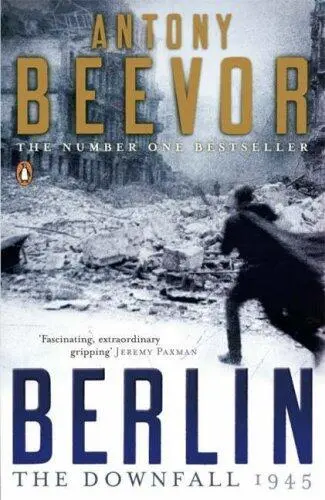
Antony Beevor - Berlin - The Downfall 1945
Здесь есть возможность читать онлайн «Antony Beevor - Berlin - The Downfall 1945» весь текст электронной книги совершенно бесплатно (целиком полную версию без сокращений). В некоторых случаях можно слушать аудио, скачать через торрент в формате fb2 и присутствует краткое содержание. Город: New York, Год выпуска: 2007, ISBN: 2007, Издательство: Penguin Books, Жанр: nonf_military, История, на английском языке. Описание произведения, (предисловие) а так же отзывы посетителей доступны на портале библиотеки ЛибКат.
- Название:Berlin: The Downfall 1945
- Автор:
- Издательство:Penguin Books
- Жанр:
- Год:2007
- Город:New York
- ISBN:978-0-141-90302-6
- Рейтинг книги:3 / 5. Голосов: 1
-
Избранное:Добавить в избранное
- Отзывы:
-
Ваша оценка:
Berlin: The Downfall 1945: краткое содержание, описание и аннотация
Предлагаем к чтению аннотацию, описание, краткое содержание или предисловие (зависит от того, что написал сам автор книги «Berlin: The Downfall 1945»). Если вы не нашли необходимую информацию о книге — напишите в комментариях, мы постараемся отыскать её.
Antony Beevor reconstructs the experiences of those millions caught up in the nightmare of the Third Reich's final collapse, telling a terrible story of pride, stupidity, fanatacism, revenge and savagery, but also one of astonishing endurance, self-sacrifice and survival against all odds.
Berlin: The Downfall 1945 — читать онлайн бесплатно полную книгу (весь текст) целиком
Ниже представлен текст книги, разбитый по страницам. Система сохранения места последней прочитанной страницы, позволяет с удобством читать онлайн бесплатно книгу «Berlin: The Downfall 1945», без необходимости каждый раз заново искать на чём Вы остановились. Поставьте закладку, и сможете в любой момент перейти на страницу, на которой закончили чтение.
Интервал:
Закладка:
On 1 April at 8 p.m., an appeal was broadcast to the German people to join the Werwolf.‘ Every Bolshevik, every Englishman, every American on our soil must be a target for our movement… Any German, whatever his profession or class, who puts himself at the service of the enemy and collaborates with him will feel the effect of our avenging hand… A single motto remains for us: “Conquer or die.”’ A few days later, Himmler issued a new order: ‘Every male in a house where a white flag appears must be shot. Not a moment must be wasted in executing these measures. By male persons who must be considered responsible for their actions this means everyone aged fourteen years and upwards.’
The true objective of Werwolf, as a document of 4 April confirmed, came from the Nazi obsession with 1918. ‘We know the plans of the enemy and we know that following a defeat there would be no chance. of Germany ever rising again like after 1918.’ The threat of killing anyone who collaborated with the allies was to prevent a ‘Stresemann-Politik’, a reference to Gustav Stresemann’s acceptance of the Treaty of Versailles in 1919. The Nazi Party was rooted in the humiliation of that defeat and it brought Germany back there again with terrible interest.
Hitler Youth boys were sent off to their selected areas, where they were told to bury their explosive, then contact the local Nazi Kreisleiter for accommodation and rations. They were all given single unspecified missions, then told to go home as if nothing had happened. Towards the end, the training became very hurried, so many of them were more likely to blow themselves up rather than the enemy.
Ultimately, Werwolf achieved very little, apart from a couple of assassinations — the mayors of Aachen and Krankenhagen — and the intimidation of civilians. Hitler Youth chalked slogans on walls such as, ‘Traitor take care, the Werwolf is watching.’ Both Skorzeny and Prützmann seem to have become less enamoured of the project as the allies closed in — if one is to believe Skorzeny’s account in his interrogation. (Prützmann committed suicide after one brief interview.) In any case, Himmler also had a change of heart in mid-April, just when negotiations via Sweden were on his mind. He instructed Prützmann to change Werwolf activity ‘to that — exclusively — of propaganda’. The only problem was that the Werwolfsender radio transmitter, under the control of Goebbels, continued to order partisan action.
On the Eastern Front, the rapid advances of the Red Army from January to March meant that hardly any groups were trained or equipped in time, and the only stay-behind groups were usually Volkssturm members, who had been cut off. The Werwolf propaganda simply lent SMERSH and the NKVD rifle regiments an urgent focus to their usual paranoia. In the west, the Allies found that Werwolf was a fiasco. Bunkers prepared for Werwolf operations had supplies ‘for 10–15 days only’ and the fanaticism of the Hitler Youth members they captured had entirely disappeared. They were ‘no more than frightened, unhappy youths’. Few resorted to the suicide pills which they had been given ‘to escape the strain of interrogation and, above all, the inducement to commit treason’. Many, when sent off by their controllers to prepare terrorist acts, had sneaked home.
Some have pointed out that the whole Werwolf project did not fit with the national character. ‘We Germans are not a nation of partisans,’ wrote an anonymous woman diarist in Berlin. ‘We wait for leadership, for orders.’ She had travelled in the Soviet Union just before the Nazis came to power and, during long discussions on trains, Russians made jokes about the German lack of revolutionary spirit. ‘German comrades would storm a railway station,’ one said, ‘only if they could first of all buy platform tickets!’
Reports also indicate that, although not part of the Werwolf programme, members of the Gestapo had been transferred to the Kriminalpolizei on the grounds that the Western Allies were sure to reinstate them later once military government was installed. As the reality of final collapse sank in, supposedly fanatical believers turned rapidly to self-preservation. Some SS members, to avoid prosecution, simply snaffled for themselves the false documents prepared for Werwolf members. Others procured Wehrmacht uniforms and the pay-books of dead men to provide themselves with new identities. German soldiers were furious that while the SS had been carrying out random executions for desertion, many of their officers were preparing their own escape. German prisoners of war told their American interrogators that tailors had been ordered to stitch a large Ρ on jackets so that SS men trying to hide could masquerade as Polish workers.
The Nazi leadership did not just rely on the ‘flying courts martial’ and SS execution squads to terrorize soldiers into continuing the fight. The tales of atrocities from the propaganda ministry never ceased. Stories of women commissars castrating wounded soldiers, for example, were circulated. The ministry also had its own squads both in Berlin and close to the Oder front, painting slogans on walls as if they were the spontaneous expression of the civilian population, such as ‘We believe in victory!’, ‘We will never surrender’ and ‘Protect our women and children from the Red beasts!’ There was, however, one group who could demonstrate their feelings about the war without fear of reprisal. German wounded who had lost hands or arms would say ‘ Heil Hitler! ’ and ‘raise their stumps ostentatiously’.
The man with the least enviable task at this time was Lieutenant General Reymann, the officer appointed Commander of the Greater Berlin Defence Area. He faced the culmination of the Nazis’ organizational chaos. General Haider, the army chief of staff sacked in 1942, was scathing on the subject. Both Hitler and Goebbels, the Reich Commissar for Defence of the capital, he wrote later, refused to give any ‘thought to defending the city until it was much too late. Thus, the city’s defence was characterized only by a mass of improvisations.’
Reymann was the third person to hold the post since Hitler had declared Berlin a fortress at the beginning of February. He found that he had to deal with Hitler, Goebbels, the Replacement Army commanded by Himmler, the Luftwaffe, Army Group Vistula headquarters, the SS, the Hitler Youth and also the local Nazi Party organization, which controlled the Volkssturm. Hitler, having ordered that Berlin should be prepared for defence, then refused to allocate any troops to the task. He simply assured Reymann that sufficient forces would be provided if the enemy reached the capital. Neither Hitler nor Goebbels could face the reality of defeat. Goebbels in particular had convinced himself that the Red Army could be held on the Oder.
Berlin’s population in early April stood at anything between 3 and 3.5 million people, including around 120,000 infants. When General Reymann raised the problem of feeding these children at a meeting in the Reich Chancellery bunker, Hitler stared at him. ‘There are no children of that age left in Berlin,’ he said. Reymann finally understood that his supreme commander had no contact with human reality. Goebbels, meanwhile, insisted that there were large reserves of tinned milk and that, if the city were encircled, cows could be brought into the centre. Reymann asked what the cows would be fed on. Goebbels had no idea. To make matters worse, the food depots were all situated on the outskirts of the city and were vulnerable to capture. Nothing was done to move either Wehrmacht or civilian supplies closer in.
Reymann and his chief of staff, Colonel Hans Refior, knew that Berlin had no hope of holding out with the forces at their disposal, so they recommended to Goebbels that civilians, especially women and children, should be allowed to leave. ‘Evacuation,’ replied Goebbels, ‘is best organized by the SS and the police commander for the Spree region. I will give the order for evacuation at the right time.’ It was quite clear that he had not for a moment seriously considered the logistic implications of evacuating such a mass of people by road and rail, to say nothing of feeding them on the way. There were not nearly enough trains still in service, and few vehicles with fuel capable of transporting the weak and the sick. The bulk of the population would have had to walk. One suspects that Goebbels, like Stalin at the start of the battle of Stalingrad, did not want to evacuate civilians in the hope that it would force the soldiers to defend the city more desperately.
Читать дальшеИнтервал:
Закладка:
Похожие книги на «Berlin: The Downfall 1945»
Представляем Вашему вниманию похожие книги на «Berlin: The Downfall 1945» списком для выбора. Мы отобрали схожую по названию и смыслу литературу в надежде предоставить читателям больше вариантов отыскать новые, интересные, ещё непрочитанные произведения.








Обсуждение, отзывы о книге «Berlin: The Downfall 1945» и просто собственные мнения читателей. Оставьте ваши комментарии, напишите, что Вы думаете о произведении, его смысле или главных героях. Укажите что конкретно понравилось, а что нет, и почему Вы так считаете.