Antony Beevor - Berlin - The Downfall 1945
Здесь есть возможность читать онлайн «Antony Beevor - Berlin - The Downfall 1945» весь текст электронной книги совершенно бесплатно (целиком полную версию без сокращений). В некоторых случаях можно слушать аудио, скачать через торрент в формате fb2 и присутствует краткое содержание. Город: New York, Год выпуска: 2007, ISBN: 2007, Издательство: Penguin Books, Жанр: nonf_military, История, на английском языке. Описание произведения, (предисловие) а так же отзывы посетителей доступны на портале библиотеки ЛибКат.
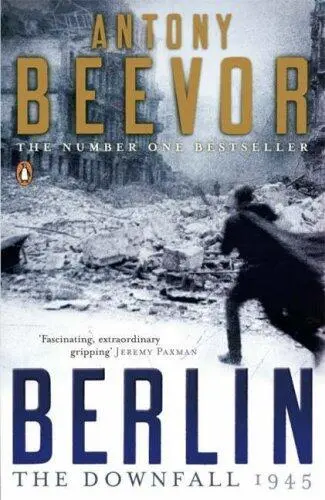
- Название:Berlin: The Downfall 1945
- Автор:
- Издательство:Penguin Books
- Жанр:
- Год:2007
- Город:New York
- ISBN:978-0-141-90302-6
- Рейтинг книги:3 / 5. Голосов: 1
-
Избранное:Добавить в избранное
- Отзывы:
-
Ваша оценка:
Berlin: The Downfall 1945: краткое содержание, описание и аннотация
Предлагаем к чтению аннотацию, описание, краткое содержание или предисловие (зависит от того, что написал сам автор книги «Berlin: The Downfall 1945»). Если вы не нашли необходимую информацию о книге — напишите в комментариях, мы постараемся отыскать её.
Antony Beevor reconstructs the experiences of those millions caught up in the nightmare of the Third Reich's final collapse, telling a terrible story of pride, stupidity, fanatacism, revenge and savagery, but also one of astonishing endurance, self-sacrifice and survival against all odds.
Berlin: The Downfall 1945 — читать онлайн бесплатно полную книгу (весь текст) целиком
Ниже представлен текст книги, разбитый по страницам. Система сохранения места последней прочитанной страницы, позволяет с удобством читать онлайн бесплатно книгу «Berlin: The Downfall 1945», без необходимости каждый раз заново искать на чём Вы остановились. Поставьте закладку, и сможете в любой момент перейти на страницу, на которой закончили чтение.
Интервал:
Закладка:
The Nazi leadership was also preparing at this time a Wehrmachthelferinnenkorps of female military auxiliaries. Young women had to swear an oath of allegiance which began, ‘I swear that I will be true and obedient to Adolf Hitler, the Führer and commander in chief of the Wehrmacht.’ The words made it sound like a mass marriage. For somebody who had perhaps diverted his sexual drive into the pursuit of power, this may have provided its own form of ersatz fantasy.
In the Wilhelmstrasse district of ministries, government officials were trying to convince any diplomats who remained in the city that they were ‘deciphering telegrams between Roosevelt and Churchill within two hours of their dispatch’. Meanwhile, rumours circulated of Communist shock troops being formed in the eastern ‘Red’ part of the city to liquidate Nazi Party members. ‘There is an atmosphere of desperation at the top,’ the Swedish military attaché reported to Stockholm. ‘A determination to sell their lives dearly.’ In fact, the only sabotage groups came from the other side of the lines, when members of the Soviet-controlled Freies Deutschland in Wehrmacht uniform slipped through German positions and moved towards Berlin. They cut cables, but little more. Freies Deutschland later claimed that its resistance group Osthafen had blown up a munitions dump in Berlin, but this is far from certain.
On 9 April, a number of well-known opponents of the regime were butchered by the SS in a variety of concentration camps. The order was given to ensure their deaths before the enemy could release them. In Dachau, Johann Georg Elser, the Communist who had tried to assassinate Hitler in the Bürgerbräukeller on 8 November 1939, was killed. Dietrich Bonhoeffer, Admiral Canaris and General Oster were executed in Flossenbürg and Hans von Dohnanyi in Sachsenhausen.
‘Revenge is coming!’ — ‘ Die Vergeltung kommt!’ — had been the Nazi propaganda slogan for the V-weapons. But this now had a hollow echo for officers on the Oder front as they awaited the onslaught. It was Soviet revenge which was coming and they knew that there were no more miracle weapons to save them. Many of them, under heavy pressure from above, lied to their men even more than before other similar defeats, with promises of miracle weapons, of rifts in the enemy coalition and of reinforcements. This was to contribute to the breakdown in discipline at the end of the battle.
Even the Waffen SS began to suffer from an unprecedented resentment between soldiers and officers. Eberhard Baumgart, the clerk with the SS Division 30. Januar, went back to headquarters to deal with a report, but found that the sentries would not let him in. A look through the windows soon explained why. ‘I thought I was dreaming,’ he wrote later. ‘Glittering dress uniforms swirled around with tarted-up women, music, noise, laughter, shrieking, cigarette smoke and clinking glasses.’ Baumgart’s mood next day was not helped when Georg, the Volga German interpreter, showed him a cartoon from Pravda of Hitler, Göring and Goebbels in an orgy in the Reich Chancellery. The caption read, ‘Every day the German soldier holds on lengthens our lives.’
Instead of miracle weapons, many of the Volkssturm and other improvised units received weapons that were useless, such as the Volkshandgranate 45. This ‘people’s hand grenade’ was simply a lump of concrete around a small explosive charge and a No. 8 detonator. It was more dangerous to the thrower than to the target. One detachment of officer cadets facing a Guards tank army received rifles captured from the French army in 1940 and just five rounds each. It was typical of Nazi corporate bluster that they continued to create impressive-sounding units — whether the Sturmzug, which lacked the weapons to storm anything, or the Panzerjadgkompanie, which was supposed to stalk tanks on foot.
Another formation, which had better reason than most to fear the consequences of capture, was the 1st Division of General Vlasov’s Russian Army of Liberation. It had been Himmler’s idea to bring the Vlasov division to the Oder front. He had trouble persuading Hitler, who still disliked the idea of using Slav troops. The German general staff had supported the idea earlier in the war of raising a Ukrainian army of a million men, but Hitler vetoed the plan, determined to maintain the separation of‘Herrenmensch und das Sklavenvolk ’. And then the terrible treatment of the Ukrainian people under Rosenberg and Gauleiter Koch in the Ukraine had put an end to Wehrmacht hopes.
Early in April, General Vlasov, accompanied by a liaison officer and an interpreter, came to Army Group Vistula headquarters to discuss matters with General Heinrici. Vlasov was a tall, rather gaunt man, with ‘clever eyes’ set in a colourless face, with one of those chins which looked grey even when freshly shaved. After a few optimistic expressions by Vlasov, Heinrici asked bluntly how such a recently formed division would perform in combat. German officers were concerned that these Russian volunteers would refuse to fight their fellow countrymen at the last moment. Now that the Third Reich was doomed to destruction, there was little incentive, save desperation, for the Vlasov volunteers.
Vlasov did not try to fool Heinrici. He explained that his plan had been to raise at least six divisions, hopefully ten, from prisoners of war in the camps. The problem was that the Nazi authorities had not come round to the idea until it was too late. He was aware of the risk of Soviet propaganda aimed at his men. Yet he felt that they should be allowed to prove themselves in an attack on one of the Oder bridgeheads.
General Busse chose for them an unimportant sector at Erlenhof, south of Frankfurt an der Oder. Soviet reconnaissance groups from the 33rd Army identified their presence almost immediately and a barrage of loudspeaker activity began. The advance of the Vlasovtsy started on 13 April. During two and a half hours’ fighting, the 1st Division created a wedge 500 metres deep, but the Soviet artillery fire was so strong that they had to lie down. General Bunyachenko, their commander, seeing no sign of either air or artillery support which he thought that the Germans had promised, withdrew his men, disregarding Busse’s order. The Vlasov division lost 370 men, including four officers. Busse was furious, and, on his recommendation, General Krebs ordered the division to be withdrawn from the front and stripped of its weapons, which would be used for ‘better purposes’. The Vlasovtsy were deeply embittered. They blamed their reverse on the lack of artillery support, but perhaps nobody had warned them that German batteries were holding back their last rounds for the major attack.
During the first two weeks of April, sporadic fighting continued in the bridgeheads. Soviet attacks were aimed to deepen them. Behind the Oder, the activity was even more intense. Altogether, twenty-eight Soviet armies were involved in regrouping and redeploying in fifteen days. The commander of the 70th Army, Colonel General Popov, had to issue orders to corps commanders even before he received final instructions from above.
Several armies had large distances to cover and very little time. According to Soviet field regulations, a mechanized column was supposed to move 150 kilometres a day, but the 200th Rifle Division of the 49th Army managed to cover 358 kilometres in just twenty-five hours. In the 3rd Shock Army, which had been diverted for the Pomeranian operation, soldiers feared that they would never make it back in time and ‘would only get to Berlin when everybody else would be picking up their hats [to go home]’. No true frontovik wanted to miss the climax of the war. He knew the jealousy which formations of the 1st Belorussian Front inspired in the rest of the Red Army.
Читать дальшеИнтервал:
Закладка:
Похожие книги на «Berlin: The Downfall 1945»
Представляем Вашему вниманию похожие книги на «Berlin: The Downfall 1945» списком для выбора. Мы отобрали схожую по названию и смыслу литературу в надежде предоставить читателям больше вариантов отыскать новые, интересные, ещё непрочитанные произведения.






Обсуждение, отзывы о книге «Berlin: The Downfall 1945» и просто собственные мнения читателей. Оставьте ваши комментарии, напишите, что Вы думаете о произведении, его смысле или главных героях. Укажите что конкретно понравилось, а что нет, и почему Вы так считаете.