Antony Beevor - Berlin - The Downfall 1945
Здесь есть возможность читать онлайн «Antony Beevor - Berlin - The Downfall 1945» весь текст электронной книги совершенно бесплатно (целиком полную версию без сокращений). В некоторых случаях можно слушать аудио, скачать через торрент в формате fb2 и присутствует краткое содержание. Город: New York, Год выпуска: 2007, ISBN: 2007, Издательство: Penguin Books, Жанр: nonf_military, История, на английском языке. Описание произведения, (предисловие) а так же отзывы посетителей доступны на портале библиотеки ЛибКат.
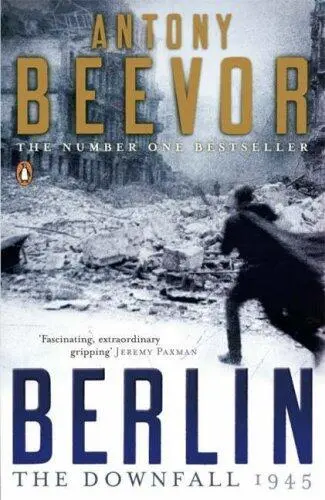
- Название:Berlin: The Downfall 1945
- Автор:
- Издательство:Penguin Books
- Жанр:
- Год:2007
- Город:New York
- ISBN:978-0-141-90302-6
- Рейтинг книги:3 / 5. Голосов: 1
-
Избранное:Добавить в избранное
- Отзывы:
-
Ваша оценка:
Berlin: The Downfall 1945: краткое содержание, описание и аннотация
Предлагаем к чтению аннотацию, описание, краткое содержание или предисловие (зависит от того, что написал сам автор книги «Berlin: The Downfall 1945»). Если вы не нашли необходимую информацию о книге — напишите в комментариях, мы постараемся отыскать её.
Antony Beevor reconstructs the experiences of those millions caught up in the nightmare of the Third Reich's final collapse, telling a terrible story of pride, stupidity, fanatacism, revenge and savagery, but also one of astonishing endurance, self-sacrifice and survival against all odds.
Berlin: The Downfall 1945 — читать онлайн бесплатно полную книгу (весь текст) целиком
Ниже представлен текст книги, разбитый по страницам. Система сохранения места последней прочитанной страницы, позволяет с удобством читать онлайн бесплатно книгу «Berlin: The Downfall 1945», без необходимости каждый раз заново искать на чём Вы остановились. Поставьте закладку, и сможете в любой момент перейти на страницу, на которой закончили чтение.
Интервал:
Закладка:
Although the real frontoviki were determined to see victory in Berlin, desertions increased as the offensive came closer. Most of those who disappeared were conscripts from the recent drafts, especially Poles, Ukrainians and Romanians. An increase in desertions also meant a growing level of banditry, looting and violence towards the civilian population: ‘Some deserters seize carts from local citizens, load them with different sorts of property and, pretending that they are carts belonging to the army, move from the front zone to the rear areas.’
NKVD rifle regiments behind the 1st Ukrainian Front arrested 355 deserters in the first part of April. The 1st Belorussian Front was even more concerned about discipline, as a report of 8 April reveals. ‘Many soldiers are still hanging around in rear areas and describing themselves as separated from their units. They are in fact deserters. They carry out looting, robbery and violence. Recently up to 600 people were arrested in the sector of the 61st Army. All the roads are jammed with vehicles and carts used by military personnel on both legitimate missions and looting missions. They leave their vehicles and carts in the streets and in yards and wander around depots and apartments looking for things. Many officers, soldiers and NCOs are no longer looking like members of the Red Army. Some very serious deviations from standard uniform are being overlooked. It becomes difficult to distinguish between a soldier and an officer and between soldiers and civilians. Dangerous cases of disobedience to senior officers have taken place.’
NKVD rifle regiments and SMERSH were also continuing their work of rounding up suspects. They were, in Beria’s view, both insufficiently selective and over-zealous. They had dispatched 148,540 prisoners to NKVD camps in the Soviet Union, yet ‘barely one half were in a condition to perform physical labour’. They had simply packed off ‘the people who were arrested as a result of clearing the rear areas of the Red Army’. Some priorities, however, did not change. Polish patriots were still considered as dangerous as Nazis. And NKVD regiments continued to encounter small groups of German stragglers trying to slip through Red Army lines after the fighting in Pomerania and Silesia. These small groups often ambushed the odd vehicle for food on the way, and the Soviet military authorities would respond, just as the Germans themselves had in the Soviet Union, by destroying the nearest village and shooting civilians.
The mood of Red Army officers and soldiers was tense but confident. Pyotr Mitrofanovich Sebelev, the second-in-command of an engineer brigade, had just been promoted to lieutenant colonel at the age of twenty-two. ‘Hello Papa, Mama, Shura and Taya,’ he wrote home on 10 April. ‘At the moment, there is an unusual and therefore scaring quietness here. I was at a concert yesterday. Yes, don’t be surprised, at a concert! given by artistes from Moscow. It cheered us up. We can’t help thinking if only the war would finish as soon as possible, but I think it depends on us mainly. Two cases occurred yesterday which I must tell you about. I went to the front line with a man from the rear areas. We walked out of the forest and up a sandy mound, and lay down. The Oder was in front of us with a long spit of sand sticking out. The spit was occupied by Germans. Behind the Oder, the town of Küstrin, an ordinary town. Suddenly wet sand flew all around me and immediately I heard a shot: the Germans had spotted us and had begun shooting from this spit.
‘Two hours ago, our recce men brought a captured German corporal to me who clicked his heels and immediately asked me through the interpreter, “Where am I, Mr Officer? Among Zhukov’s troops, or in Rokossovsky’s band?” I laughed and said to the German, “You are with the troops of the 1st Belorussian Front, which is commanded by Marshal Zhukov. But why do you call Marshal Rokossovsky’s troops a band?” The corporal answered, “They don’t follow the rules when fighting. This is why German soldiers call them a band.”
‘Another piece of news. My adjutant, Kolya Kovalenko, was wounded in the arm but he escaped from hospital. I reprimanded him for this and he cursed and said, “You are depriving me of the honour of being one of the first to enter Berlin with our boys.”… Goodbye, kisses to all of you. Your Pyotr.’
For the truly committed majority, the greatest concern was the rapid advance of the Western Allies. In the 69th Army, the political department reported the soldiers as saying, ‘Our advance is too slow and the Germans will surrender their capital to the English and Americans.’
Komsomol members in the 4th Guards Tank Army prepared for the offensive by getting experienced soldiers to talk to the newcomers about the reality of battle. Komsomol members also helped the barely literate ones write letters home. They were particularly proud of having bought a T-34 tank with their own money. Their tank ‘Komsomolets’ had already ‘destroyed a few enemy tanks and other armoured vehicles and crushed many Fritzes under its tracks’. At Party meetings members were reminded that ‘all Communists have a duty to speak out against looting and drinking’.
Artillery regiments, meanwhile, paid ‘special attention to the replacement of casualties’. They foresaw that losses would increase sharply once they reached Berlin, because gun crews would be firing over open sights. Crew members therefore had to train hard in each other’s tasks. And each regiment prepared a reserve of trained gun layers, ready to replace casualties.
To preserve secrecy, ‘the local population was sent twenty kilometres back from the front line’. Radio silence was imposed and signs were placed by every field telephone: ‘Don’t speak about things you should not speak about.’
German preparations, on the other hand, emphasized the reprisals that would be carried out against all those who failed in their duty and against their families, whatever their rank. An announcement was made that General Lasch, the commander of Königsberg, had been condemned to death by hanging in absentia and his whole family arrested under the Sippenhaft law to persecute the closest relatives of traitors to the Nazi cause.
The final agony of East Prussia affected morale in Berlin almost as much as the threat from the Oder. On 2 April, Soviet artillery began its softening-up barrage on the centre of Königsberg. The Soviet artillery officer Senior Lieutenant Inozemstev recorded in his diary on 4 April that sixty shells from his battery had reduced one fortified building into ‘a pile of stones’. The NKVD was concerned that nobody escaped. ‘Encircled soldiers in Königsberg are putting on civilian clothes to get away. Documents must be checked more carefully in East Prussia.’
‘The aviation is very effective,’ Inozemstev wrote on 7 April. ‘We are using flame-throwers on a massive scale. If there is only one German in a building he is chased out by the fire. There is no fighting for a storey or a staircase. It is already clear to everyone now that the storming of Königsberg will go down as a classic example of storming a big city.’ The next day, when his comrade Safonov was killed, the regiment fired a salute of salvoes at the citadel.
The destruction was terrible. Thousands of soldiers and civilians were buried by the bombardments. There was a ‘smell of death in the air’, Inozemstev wrote, ‘literally — because thousands of corpses are decomposing under the ruins’. As the wounded filled every usable cellar, General Lasch knew that there was no hope. The 11th Guards Army and the 43rd Army had fought their way right into the city. Even Koch’s deputy Gauleiter urged the abandonment of the city, but all links with the Samland Peninsula had been severed. A counter-attack was mounted to force a way through, but it collapsed in chaos on the night of 8 April. The bombardment had blocked many of the routes leading to the start-line. The local Party leadership, without telling Lasch, had passed the word to civilians to assemble ready for the breakout, but their concentration attracted the attention of Soviet artillery observation officers and they were massacred.
Читать дальшеИнтервал:
Закладка:
Похожие книги на «Berlin: The Downfall 1945»
Представляем Вашему вниманию похожие книги на «Berlin: The Downfall 1945» списком для выбора. Мы отобрали схожую по названию и смыслу литературу в надежде предоставить читателям больше вариантов отыскать новые, интересные, ещё непрочитанные произведения.








Обсуждение, отзывы о книге «Berlin: The Downfall 1945» и просто собственные мнения читателей. Оставьте ваши комментарии, напишите, что Вы думаете о произведении, его смысле или главных героях. Укажите что конкретно понравилось, а что нет, и почему Вы так считаете.