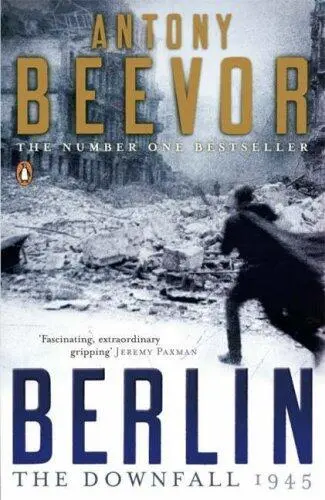
Antony Beevor - Berlin - The Downfall 1945
Здесь есть возможность читать онлайн «Antony Beevor - Berlin - The Downfall 1945» весь текст электронной книги совершенно бесплатно (целиком полную версию без сокращений). В некоторых случаях можно слушать аудио, скачать через торрент в формате fb2 и присутствует краткое содержание. Город: New York, Год выпуска: 2007, ISBN: 2007, Издательство: Penguin Books, Жанр: nonf_military, История, на английском языке. Описание произведения, (предисловие) а так же отзывы посетителей доступны на портале библиотеки ЛибКат.
- Название:Berlin: The Downfall 1945
- Автор:
- Издательство:Penguin Books
- Жанр:
- Год:2007
- Город:New York
- ISBN:978-0-141-90302-6
- Рейтинг книги:3 / 5. Голосов: 1
-
Избранное:Добавить в избранное
- Отзывы:
-
Ваша оценка:
Berlin: The Downfall 1945: краткое содержание, описание и аннотация
Предлагаем к чтению аннотацию, описание, краткое содержание или предисловие (зависит от того, что написал сам автор книги «Berlin: The Downfall 1945»). Если вы не нашли необходимую информацию о книге — напишите в комментариях, мы постараемся отыскать её.
Antony Beevor reconstructs the experiences of those millions caught up in the nightmare of the Third Reich's final collapse, telling a terrible story of pride, stupidity, fanatacism, revenge and savagery, but also one of astonishing endurance, self-sacrifice and survival against all odds.
Berlin: The Downfall 1945 — читать онлайн бесплатно полную книгу (весь текст) целиком
Ниже представлен текст книги, разбитый по страницам. Система сохранения места последней прочитанной страницы, позволяет с удобством читать онлайн бесплатно книгу «Berlin: The Downfall 1945», без необходимости каждый раз заново искать на чём Вы остановились. Поставьте закладку, и сможете в любой момент перейти на страницу, на которой закончили чтение.
Интервал:
Закладка:
The speed of Patton’s advance had an unintended side-effect. The SS, in many cases aided by the local Volkssturm, carried out a number of massacres of concentration camp prisoners and forced labourers. At the Thekla factory, which manufactured aircraft wings three kilometres north-east of Leipzig, 300 prisoners were forced into an isolated building by the SS and Volkssturm auxiliaries. All windows were fastened, then the SS threw in incendiary bombs. Those who managed to break out of the building were machine-gunned. Three Frenchmen survived. Over 100 allied prisoners — mainly French political prisoners — were executed in the courtyard of Leipzig prison. And a column of 6,500 women of many nationalities from the HASAG group of factories two kilometres north-east of Leipzig were marched towards Dresden. Allied air reconnaissance sighted them along their route. Prisoners too weak to march had been shot by SS guards and rolled into the ditch beside the road. Striped blue and white concentration camp garments ‘marked the route and the Calvary of these unfortunate women’.
In southern Germany, meanwhile, General Devers’s Sixth Army Group — consisting of General Patch’s Seventh Army and the French First Army under General de Lattre de Tassigny — was pushing across the Black Forest. Its left flank advanced into Swabia. After the capture of Karlsruhe, they moved towards Stuttgart. Eisenhower, still concerned about an Alpine Fortress, wanted the two armies to head south-eastwards for the area of Salzburg and meet up with Soviet forces in the Danube valley.
German civilians used to gaze in amazement at American troops. GIs sprawled in jeeps, smoking or chewing gum, bore no resemblance to the German image of a soldier. Their olive-painted vehicles, even their tanks, were labelled with girls’ names. But some soldierly habits proved universal. Wehrmacht troops when retreating had looted shamelessly, and now the liberators had arrived.
Looting by Allied forces appears to have begun even before the German frontier was crossed. ‘On the basis of findings made,’ an American report on the Ardennes stated, ‘it may unequivocally be stated that pillage of Belgian civilian property by US troops did in fact take place on a considerable scale.’ There had apparently been a good deal of safe-blowing with explosives. As US forces advanced into central and southern Germany, American military police erected signs at the entry to villages, ‘No speeding, no looting, no fraternizing’, but they had little effect on all counts.
Further north, an officer with the Scots Guards, and later a judge, wrote that the codename for the crossing of the Rhine, Operation Plunder, was most appropriate. He described how the smashed windows of shops provided ‘a looter’s paradise’. ‘There was not very much one could do beyond restricting loot to small articles. The tanks came off best as they could carry everything from typewriters to wireless sets… I was cursing my platoon for looting rather than house clearing when I discovered that I was wearing two pairs of captured binoculars myself!’
Those acting independently, such as SAS teams, were able to be far more ambitious. One officer commented that ‘Monty was very stuffy about looting’. Field Marshal Alexander had apparently been ‘much more relaxed’. In one or two cases, some very fine jewellery was taken from German country houses at gunpoint in escapades which might even have shocked the legendary Raffles. One SAS troop later discovered a hoard of paintings accumulated by Göring’s wife. The squadron commander insisted on having first pick himself, then let his officers make their choice. The canvases were removed from their stretchers, rolled up and slid into the mortar tubes.
Attitudes to the war varied between armies. Idealistic Americans and Canadians felt that they had a duty to rescue the old world, then return home as soon as possible. Their more cynical comrades took a close business interest in the black market. French regular officers in particular were focused on revenge for the humiliations of 1940 and on restoring national pride. In the British Army, however, a newly arrived officer might believe that he had come to take part in ‘a life and death struggle for democracy and the freedom of the world’, but found instead that the war was ‘treated more as an incident in regimental history against a reasonably sporting opponent’. Nothing, needless to say, could have been further from the Russian view.
The sudden American advance in the centre aroused a mixture of suspicion and moral outrage in the Kremlin. The Soviet leadership, having complained so frequently of the Western Allies’ slowness in starting a second front, was now appalled by the idea that they might reach Berlin first. The reality of Allied air power, with German troops fearing Typhoons and Mustangs far more than Shturmoviks, was completely overlooked in Moscow, perhaps deliberately. Stalin, never one to seek natural explanations, found it hard to swallow the fact that the Germans were bound to prefer to surrender to the Western Allies rather than to the Soviet Union, which promised and practised revenge on a huge scale.
‘American tankists are enjoying excursions in the picturesque Harz mountains,’ Ilya Ehrenburg wrote in Krasnaya Zvezda. The Germans were surrendering, he joked bitterly, ‘with fanatical persistence’. They were behaving towards Americans, he claimed, as if they belonged to ‘some neutral state’. The phrase which incensed Averell Harriman the most was his comment that the Americans were ‘conquering with cameras’.
Stalin, perhaps judging others by himself, suspected that the Western Allies, hoping to reach Berlin first, would be tempted into a deal with Nazi factions. He seized on the contacts between Allen Dulles in Berne and SS-Obergruppenführer Wlff about a surrender in Italy as evidence of their double-dealing. Dulles had in fact also been contacted by a representative of Kaltenbrunner, who said that the SS wanted to launch a coup against the Nazi Party and the SS diehards who wished to continue the war. When this was done, the SS could ‘arrange for an orderly transfer of administrative functions to the western powers’. Kaltenbrunner’s man also talked of opening the Western Front to the Americans and British, while German troops there were switched to the east — the exact scenario that Stalin feared. Stalin fortunately did not learn of this until later, but he had heard that American and British airborne forces were ready to drop on Berlin if Nazi power suddenly collapsed. Indeed, the 101st Airborne Division had been allocated Tempelhof aerodrome as their dropping zone, the 82nd Airborne would drop on Gatow airfield and the British on Oranienburg, but ever since the decision to halt on the Elbe the whole operation was in abeyance. In any case, such contingency plans had nothing to do with any peace-feelers from the Germans. Since their declaration at the Casablanca conference insisting on Germany’s unconditional surrender, neither Roosevelt nor even Churchill had seriously considered any backstairs deal with Nazi leaders.
All of Roosevelt and Eisenhower’s optimism in February and March that they could win Stalin’s trust was proved to be misplaced during the first week of April. As already mentioned, Eisenhower, in his controversial message to Stalin of 28 March, had given a detailed and accurate outline of his plans yet received nothing in return. In fact, on 1 April, Stalin had deliberately duped him when he said that Berlin had lost its former strategic importance. At that time, Stalin claimed that the Soviet offensive would probably come in the second half of May (instead of the middle of April), that the Red Army would concentrate its attack further south to meet up with him, and that only ‘secondary forces’ would be sent against Berlin.
Читать дальшеИнтервал:
Закладка:
Похожие книги на «Berlin: The Downfall 1945»
Представляем Вашему вниманию похожие книги на «Berlin: The Downfall 1945» списком для выбора. Мы отобрали схожую по названию и смыслу литературу в надежде предоставить читателям больше вариантов отыскать новые, интересные, ещё непрочитанные произведения.








Обсуждение, отзывы о книге «Berlin: The Downfall 1945» и просто собственные мнения читателей. Оставьте ваши комментарии, напишите, что Вы думаете о произведении, его смысле или главных героях. Укажите что конкретно понравилось, а что нет, и почему Вы так считаете.