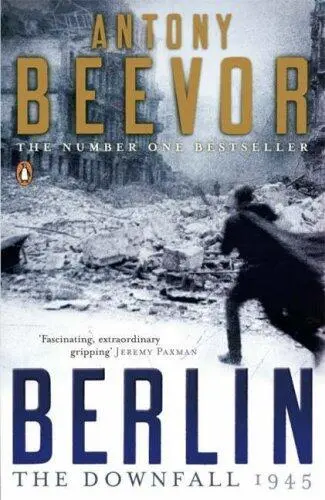
Antony Beevor - Berlin - The Downfall 1945
Здесь есть возможность читать онлайн «Antony Beevor - Berlin - The Downfall 1945» весь текст электронной книги совершенно бесплатно (целиком полную версию без сокращений). В некоторых случаях можно слушать аудио, скачать через торрент в формате fb2 и присутствует краткое содержание. Город: New York, Год выпуска: 2007, ISBN: 2007, Издательство: Penguin Books, Жанр: nonf_military, История, на английском языке. Описание произведения, (предисловие) а так же отзывы посетителей доступны на портале библиотеки ЛибКат.
- Название:Berlin: The Downfall 1945
- Автор:
- Издательство:Penguin Books
- Жанр:
- Год:2007
- Город:New York
- ISBN:978-0-141-90302-6
- Рейтинг книги:3 / 5. Голосов: 1
-
Избранное:Добавить в избранное
- Отзывы:
-
Ваша оценка:
Berlin: The Downfall 1945: краткое содержание, описание и аннотация
Предлагаем к чтению аннотацию, описание, краткое содержание или предисловие (зависит от того, что написал сам автор книги «Berlin: The Downfall 1945»). Если вы не нашли необходимую информацию о книге — напишите в комментариях, мы постараемся отыскать её.
Antony Beevor reconstructs the experiences of those millions caught up in the nightmare of the Third Reich's final collapse, telling a terrible story of pride, stupidity, fanatacism, revenge and savagery, but also one of astonishing endurance, self-sacrifice and survival against all odds.
Berlin: The Downfall 1945 — читать онлайн бесплатно полную книгу (весь текст) целиком
Ниже представлен текст книги, разбитый по страницам. Система сохранения места последней прочитанной страницы, позволяет с удобством читать онлайн бесплатно книгу «Berlin: The Downfall 1945», без необходимости каждый раз заново искать на чём Вы остановились. Поставьте закладку, и сможете в любой момент перейти на страницу, на которой закончили чтение.
Интервал:
Закладка:
Eisenhower, unaware that he had been tricked, curtly informed Montgomery that Berlin had become ‘nothing but a geographical location’. He also continued, with General Marshall’s strong support, to reject Churchill’s arguments that the Americans and British ‘should shake hands with the Russians as far to the east as possible’. He simply could not accept Churchill’s point that Berlin, while it remained under the German flag, was bound to be ‘the most decisive point in Germany’. Eisenhower obstinately believed that the Leipzig—Dresden axis, splitting Germany in two, was more important, and he was convinced that Stalin thought so too.
Eisenhower also refused to be influenced by Stalin’s trickery over Poland. Churchill’s worst fears were proved correct when sixteen leaders of Polish democratic parties who had been invited to confer with Zhukov under cover of a safe-conduct were arrested at the end of March by the NKVD and bundled off to Moscow. Yet even though Eisenhower had fallen for his lies, Stalin was far from relaxed. Perhaps he believed, with true Stalinian paranoia, that Eisenhower might be playing a double bluff. In any case, he was clearly determined to make the Americans feel guilty. In an aggressive signal to Roosevelt on 7 April, Stalin again made much of the German overtures through Dulles in Switzerland. He also emphasized that the Red Army was facing far more German divisions than the Western Allies. ‘[The Germans] continue to fight savagely against the Russians for some unknown junction in Czechoslovakia which they need as much as a dead man needs poultices,’ Stalin wrote to the President, ‘but [they] surrender without any resistance such important towns in central Germany as Osnabruck, Mannheim and Kassel. Don’t you agree that such behaviour is more than strange and incomprehensible?’
Ironically, Hitler’s ill-judged decision to keep the Sixth SS Panzer Army down near Vienna when Berlin was being threatened seemed to support the theory of the Alpine Fortress. SHAEF’s joint intelligence committee acknowledged on 10 April that ‘there is no evidence to show that the strategy of the German high command is being conducted with a view to occupying eventually the so-called National Redoubt’. But they then went on to say that the objective of the Redoubt was to drag the war into the next winter, in the hope that the Western Allies and the Soviet Union would fall out among themselves. Yet the same day, another report should have put paid to this extraordinarily deep-rooted idea. ‘The interrogation of various German generals and senior officers recently captured reveals that none of them had heard of the National Redoubt. All of them consider such a plan to be “ridiculous and inapplicable”.’
Neither Stalin nor Churchill realized that the American President was in no condition to read their telegrams, let alone answer them himself. On Good Friday, 30 March, Roosevelt had been taken down by train to Warm Springs, Georgia. It was his last journey alive. He had been carried to the waiting limousine barely conscious. Those who saw him were deeply shocked by his state. In less than two weeks Roosevelt would be dead and Harry Truman, his Vice-President, would become the next President of the United States.
On 11 April, the Americans reached Magdeburg. The next day they crossed the Elbe south of Dessau. Plans were drawn up on the projection that they could reach Berlin within forty-eight hours. This was not an improbable estimate. There were few SS units left on the western side of the capital.
On the same day, Germans were shaken by the ferocity of a French government radio station broadcasting from Cologne. ‘Deutschland, dein Lebensraum ist jetzt dein Sterbensraum ’ — ‘Germany, your room to live is now your room to die.’ It was the sort of remark which they would have expected of Ilya Ehrenburg.
Ehrenburg, on that day, published his last and most controversial article of the war in Krasnaya Zvezda. It was entitled ‘Khvatit ’ or ‘Enough’. ‘Germany is dying miserably, without pathos or dignity,’ he wrote. ‘Let us remember the pompous parades, the Sportpalast in Berlin, where Hitler used to roar that he was going to conquer the world. Where is he now? In what hole? He has led Germany to a precipice, and now he prefers not to show himself.’ As far as Ehrenburg was concerned, ‘Germany does not exist; there is only a colossal gang.’
This was the same article in which Ehrenburg bitterly compared German resistance in the east and the surrenders in the west. He evoked ‘the terrible wounds of Russia’ which the Western Allies did not want to know about. He then mentioned the handful of German atrocities in France, such as the massacre of Oradour. ‘There are four such villages in France. And how many are there in Belorussia? Let me remind you about villages in the region of Leningrad…’
Ehrenburg’s inflammatory rhetoric often did not accord with his own views. In his article, he implicitly condoned looting — ‘Well, German women are losing fur coats and spoons that had been stolen’ — when in Red Army parlance looting often implicitly included rape. Yet he had recently lectured officers at the Frunze military academy, criticizing Red Army looting and destruction in East Prussia and blaming it on the troops’ ‘extremely low’ level of culture. His only reference to rape, however, was to say that Soviet soldiers ‘were not refusing “the compliments” of German women’. Abakumov, the head of SMERSH, reported Ehrenburg’s ‘incorrect opinions’ to Stalin, who regarded them as ‘politically harmful’. This, combined with the similar report on East Prussia by Count von Einsiedel of the NKVD-controlled National Committee for a Free Germany, set in motion a train of events and discussions which triggered a major reappraisal of Soviet policy.
The tone and content of Ehrenburg’s article on 12 April were no more bloodthirsty than previous diatribes, but to the writer’s shock it was attacked from on high to signal a change in the Party line. An embittered Ehrenburg later recognized that his role as the scourge of the Germans made him the obvious symbolic sacrifice in the circumstances. The Soviet leadership, rather late in the day, had finally realized that the horror inspired by the Red Army’s onslaught on the civilian population was increasing enemy resistance and would complicate the post-war Soviet occupation of Germany. In Ehrenburg’s words, they wanted to undermine the enemy’s will to fight on ‘by promising immunity to the rank and file of those who had carried out Hitler’s orders’.
On 14 April, Georgy Aleksandrov, the main ideologist on the central committee and the chief of Soviet propaganda, replied in Pravda with an article entitled ‘Comrade Ehrenburg Oversimplifies’. In a conspicuously important piece, which had no doubt been checked by Stalin if not virtually dictated by him, Aleksandrov rejected Ehrenburg’s explanation of rapid surrender in the west and his depiction of Germany as ‘only a colossal gang’. While some German officers ‘fight for the cannibal regime, others throw bombs at Hitler and his clique [the July plotters] or persuade Germans to put down their weapons [General von Seydlitz and the League of German Officers]. The Gestapo hunt for opponents of the regime, and the appeals to Germans to denounce them proved that not all Germans were the same. It was the Nazi government which was desperate to call upon the idea of national unity. The very intensity of the appeals for national unity in fact proved how little unity there was.’ Aleksandrov also quoted Stalin’s remark, ‘Hitlers come and go, but Germany and the German people remain’ — a slogan first coined as early as 23 February 1942 but only really used in 1945.
Читать дальшеИнтервал:
Закладка:
Похожие книги на «Berlin: The Downfall 1945»
Представляем Вашему вниманию похожие книги на «Berlin: The Downfall 1945» списком для выбора. Мы отобрали схожую по названию и смыслу литературу в надежде предоставить читателям больше вариантов отыскать новые, интересные, ещё непрочитанные произведения.








Обсуждение, отзывы о книге «Berlin: The Downfall 1945» и просто собственные мнения читателей. Оставьте ваши комментарии, напишите, что Вы думаете о произведении, его смысле или главных героях. Укажите что конкретно понравилось, а что нет, и почему Вы так считаете.