Antony Beevor - Berlin - The Downfall 1945
Здесь есть возможность читать онлайн «Antony Beevor - Berlin - The Downfall 1945» весь текст электронной книги совершенно бесплатно (целиком полную версию без сокращений). В некоторых случаях можно слушать аудио, скачать через торрент в формате fb2 и присутствует краткое содержание. Город: New York, Год выпуска: 2007, ISBN: 2007, Издательство: Penguin Books, Жанр: nonf_military, История, на английском языке. Описание произведения, (предисловие) а так же отзывы посетителей доступны на портале библиотеки ЛибКат.
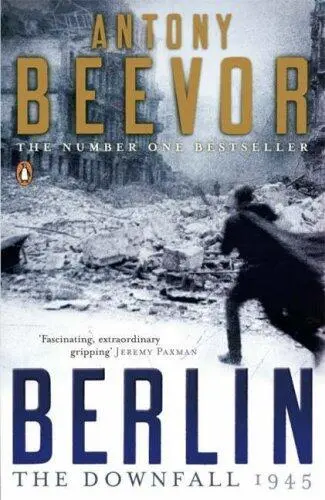
- Название:Berlin: The Downfall 1945
- Автор:
- Издательство:Penguin Books
- Жанр:
- Год:2007
- Город:New York
- ISBN:978-0-141-90302-6
- Рейтинг книги:3 / 5. Голосов: 1
-
Избранное:Добавить в избранное
- Отзывы:
-
Ваша оценка:
Berlin: The Downfall 1945: краткое содержание, описание и аннотация
Предлагаем к чтению аннотацию, описание, краткое содержание или предисловие (зависит от того, что написал сам автор книги «Berlin: The Downfall 1945»). Если вы не нашли необходимую информацию о книге — напишите в комментариях, мы постараемся отыскать её.
Antony Beevor reconstructs the experiences of those millions caught up in the nightmare of the Third Reich's final collapse, telling a terrible story of pride, stupidity, fanatacism, revenge and savagery, but also one of astonishing endurance, self-sacrifice and survival against all odds.
Berlin: The Downfall 1945 — читать онлайн бесплатно полную книгу (весь текст) целиком
Ниже представлен текст книги, разбитый по страницам. Система сохранения места последней прочитанной страницы, позволяет с удобством читать онлайн бесплатно книгу «Berlin: The Downfall 1945», без необходимости каждый раз заново искать на чём Вы остановились. Поставьте закладку, и сможете в любой момент перейти на страницу, на которой закончили чтение.
Интервал:
Закладка:
Soldiers passed the day either catching up on sleep or writing home, even though little post had been getting through since the end of February. Officers felt that this collapse of the postal system at least had one advantage. There had been a number of suicides when soldiers received disastrous news from home, whether damage from bombing or members of the family killed. Captured German soldiers told their Soviet interrogators, and it is impossible to know whether they were speaking the truth or trying to curry favour, that their own artillery fired salvoes to explode behind their trenches as a warning not to retreat.
Soldiers knew that they were going to be overwhelmed and they waited only for one thing, the order to retreat. When a platoon commander rang back to company headquarters on the field telephone and received no reply, there was nearly always panic. Most jumped to the assumption that they had been abandoned by the very commanders who had ordered them to fight to the end, but they did not want to risk the Feldgendarmerie. The best solution was to bury themselves deep in a bunker and pray that Soviet attackers would give them a chance to surrender before chucking in a grenade. But even if their surrender was accepted, there was always the risk of an immediate German counter-attack. Any soldier found to have surrendered faced summary execution.
Despite all its weaknesses in trained men and ammunition, the German Army at bay could still prove itself a dangerous opponent. On 22 March, Chuikov’s 8th Guards Army attacked at Gut Hathenow, on the treeless flood plain near the Reitwein Spur. The 920th Assault Gun Training Brigade with the 303rd Döberitz Infantry Division was alerted. They deployed rapidly on seeing T-34 tanks. Oberfeldwebel Weinheimer yelled his fire orders: ‘Range — Armour-piercing — Target — Fire!’ Gerhard Laudan reloaded as soon as the gun recoiled. The crew established a good rhythm of firing. They hit four T-34S in a matter of minutes, but then there was a blinding flash of light and they felt a huge blow as their armoured vehicle shuddered. Laudan’s head struck the steel plate. He heard their commander scream, ‘ Raus! ’ Laudan forced open the hatch to throw himself out, but was yanked back by his headset and microphone, which he had forgotten to detach. By the time he had extracted himself with only minor wounds, he found the rest of the crew outside sheltering in the lee of the vehicle. Amid the chaos of enemy tanks charging around, there seemed to be no chance of rescue or recovery. But then their driver, Soldat Klein, climbed back into the vehicle through a hatch. To their astonishment, they heard the engine restart. They scrambled back inside and the vehicle reversed slowly. They found that the enemy shell had struck the armour near the gun, but fortunately there was a gap there between the outer armour and the inner steel skin of the hull. This had saved them. ‘For once “soldier’s luck” was on our side,’ Laudan commented. They were even able to drive the vehicle back to the brigade repair base at Rehfelde, south of Strausberg.
Both on the Oder front and on the Neisse opposite the 1st Ukrainian Front, officers suffered from mixed feelings. ‘Officers have two opinions of the situation,’ Soviet interrogators reported, ‘the official version and their own views, which they share only with very close friends.’ They firmly believed that they had to defend the Fatherland and their families, yet they were well aware that the situation was hopeless. ‘One should distinguish between regiments,’ a captured senior lieutenant told a 7th Department interrogator at 21st Army headquarters. ‘The regular units are strong. The discipline and fighting spirit are good. But in the hastily thrown-together battle-groups, the situation is totally different. Discipline is terrible and as soon as Russian troops appear, the soldiers panic and run from their positions.’
‘To be an officer,’ another German lieutenant wrote to his fiancée, ‘means always having to swing back and forth like a pendulum between a Knight’s Cross, a birchwood cross and a court martial.’
11. Preparing the Coup de Grâce
On 3 April, Marshal Zhukov flew from Moscow’s central airfield back to his headquarters. Konev took off in his aeroplane almost at the same time. The race was on. The plan was to launch the offensive on 16 April and to take Berlin on 22 April, Lenin’s birthday. Zhukov was in constant touch with the Stavka, but all his communications with Moscow were controlled by the NKVD in the form of the 108th Special Communications Company attached to his headquarters.
‘The Berlin operation… planned by the genius commander-in-chief, Comrade Stalin’, as the political department of the 1st Ukrainian Front put it so diplomatically, was not a bad plan. The trouble was that the main bridgehead seized by the 1st Belorussian Front lay right under the best defensive feature in the whole region: the Seelow Heights. Zhukov admitted later that he underestimated the strength of this position.
The tasks facing the staffs of the two main Fronts involved in the operation were huge. Russian-gauge railways had been rapidly laid right across Poland and the temporary bridges over the Vistula to bring up the millions of tons of supplies required — including artillery shells and rockets, ammunition, fuel and food.
The Red Army’s principal raw material, its manpower, also needed restocking and refashioning. Casualties in the Vistula-Oder and the Pomeranian operations had not been heavy by Red Army standards, especially when considering the huge advances made. But Zhukov and Konev’s rifle divisions, averaging 4,000 men each, had never really had a chance to refill their ranks. By 5 September 1944, 1,030,494 criminals from the Gulag had been transferred to the Red Army. The term criminal also included those sentenced for failing to turn up at their place of work. Political prisoners, or zeky, accused of treason or anti-Soviet activities were deemed too dangerous for release even to shtraf companies.
Further transfers from the Gulag were made in the early spring of 1945, once again with the promise that a prisoner could expunge his crime with his blood. In fact, the need for reinforcements was deemed so great that at the end of March, just over two weeks from the offensive against Berlin, a decree of the State Defence Committee ordered a wide range of categories of prisoners to be produced from each oblast, NKVD department and from pending cases in front of procurators.
It is doubtful whether the idea of exchanging a Gulag death — ‘a dog’s death for dogs’, as it was called — for a hero’s death motivated a majority of these prisoners, even if five of them became Heroes of the Soviet Union, including one of the most famous heroes of the war, Aleksandr Matrosov, who reputedly threw himself against a German embrasure. Life in the camps had taught them to think no more than a day ahead. The only thing likely to inspire them was a complete change of routine and the chance of misbehaviour. Some of the ex-Gulag soldiers did indeed ‘redeem their guilt with their blood’, either with shtraf companies or in mine-clearing units. Those integrated with sapper companies appear, not surprisingly, to have fought much better than those sent to shtraf companies.
Liberated prisoners of war, those who had survived the appalling conditions of German camps, were treated little better. In October 1944, the State Defence Committee had decreed that, when liberated, they should be transferred to special reserve units of military districts for screening by NKVD and SMERSH. Those sent straight from reserve battalions to frontline units were often far from healthy after their ordeal. They were always treated as deeply suspect. Front commands did not hide their unease about reincorporating ‘soldiers who were Soviet citizens released from fascist slavery’. Their ‘morale’ had been considerably lowered by ‘false fascist propaganda’ during their long imprisonment. Yet the methods of political officers were hardly likely to cure them of their worst impulses. They read them orders of Comrade Stalin, showed them films of the Soviet Union and the Great Patriotic War, and encouraged them to recount ‘the terrible atrocities of the German bandits’.
Читать дальшеИнтервал:
Закладка:
Похожие книги на «Berlin: The Downfall 1945»
Представляем Вашему вниманию похожие книги на «Berlin: The Downfall 1945» списком для выбора. Мы отобрали схожую по названию и смыслу литературу в надежде предоставить читателям больше вариантов отыскать новые, интересные, ещё непрочитанные произведения.








Обсуждение, отзывы о книге «Berlin: The Downfall 1945» и просто собственные мнения читателей. Оставьте ваши комментарии, напишите, что Вы думаете о произведении, его смысле или главных героях. Укажите что конкретно понравилось, а что нет, и почему Вы так считаете.