Antony Beevor - Berlin - The Downfall 1945
Здесь есть возможность читать онлайн «Antony Beevor - Berlin - The Downfall 1945» весь текст электронной книги совершенно бесплатно (целиком полную версию без сокращений). В некоторых случаях можно слушать аудио, скачать через торрент в формате fb2 и присутствует краткое содержание. Город: New York, Год выпуска: 2007, ISBN: 2007, Издательство: Penguin Books, Жанр: nonf_military, История, на английском языке. Описание произведения, (предисловие) а так же отзывы посетителей доступны на портале библиотеки ЛибКат.
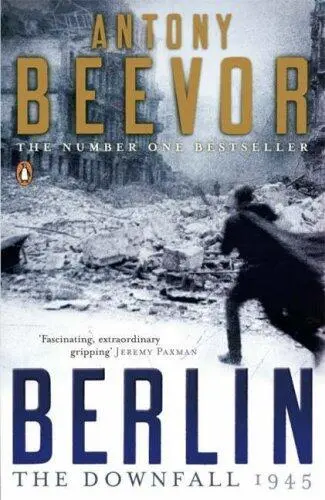
- Название:Berlin: The Downfall 1945
- Автор:
- Издательство:Penguin Books
- Жанр:
- Год:2007
- Город:New York
- ISBN:978-0-141-90302-6
- Рейтинг книги:3 / 5. Голосов: 1
-
Избранное:Добавить в избранное
- Отзывы:
-
Ваша оценка:
Berlin: The Downfall 1945: краткое содержание, описание и аннотация
Предлагаем к чтению аннотацию, описание, краткое содержание или предисловие (зависит от того, что написал сам автор книги «Berlin: The Downfall 1945»). Если вы не нашли необходимую информацию о книге — напишите в комментариях, мы постараемся отыскать её.
Antony Beevor reconstructs the experiences of those millions caught up in the nightmare of the Third Reich's final collapse, telling a terrible story of pride, stupidity, fanatacism, revenge and savagery, but also one of astonishing endurance, self-sacrifice and survival against all odds.
Berlin: The Downfall 1945 — читать онлайн бесплатно полную книгу (весь текст) целиком
Ниже представлен текст книги, разбитый по страницам. Система сохранения места последней прочитанной страницы, позволяет с удобством читать онлайн бесплатно книгу «Berlin: The Downfall 1945», без необходимости каждый раз заново искать на чём Вы остановились. Поставьте закладку, и сможете в любой момент перейти на страницу, на которой закончили чтение.
Интервал:
Закладка:
The witnesses to this dispute were deeply alarmed. Freytag von Loringhoven slipped out of the conference room and put through an urgent call to General Krebs at Zossen. He explained the situation and suggested that he must interrupt the meeting with some excuse. Krebs agreed and Freytag von Loringhoven went back into the room to tell Guderian that Krebs needed to speak to him urgently. Krebs spoke to Guderian for ten minutes, during which time the chief of staff calmed down. When he went back into Hitler’s presence, Jodl was reporting on developments in the west. Hitler insisted that everyone should leave the room except Field Marshal Keitel and General Guderian. He told Guderian that he must go away from Berlin to restore his health. ‘In six weeks the situation will be very critical. Then I shall need you urgently.’ Keitel asked him where he would go on leave. Guderian, suspicious of his motives, replied that he had made no plans.
Staff officers at Zossen and at Army Group Vistula headquarters were shocked by the day’s events. Hitler’s dismissal of Guderian threw them into a deep gloom. They were already suffering from what Colonel de Maizière described as ‘a mixture of nervous energy and trance’ and a feeling of ‘having to do your duty while at the same time seeing that this duty was completely pointless’. Hitler’s defiance of military logic reduced them to despair. The dictator’s charisma, they had finally realized, was based on a ‘ kriminelle Energie ’ and a complete disregard for good and evil. His severe personality disorder, even if it could not quite be defined as mental illness, had certainly made him deranged. Hitler had so utterly identified himself with the German people that he believed that anybody who opposed him was opposing the German people as a whole; and that if he were to die, the German people could not survive without him.
General Hans Krebs, Guderian’s deputy, was appointed the new chief of staff. ‘This short, bespectacled, somewhat bandy-legged man,’ wrote one staff officer, ‘had a perpetual smile and the air of a faun about him.’ He had a sharp, often sarcastic, wit and always had the right joke or anecdote for any moment. Krebs, a staff officer and not a field commander, was the archetypal second-in-command, which was exactly what Hitler wanted. Krebs had been military attaché in Moscow in 1941 shortly before the German invasion of the Soviet Union. And for an officer of the Wehrmacht, he enjoyed the unusual distinction of having been slapped on the back by Stalin. ‘We must always remain friends, whatever should happen,’ the Soviet leader had then said to him, when saying farewell to the Japanese foreign minister on a Moscow railway platform early in 1941. ‘I’m convinced of it,’ Krebs had replied, quickly recovering from his astonishment. Field commanders, however, had little respect for Krebs’s opportunism. He was known as ‘the man who can make white out of black’.
On Guderian’s departure, Freytag von Loringhoven asked to be sent to a frontline division, but Krebs insisted that he stayed on with him. ‘The war’s over anyway,’ he said. ‘I want you to help me in this last phase.’ Freytag von Loringhoven felt obliged to agree. He thought that Krebs was ‘no Nazi’ and that he had refused to join the July plotters only because he was convinced that the attempt would fail. But others noticed how General Burgdorf, an old war academy classmate, persuaded Krebs to join the Bormann-Fegelein circle. Presumably in Bormann’s scheme, a loyal Krebs would ensure the army’s obedience. The bull-necked and rubber-faced Bormann appeared to be collecting supporters for the fast-approaching day when he hoped to slip into his master’s shoes. He appears to have earmarked Fegelein, his favourite companion in the privacy of the sauna, where they almost certainly bragged to each other about their numerous affaires, as the future Reichsführer SS.
Staff officers from Zossen and Army Group Vistula observed the court of the Third Reich with a horrified fascination. They also watched Hitler’s treatment of his entourage in case it signified a change in favour and therefore in the power struggle. Hitler addressed the discredited Göring as ‘Herr Reichsmarschall’ in an attempt to prop up what little dignity he had left. Although he remained on familiar ‘ du ’ terms with Himmler, the Reichsführer SS had lost power since his moment of glory after the July plot. At that time, Himmler, as commander of the Waffen SS and the Gestapo, had appeared to be the only counterweight to the army.
Goebbels, although his propaganda talents were essential to the Nazi cause in its eclipse, had still not been accepted back to the same degree of intimacy he had enjoyed before his love affair with a Czech actress. Hitler, appalled that a leading member of the Nazi Party should consider divorce, had sided with Magda Goebbels. The Reichsminister for Propaganda was forced to uphold the family values of the regime.
Grand Admiral Dönitz was favoured because of his complete loyalty and because Hitler saw his new generation of U-boats as the most promising weapon of revenge. In German navy circles, Dönitz was known as ‘Hitlerjunge Quex’ — the devoted Nazi youth in a famous propaganda movie — because he was the ‘mouthpiece of his Führer’. But Bormann appeared to be the best-placed member of the ‘ Kamarilla’. Hitler called his indispensable assistant and chief administrator ‘dear Martin’.
The officers also watched the deadly competition among the heirs apparent within the ‘ Kamarilla’. Himmler and Bormann addressed each other as ‘ du ’ but ‘mutual respect was thin on the ground’. They also observed Fegelein, ‘with his dirty finger sticking into everything’, do his utmost to undermine Himmler, a man whose friendship he had sought and achieved. Himmler appears to have been oblivious of the treachery. He generously permitted his subordinate, no doubt as the Führer’s brother-in-law presumptive, to address him as ‘ du ’.
Eva Braun had already returned to Berlin to stay by her adored Führer’s side right to the end. The popular notion that her return from Bavaria was much later and totally unexpected is undermined by Bormann’s diary entry of Wednesday 7 March: ‘In the evening Eva Braun left for Berlin with a courier train.’ If Bormann had known of her movements in advance then so, presumably, had Hitler.
On 13 March, a day in which 2,500 Berliners died in air raids and another 120,000 found themselves homeless, Bormann ordered ‘on the grounds of security’ that prisoners must be moved from areas close to the front to the interior of the Reich. It is not entirely clear whether this instruction also accelerated the existing SS programme for evacuating concentration camps threatened by advancing troops. The killing of sick prisoners and the death marches of concentration camp survivors were probably the most ghastly developments in the fall of the Third Reich. Those too weak to march and those regarded as politically dangerous were usually hanged or shot by the SS or Gestapo. On some occasions, even the local Volkssturm was used for execution squads. Yet men and women condemned for listening to a foreign radio station apparently constituted the largest group among those defined as ‘dangerous’. The Gestapo and SS also reacted brutally to reports of looting, especially when it involved foreign workers. German citizens were usually spared. In this frenzy of reprisal and revenge, Italian forced labourers suffered more than almost any other national group. They suffered presumably because of a Nazi desire to take revenge on a former ally who had changed sides.
Soon after issuing his order for the evacuation of prisoners, Bormann flew to Salzburg on 15 March. Over the next three days he visited mines in the area. The purpose of this must have been to choose sites for concealing Nazi loot and Hitler’s private possessions. He was back in Berlin on 19 March, after an overnight train journey. Later that day, Hitler issued what became known as the ‘Nero’ or ‘scorched-earth’ order. Everything which might be of use to the enemy should be destroyed on withdrawal. The timing, just after Bormann’s journey to conceal Nazi loot, was an ironic coincidence.
Читать дальшеИнтервал:
Закладка:
Похожие книги на «Berlin: The Downfall 1945»
Представляем Вашему вниманию похожие книги на «Berlin: The Downfall 1945» списком для выбора. Мы отобрали схожую по названию и смыслу литературу в надежде предоставить читателям больше вариантов отыскать новые, интересные, ещё непрочитанные произведения.









Обсуждение, отзывы о книге «Berlin: The Downfall 1945» и просто собственные мнения читателей. Оставьте ваши комментарии, напишите, что Вы думаете о произведении, его смысле или главных героях. Укажите что конкретно понравилось, а что нет, и почему Вы так считаете.