Antony Beevor - Berlin - The Downfall 1945
Здесь есть возможность читать онлайн «Antony Beevor - Berlin - The Downfall 1945» весь текст электронной книги совершенно бесплатно (целиком полную версию без сокращений). В некоторых случаях можно слушать аудио, скачать через торрент в формате fb2 и присутствует краткое содержание. Город: New York, Год выпуска: 2007, ISBN: 2007, Издательство: Penguin Books, Жанр: nonf_military, История, на английском языке. Описание произведения, (предисловие) а так же отзывы посетителей доступны на портале библиотеки ЛибКат.
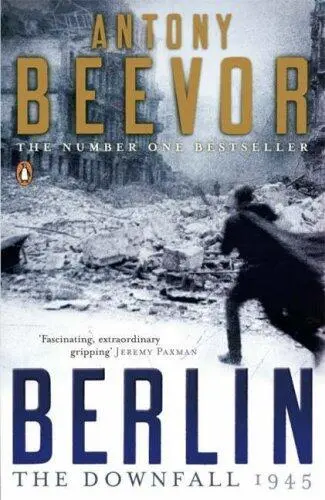
- Название:Berlin: The Downfall 1945
- Автор:
- Издательство:Penguin Books
- Жанр:
- Год:2007
- Город:New York
- ISBN:978-0-141-90302-6
- Рейтинг книги:3 / 5. Голосов: 1
-
Избранное:Добавить в избранное
- Отзывы:
-
Ваша оценка:
Berlin: The Downfall 1945: краткое содержание, описание и аннотация
Предлагаем к чтению аннотацию, описание, краткое содержание или предисловие (зависит от того, что написал сам автор книги «Berlin: The Downfall 1945»). Если вы не нашли необходимую информацию о книге — напишите в комментариях, мы постараемся отыскать её.
Antony Beevor reconstructs the experiences of those millions caught up in the nightmare of the Third Reich's final collapse, telling a terrible story of pride, stupidity, fanatacism, revenge and savagery, but also one of astonishing endurance, self-sacrifice and survival against all odds.
Berlin: The Downfall 1945 — читать онлайн бесплатно полную книгу (весь текст) целиком
Ниже представлен текст книги, разбитый по страницам. Система сохранения места последней прочитанной страницы, позволяет с удобством читать онлайн бесплатно книгу «Berlin: The Downfall 1945», без необходимости каждый раз заново искать на чём Вы остановились. Поставьте закладку, и сможете в любой момент перейти на страницу, на которой закончили чтение.
Интервал:
Закладка:
A senior Kriegsmarine officer told Juhlin-Dannfel about a recent conference where senior military officers discussed the possibility of a last-ditch attack on the Eastern Front to force the Red Army back to the frontier of 1939. ‘If the attempt were successful,’ the naval officer said, ‘then this would provide the right opportunity to open negotiations. In order to do this, Hitler must be removed. Himmler would take over and be the guarantor of maintaining order.’ This idea revealed not just a stupendous lack of imagination. It also shows that Wehrmacht officers in Berlin seemed to have no understanding of the state of affairs at the front. The Vistula—Oder operation had smashed the German Army’s capacity to launch another sustained offensive. The only question which remained was the number of days it would take the Red Army to reach Berlin from the front along the Oder, the line which — they now heard to their horror — might become the future frontier of Poland.
The events which brought the conflict between Hitler and Guderian to a head were linked to the rather grim fortress town of Küstrin, which stood between the two main Soviet bridgeheads across the Oder. Küstrin was known as the gateway to Berlin. It was situated on the confluence of the rivers Oder and Warthe, eighty kilometres east of Berlin and astride Reichsstrasse 1, the main road from the capital to Königsberg.
Küstrin was the focal point of operations for both sides. Zhukov wanted to merge the two bridgeheads — Berzarin’s 5th Shock Army had the northern one and Chuikov’s 8th Guards Army the southern one — to prepare a large forming-up area for the forthcoming Berlin offensive. Hitler, meanwhile, had insisted on a counter-attack with five divisions from Frankfurt an der Oder, to encircle Chuikov’s army from the south.
Guderian had tried to put a stop to Hitler’s plan, knowing that they had neither the air and artillery support nor the tanks necessary for such an enterprise. The débâcle which happened on 22 March, the day Heinrici had been lectured by Himmler at the headquarters of Army Group Vistula, had taken place as divisions were redeployed for the offensive. The 25th Panzergrenadier Division withdrew from the Küstrin corridor before its replacement was ready. Berzarin’s 5th Shock Army and Chuikov’s 8th Guards Army advanced inwards on previous orders from Marshal Zhukov and managed to cut off Küstrin.
Guderian, however, still hoped that peace negotiations would save the Wehrmacht from total destruction. On 21 March, the day before the loss of the Küstrin corridor, he had approached Himmler in the Reich Chancellery garden, where he had been ‘taking a stroll with Hitler among the rubble’. Hitler left the two men to talk. Guderian said straight out that the war could no longer be won. ‘The only problem now is how most quickly to put an end to the senseless slaughter and bombing. Apart from Ribbentrop, you are the only man who still possesses contacts in neutral countries. Since the foreign minister has proved reluctant to propose to Hitler that negotiations be begun, I must ask you to make use of your contacts and go with me to Hitler and urge him to arrange an armistice.’
‘My dear Colonel General,’ Himmler replied. ‘It is still too early for that.’ Guderian persisted, but either Himmler was still afraid of Hitler, as Guderian thought, or he was playing his cards carefully. One of his confidants in the SS, Gruppenführer von Alvensleben, sounded out Colonel Eismann at Army Group Vistula, and told him in the strictest confidence that Himmler wanted to approach the Western Allies through Count Folke Bernadotte of the Swedish Red Cross. Eismann replied that first of all he thought it too late for any western leader to consider terms, and secondly Himmler struck him as ‘the most unsuitable man in the whole of Germany for such negotiations’.
During the evening of 21 March, just after Guderian’s approach to Himmler, Hitler told the army chief of staff that he should take sick leave, because of his heart trouble. Guderian replied that with General Wenck still recovering from his car crash, and General Krebs wounded in the heavy bombing raid on Zossen six days before, he could not abandon his post. Guderian states that while they were talking, an aide came in to tell Hitler that Speer wanted to see him. (He must have confused the date or the occasion, because Speer was not in Berlin at this time.) Hitler exploded and refused. ‘Always when any man asks to see me alone,’ he apparently complained to Guderian, ‘it is because he has something unpleasant to say to me. I cannot stand any more of these Job’s comforters. His memoranda begin with the words, “The war is lost!” And that’s what he wants to tell me now. I always just lock his memoranda away in the safe, unread.’ According to his aide, Nicolaus von Below, this was not true. Hitler did read them. But as Hitler’s reaction to the loss of the bridge at Remagen had shown, he had only one reaction to disaster. It was to blame others. On that day, 8 March, Jodl had come in person to the conference to tell Hitler of the failure to blow the bridge. ‘Hitler was very quiet then,’ said a staff officer who had been present, ‘but the next day he was raging.’ He ordered the summary execution of five officers, a decision which horrified the Wehrmacht.
Even the Waffen SS soon found that it was not exempt from the Führer’s rages. Hitler heard from either Bormann or Fegelein, both eager to undermine Himmler, that Waffen SS divisions in Hungary had been retreating without orders. As a humiliating punishment, Hitler decided to strip them, including his personal guard, the Leibstandarte Adolf Hitler, of their prized armband divisional titles. Himmler was forced to implement the order himself. ‘This mission of his to Hungary,’ Guderian noted with little regret, ‘did not win him much affection from his Waffen SS.’
The attack to relieve Küstrin, which Hitler still refused to give up, took place on 27 March. General Busse, the commander of the Ninth Army, was its reluctant orchestrator. The operation was a costly failure, even though it initially took the 8th Guards Army by surprise. German panzer and infantry troops in the open were massacred by Soviet artillery and aviation.
The next day, during the ninety-minute drive from Zossen into Berlin for the situation conference, Guderian made his intentions clear to his aide, Major Freytag von Loringhoven. ‘Today I am really going to give it to him straight,’ he said in the back of the huge Mercedes staff car.
The atmosphere in the Reich Chancellery bunker was tense even before General Burgdorf announced Hitler’s arrival with his usual call — ‘ Meine Herren, der Führer kommt! ’ This was the signal for everyone to come to attention and give the Nazi salute. Keitel and Jodl were there, and so was General Busse, whom Hitler had had summoned along with Guderian to explain the Küstrin fiasco.
While Jodl displayed his usual ‘ice-cold lack of emotion’, Guderian was clearly in a truculent frame of mind. Hitler’s mood was evidently not improved by having just heard that General Patton’s tanks had reached the outskirts of Frankfurt am Main. General Busse was told to present his report. As Busse spoke, Hitler demonstrated a mounting impatience. He suddenly demanded why the attack had failed. And before Busse or anyone else had the chance to reply, he began another tirade against the incompetence of the officer corps and the general staff. In this case he blamed Busse for not using his artillery.
Guderian stepped in to tell Hitler that General Busse had used all the artillery shells available to him. ‘Then you should have arranged for him to have more!’ Hitler screamed back at him. Freytag von Loringhoven observed Guderian’s face turn red with rage as he defended Busse. The chief of staff turned the subject to Hitler’s refusal to withdraw the divisions from Courland for the defence of Berlin. The row escalated rapidly to a terrifying intensity. ‘Hitler became paler and paler,’ noted Freytag von Loringhoven, ‘while Guderian became redder and redder.’
Читать дальшеИнтервал:
Закладка:
Похожие книги на «Berlin: The Downfall 1945»
Представляем Вашему вниманию похожие книги на «Berlin: The Downfall 1945» списком для выбора. Мы отобрали схожую по названию и смыслу литературу в надежде предоставить читателям больше вариантов отыскать новые, интересные, ещё непрочитанные произведения.









Обсуждение, отзывы о книге «Berlin: The Downfall 1945» и просто собственные мнения читателей. Оставьте ваши комментарии, напишите, что Вы думаете о произведении, его смысле или главных героях. Укажите что конкретно понравилось, а что нет, и почему Вы так считаете.