Antony Beevor - Berlin - The Downfall 1945
Здесь есть возможность читать онлайн «Antony Beevor - Berlin - The Downfall 1945» весь текст электронной книги совершенно бесплатно (целиком полную версию без сокращений). В некоторых случаях можно слушать аудио, скачать через торрент в формате fb2 и присутствует краткое содержание. Город: New York, Год выпуска: 2007, ISBN: 2007, Издательство: Penguin Books, Жанр: nonf_military, История, на английском языке. Описание произведения, (предисловие) а так же отзывы посетителей доступны на портале библиотеки ЛибКат.
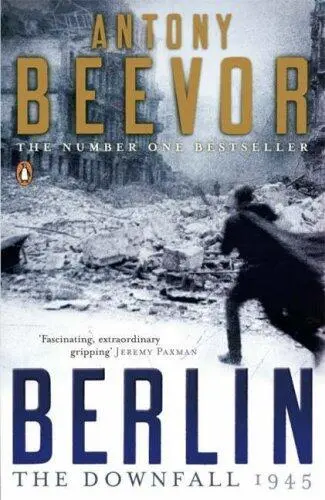
- Название:Berlin: The Downfall 1945
- Автор:
- Издательство:Penguin Books
- Жанр:
- Год:2007
- Город:New York
- ISBN:978-0-141-90302-6
- Рейтинг книги:3 / 5. Голосов: 1
-
Избранное:Добавить в избранное
- Отзывы:
-
Ваша оценка:
Berlin: The Downfall 1945: краткое содержание, описание и аннотация
Предлагаем к чтению аннотацию, описание, краткое содержание или предисловие (зависит от того, что написал сам автор книги «Berlin: The Downfall 1945»). Если вы не нашли необходимую информацию о книге — напишите в комментариях, мы постараемся отыскать её.
Antony Beevor reconstructs the experiences of those millions caught up in the nightmare of the Third Reich's final collapse, telling a terrible story of pride, stupidity, fanatacism, revenge and savagery, but also one of astonishing endurance, self-sacrifice and survival against all odds.
Berlin: The Downfall 1945 — читать онлайн бесплатно полную книгу (весь текст) целиком
Ниже представлен текст книги, разбитый по страницам. Система сохранения места последней прочитанной страницы, позволяет с удобством читать онлайн бесплатно книгу «Berlin: The Downfall 1945», без необходимости каждый раз заново искать на чём Вы остановились. Поставьте закладку, и сможете в любой момент перейти на страницу, на которой закончили чтение.
Интервал:
Закладка:
Göring’s vanity was as ludicrous as his irresponsibility. According to one staff officer at Army Group Vistula, his twinkling eyes and the fur trimming on his specially designed uniform gave him more the appearance of ‘a cheerful market woman’ than a Marshal of the Reich. Göring, wearing all his medals and thick gold-braid epaulettes, insisted on going on tours of inspection, and then spent his time sending messages to army commanders complaining that he had not been saluted properly by their men.
During one planning session at Hassleben, he described his two parachute divisions on the Oder front as ‘ Übermenschen’. ‘You must attack with both my paratroop divisions,’ he declared, ‘then you can send the whole Russian army to the devil.’ Göring failed to acknowledge that even many of the officers were not paratroopers at all, but Luftwaffe personnel transferred to ground combat duties of which they had no experience. His cherished 9th Parachute Division would be the first to crack when the attack came.
Göring and Dönitz intended to raise at least 30,000 men from Luftwaffe and Kriegsmarine base units to throw them into the battle. The fact that they had received virtually no training did not seem to concern them. A marine division was formed, with an admiral as divisional commander and only one army officer on the staff to advise them on tactics and staff procedures. Not to be outdone in the competitive bidding between the armed forces, the SS had formed more police battalions and a motorized brigade of Waffen SS headquarters staff. It was designated ‘Thousand and One Nights’. SS codenames became curiously exotic as the end of the Third Reich approached: the brigade’s tank-hunting detachment was codenamed Suleika and the reconnaissance battalion Harem.
On 2 April, one of Himmler’s staff officers proposed from the special train of the Reichsführer SS that another 4,000 ‘front helpers’ could be added to the figure of 25,000 men marked to come from the Reichspost. The Nazi leadership was trying to meet the target of ‘ Der 800,000 Mann-Plan’. Army Group Vistula headquarters argued that if there were no weapons to give all these untrained men, then they would be worse than useless. Yet the Nazi authorities were quite prepared to distribute a few panzerfausts among them and give them a grenade each to take a few of the enemy with them. ‘It was quite simply,’ wrote Colonel Eismann, ‘an order of organized mass murder, nothing less.’
The Nazi Party itself tried to keep alive the idea of the Freikorps Adolf Hitler. Bormann was still discussing it on Wednesday 28 March ‘with Dr Kaltenbrunner’. Members of the SS were conspicuously punctilious about their academic qualifications. They were also keen to display their historical knowledge at a time when Dr Goebbels was dragging up every example of reversals of military fortune for his propaganda barrage. Frederick the Great and Blücher had been overused, so Kaltenbrunner recommended to the propaganda ministry the defeat of King Darius of Persia.
Army Group Vistula’s two armies received largely unrealizable promises from the Nazi leadership. General Hasso von Manteuffel’s so-called Third Panzer Army, on the Oder front north of the Ninth Army, had little more than a single panzer division. The bulk of his divisions were also composed of composite battalions and trainees. General Busse’s Ninth Army was a similar hotch-potch. It even included an assault gun company wearing U-boat uniforms.
That sector of the Oderbruch front was almost entirely manned by training units sent forward with a small ration of bread, dry sausage and tobacco. Some soldiers were so young that they were given sweets instead of tobacco. Field kitchens were set up in the villages just behind the lines and the trainees were marched forward to start digging their trenches. A comrade, one of them wrote, was ‘a companion in suffering’. They were not a unit in any usual military sense of the word. Nobody, not even their officers, knew what their duties were or what they were supposed to do. They just dug in and waited. Jokes reflected their mood. One of the current ones, a captured soldier told his Soviet interrogator, was, ‘Life is like a child’s shirt — short and shitty.’
German soldiers with enough experience of war to know that any fool could be uncomfortable took great pride in creating a ‘ gemütlich ’ ‘earth bunker’, usually about two metres by three metres, with small tree trunks holding up the metre of earth cover above. ‘My main dugout was really cosy,’ wrote one soldier. ‘I turned it into a little room with a wooden table and bench.’ Mattresses and eiderdowns looted from nearby houses provided the final home comforts.
Since firelight or smoke attracted the attention of snipers, soldiers soon gave up shaving and washing. Rations started to get worse towards the end of March. On most days, each soldier received half a Kommissbrot, a rock-hard army loaf, and some stew or soup which reached the front at night, cold and congealed, from a field kitchen well to the rear. If the soldiers were lucky, they received a quarter-litre bottle of schnapps each and, very occasionally, ‘ Frontkämpferpäckchen ’ — small packs for frontline combatants containing cake, sweets and chocolate. The main problem, however, was the lack of clean drinking water. As a result many soldiers suffered from dysentery and their trenches became squalid.
The faces of the young trainees were soon gaunt from tiredness and strain. Attacks by Shturmovik fighter-bombers in clear weather, the ‘midday concert’ of artillery and mortar fire, and random shelling at night took their toll. From time to time, the Soviet artillery ranged in on any buildings, in case they contained a command post, and then fired phosphorous shells. But for the young and inexperienced, the most frightening experience was a four-hour stint on sentry duty at night. Everyone feared a Soviet raiding party coming to grab them as ‘a tongue’.
Nobody moved by day. A Soviet sniper shot Pohlmeyer, one of Gerhard Tillery’s comrades in the ‘Potsdam’ Regiment of officer cadets, straight through the head as he climbed out of his slit trench. Otterstedt, who tried to help him, was also picked off. They never spotted the muzzle flash, so they had no idea where the shot had come from. The Germans on that sector, however, had their own sniper. He was ‘a really crazy type’ who dressed up when off-duty in an undertaker’s black top hat and tailcoat, to which he pinned his German Cross in Gold, a vulgar decoration known as ‘the fried egg’. His eccentricities were presumably tolerated because of his 130 victories. This sniper used to take up position just behind the front line in a barn. Observers with binoculars in the trenches would then relay targets to him. One day when little was happening, the observer told him of a dog running around the Russian positions. The dog was killed with a single shot.
Ammunition was in such short supply that exact figures had to be reported every morning. Experienced company commanders were over-reporting expenditure to build up their own reserves for the big attack, which they knew must come soon. German formation commanders became increasingly uneasy during that last part of March. They felt that the Soviets were playing with them ‘like a cat with a mouse’, deliberately achieving two goals at once. The battle for the bridgeheads on the west side of the Oder was not only preparing the Red Army’s springboard for Berlin, it was also grinding down the Ninth Army and forcing it to use up its dwindling supplies of ammunition before the big attack. German artillery guns, restricted to less than a couple of shells per gun per day, could not indulge in counter-battery fire, so the Soviet gunners were able to range at will on specified targets, ready for their opening bombardment. The major offensive against the Seelow Heights towards Berlin was only a matter of time.
Читать дальшеИнтервал:
Закладка:
Похожие книги на «Berlin: The Downfall 1945»
Представляем Вашему вниманию похожие книги на «Berlin: The Downfall 1945» списком для выбора. Мы отобрали схожую по названию и смыслу литературу в надежде предоставить читателям больше вариантов отыскать новые, интересные, ещё непрочитанные произведения.







Обсуждение, отзывы о книге «Berlin: The Downfall 1945» и просто собственные мнения читателей. Оставьте ваши комментарии, напишите, что Вы думаете о произведении, его смысле или главных героях. Укажите что конкретно понравилось, а что нет, и почему Вы так считаете.