Antony Beevor - Berlin - The Downfall 1945
Здесь есть возможность читать онлайн «Antony Beevor - Berlin - The Downfall 1945» весь текст электронной книги совершенно бесплатно (целиком полную версию без сокращений). В некоторых случаях можно слушать аудио, скачать через торрент в формате fb2 и присутствует краткое содержание. Город: New York, Год выпуска: 2007, ISBN: 2007, Издательство: Penguin Books, Жанр: nonf_military, История, на английском языке. Описание произведения, (предисловие) а так же отзывы посетителей доступны на портале библиотеки ЛибКат.
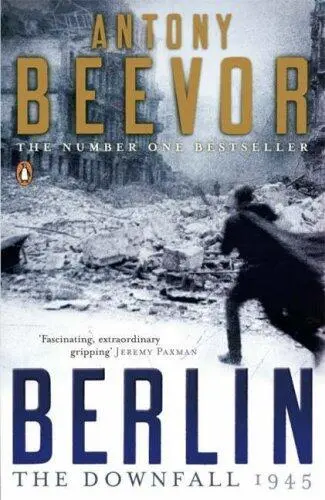
- Название:Berlin: The Downfall 1945
- Автор:
- Издательство:Penguin Books
- Жанр:
- Год:2007
- Город:New York
- ISBN:978-0-141-90302-6
- Рейтинг книги:3 / 5. Голосов: 1
-
Избранное:Добавить в избранное
- Отзывы:
-
Ваша оценка:
Berlin: The Downfall 1945: краткое содержание, описание и аннотация
Предлагаем к чтению аннотацию, описание, краткое содержание или предисловие (зависит от того, что написал сам автор книги «Berlin: The Downfall 1945»). Если вы не нашли необходимую информацию о книге — напишите в комментариях, мы постараемся отыскать её.
Antony Beevor reconstructs the experiences of those millions caught up in the nightmare of the Third Reich's final collapse, telling a terrible story of pride, stupidity, fanatacism, revenge and savagery, but also one of astonishing endurance, self-sacrifice and survival against all odds.
Berlin: The Downfall 1945 — читать онлайн бесплатно полную книгу (весь текст) целиком
Ниже представлен текст книги, разбитый по страницам. Система сохранения места последней прочитанной страницы, позволяет с удобством читать онлайн бесплатно книгу «Berlin: The Downfall 1945», без необходимости каждый раз заново искать на чём Вы остановились. Поставьте закладку, и сможете в любой момент перейти на страницу, на которой закончили чтение.
Интервал:
Закладка:
It was Albert Speer’s latest memorandum which had suddenly triggered Hitler’s insistence on a scorched-earth policy to the end. When Speer tried to persuade Hitler in the early hours of that morning that bridges should not be blown up unnecessarily, because their destruction meant ‘eliminating all further possibility for the German people to survive’, Hitler’s reply revealed his contempt for them all. ‘This time you will receive a written reply to your memorandum,’ Hitler told him. ‘If the war is lost, the people will also be lost [and] it is not necessary to worry about their needs for elemental survival. On the contrary, it is best for us to destroy even these things. For the nation has proved to be weak, and the future belongs entirely to the strong people of the East. Whatever remains after this battle is in any case only the inadequates, because the good ones will be dead.’
Speer, who had travelled straight to Field Marshal Model’s headquarters in the Ruhr to persuade him not to wreck the railway system, received Hitler’s written reply on the morning of 20 March. ‘All military, transport, communication and supply facilities, as well as all material assets in the territory of the Reich’ were to be destroyed. Reichsminister Speer was relieved of all his responsibilities in this field and his orders for the preservation of factories were to be rescinded immediately. Speer had cleverly used an anti-defeatist argument, saying that factories and other structures should not be destroyed since they were bound to be recaptured in a counter-attack, but now Hitler had rumbled his tactic. One of the most striking aspects of this exchange was that Speer finally realized that Hitler was a ‘criminal’ only after receiving his patron’s reply.
Speer, who had been touring the front from Field Marshal Model’s headquarters, returned to Berlin on 26 March. He was summoned to the Reich Chancellery.
‘I have reports that you are no longer in harmony with me,’ Hitler said to his former protégé. ‘It is apparent that you no longer believe that the war can be won.’ He wanted to send Speer on leave. Speer suggested resignation instead, but Hitler refused.
Speer, although officially deposed, still managed to thwart those Gauleiters who wished to carry out Hitler’s order, because he retained control over the supply of explosives. But on 27 March, Hitler issued yet another order, insisting on the ‘total annihilation by explosives, fire or dismantlement’ of the whole railway and other transport systems and all communications, including telephones, telegraph and broadcasting. Speer, who returned to Berlin in the early hours of 29 March, contacted various sympathetic generals, including the recently deposed Guderian, as well as the less fanatical Gauleiters, to see if they supported his plan to continue thwarting Hitler’s mania for destruction. Guderian, with ‘funereal laughter’, warned him not to ‘lose his head’.
That evening Hitler began by warning Speer that his conduct was treasonous. He asked Speer again whether he still believed that the war could be won. Speer said that he did not. Hitler claimed that it was ‘impossible to deny the hope of final victory’. He talked about the disappointments of his own career, a favourite refrain which also confused his own fate with that of Germany. He demanded and advised Speer ‘to repent and have faith’. Speer was given twenty-four hours to see whether he could bring himself to believe in victory. Hitler, clearly nervous of losing his most competent minister, did not wait for the ultimatum to expire. He rang him in his office at the armaments ministry on the Pariserplatz. Speer returned to the Reich Chancellery bunker.
‘Well?’ Hitler demanded.
‘My Führer, I stand unconditionally behind you,’ Speer replied, suddenly deciding to lie. Hitler became emotional. His eyes filled with tears and he shook Speer’s hand warmly. ‘But then it will help,’ Speer continued, ‘if you will immediately reconfirm my authority for the implementation of your 19 March decree.’ Hitler agreed at once, and told him to draw up an authorization which he would sign. In the document, Speer reserved almost all demolition decisions for the minister of armaments and war production, that is to say for himself. Hitler must have sensed that he was being deceived, and yet his greatest need appears to have been to have his favourite minister back at his side.
Bormann, meanwhile, was issuing orders through the Gauleiters on a wide range of issues. It came to his attention, for example, that doctors were already carrying out abortions on many rape victims who arrived as refugees from the eastern provinces. On 28 March, he decided that the situation had to be regularized and issued an instruction classified ‘Highly confidential!’ Any woman requesting an abortion in these circumstances first had to be interrogated by an officer of the Kriminalpolizei to establish the probability that she had really been raped by a Red Army soldier as she claimed. Only then would an abortion be permitted.
Speer, in his attempts to prevent needless destruction, was a frequent visitor to Army Group Vistula headquarters at Hassleben. He found that General Heinrici entirely agreed with his aims. Speer claimed when interrogated by the Americans after the defeat that he had suggested to Heinrici’s chief of staff, General Kinzel, the possibility of withdrawing Army Group Vistula to the west of Berlin to save the city from more destruction.
Heinrici had now been given responsibility for the defence of Berlin, so he and Speer worked together on the best way to save as many bridges as possible from demolition. This was doubly important because water mains and sewage pipes were an integral part of their construction. The fifty-eight-year-old Heinrici, according to one of his many admirers on the general staff, was ‘in our eyes the perfect example of a traditional Prussian officer’. He had recently been awarded the Knight’s Cross with Swords and Oak-Leaves. This ‘grizzled soldier’ was a scruffy dresser who preferred a frontline sheepskin jacket and First World War leather leggings to the smart general staff uniform. His aide tried in vain to persuade him to order a new tunic at least.
General Helmuth Reymann, a not very imaginative officer who had been designated the commander of Berlin’s defence, was planning to demolish all the city’s bridges. So Speer, with Heinrici’s support, played his defeatist card again and asked Reymann whether he believed in victory. Reymann could not, of course, say no. Speer then persuaded him to accept Heinrici’s compromise formula: to restrict his demolition plans to the outermost bridges on the Red Army’s line of advance and leave the bridges in the centre of the capital intact. After the meeting with Reymann, Heinrici told Speer that he had no intention of fighting a prolonged battle for Berlin. He just hoped that the Red Army would get there quickly and take Hitler and the Nazi leadership unawares.
The headquarters staff at Hassleben were interrupted by a constant stream of less welcome visitors. Gauleiter Greiser, who had claimed urgent duties in Berlin when abandoning the besieged population of Poznan to their fate, had turned up at Army Group Vistula headquarters and hung around listlessly. He said he wanted to work as an aide on the staff. Gauleiter Hildebrandt of Mecklenburg and Gauleiter Stürz of Brandenburg also turned up, demanding briefings on the situation. There was just one question which they really wanted to ask — ‘ Wann kommt der Russe? ’ — but they did not quite dare, because it was defeatist.
Göring was also a frequent visitor to Army Group Vistula headquarters from his ostentatious mansion at Karinhall. He made much of the Sonderstaffel — the special planning group led by the famous Stuka ace Lieutenant Colonel Baumbach to target the Soviet bridges and crossing points to their Oder bridgeheads, dropping newly developed radio-controlled bombs. The Kriegsmarine also organized ‘ Sprengboote ’, an explosive version of Elizabethan fireships, floating downriver. Attacks from neither the air nor the river achieved any lasting damage. Repairs were made with great sacrifice by Soviet engineers working in freezing water. Many of them lost their lives to the cold or the current. Colonel Baumbach admitted to army staff officers that it was pointless to continue. It would be better to distribute the aircraft fuel used to armoured units. Baumbach, who, according to Colonel Eismann, had none of the ‘ Primadonna-Allüren ’ of many fighter aces, was a realist, unlike the Reichsmarschall.
Читать дальшеИнтервал:
Закладка:
Похожие книги на «Berlin: The Downfall 1945»
Представляем Вашему вниманию похожие книги на «Berlin: The Downfall 1945» списком для выбора. Мы отобрали схожую по названию и смыслу литературу в надежде предоставить читателям больше вариантов отыскать новые, интересные, ещё непрочитанные произведения.








Обсуждение, отзывы о книге «Berlin: The Downfall 1945» и просто собственные мнения читателей. Оставьте ваши комментарии, напишите, что Вы думаете о произведении, его смысле или главных героях. Укажите что конкретно понравилось, а что нет, и почему Вы так считаете.