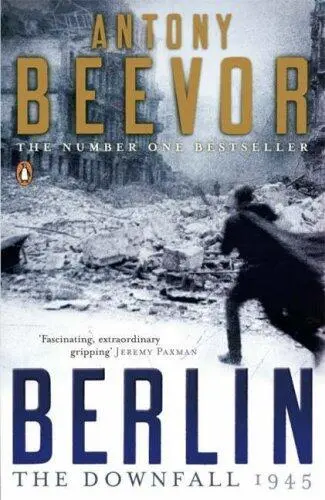
Antony Beevor - Berlin - The Downfall 1945
Здесь есть возможность читать онлайн «Antony Beevor - Berlin - The Downfall 1945» весь текст электронной книги совершенно бесплатно (целиком полную версию без сокращений). В некоторых случаях можно слушать аудио, скачать через торрент в формате fb2 и присутствует краткое содержание. Город: New York, Год выпуска: 2007, ISBN: 2007, Издательство: Penguin Books, Жанр: nonf_military, История, на английском языке. Описание произведения, (предисловие) а так же отзывы посетителей доступны на портале библиотеки ЛибКат.
- Название:Berlin: The Downfall 1945
- Автор:
- Издательство:Penguin Books
- Жанр:
- Год:2007
- Город:New York
- ISBN:978-0-141-90302-6
- Рейтинг книги:3 / 5. Голосов: 1
-
Избранное:Добавить в избранное
- Отзывы:
-
Ваша оценка:
Berlin: The Downfall 1945: краткое содержание, описание и аннотация
Предлагаем к чтению аннотацию, описание, краткое содержание или предисловие (зависит от того, что написал сам автор книги «Berlin: The Downfall 1945»). Если вы не нашли необходимую информацию о книге — напишите в комментариях, мы постараемся отыскать её.
Antony Beevor reconstructs the experiences of those millions caught up in the nightmare of the Third Reich's final collapse, telling a terrible story of pride, stupidity, fanatacism, revenge and savagery, but also one of astonishing endurance, self-sacrifice and survival against all odds.
Berlin: The Downfall 1945 — читать онлайн бесплатно полную книгу (весь текст) целиком
Ниже представлен текст книги, разбитый по страницам. Система сохранения места последней прочитанной страницы, позволяет с удобством читать онлайн бесплатно книгу «Berlin: The Downfall 1945», без необходимости каждый раз заново искать на чём Вы остановились. Поставьте закладку, и сможете в любой момент перейти на страницу, на которой закончили чтение.
Интервал:
Закладка:
‘Well, what have you got to say?’ said Stalin. Not waiting for a reply, he said, ‘I think Roosevelt won’t violate the Yalta agreement, but as for Churchill… that one’s capable of anything.’
At 8 p.m. on 31 March, the United States ambassador, Averell Harriman, and his British counterpart, Sir Archibald Clerk Kerr, went to the Kremlin, accompanied by General Deane. They met Stalin, General Antonov and Molotov. ‘Stalin was given an English and Russian text of the message contained in [Eisenhower’s] SCAF-252,’ Deane reported late that night. ‘After Stalin had read Eisenhower’s message, we pointed out the operations described in the message on the map. Stalin immediately reacted and said that the plan seemed to be a good one, but that he of course could not commit himself definitely until he had consulted his staff. He said that he would give us an answer tomorrow. He seemed to be favourably impressed with the direction of the attack in central Germany and also of the secondary attack in the south. We emphasized the urgency of obtaining Stalin’s views in order that the plans could be properly concerted… Stalin was much impressed with the number of prisoners that had been taken in the month of March and said certainly this will help finish the war very soon.’ Stalin then talked about every front except the crucial Oder front. He estimated that ‘only about a third of the Germans wanted to fight’. He again came back to Eisenhower’s message. He said that the ‘plan for Eisenhower’s main effort was a good one in that it accomplished the most important objective of dividing Germany in half’… ‘He felt that the Germans’ last stand would probably be in the mountains of western Czechoslovakia and Bavaria.’ The Soviet leader was clearly keen to encourage the idea of a German national redoubt in the south.
The very next morning, 1 April, Stalin received Marshals Zhukov and Konev in his large study in the Kremlin, with its long conference table and the portraits of Suvorov and Kutuzov on the wall. General Antonov, the chief of the general staff, and General Shtemenko, the chief of operations, were also present.
‘Are you aware how the situation is shaping up?’ Stalin asked the two marshals. Zhukov and Konev replied cautiously that they were, as far as the information which they had received.
‘Read the telegram to them,’ Stalin told General Shtemenko. This message, presumably from one of the Red Army liaison officers at SHAEF headquarters, claimed that Montgomery would head for Berlin and that Patton’s Third Army would also divert from its drive towards Leipzig and Dresden to attack Berlin from the south. The Stavka had already heard of the contingency plan to drop parachute divisions on Berlin in the event of a sudden collapse of the Nazi regime. All this was evidently conflated into an Allied plot to seize Berlin first under the guise of assisting the Red Army. One cannot, of course, rule out the possibility that Stalin had the telegram faked to put pressure on both Zhukov and Konev.
‘Well, then,’ Stalin said, eyeing his two marshals. ‘Who is going to take Berlin: are we or are the Allies?’
‘It is we who shall take Berlin,’ Konev replied immediately, ‘and we will take it before the Allies.’
‘So that’s the sort of man you are,’ Stalin replied with a faint smile. ‘And how will you be able to organize forces for it? Your main force is on the southern flank [after the Silesian operation] and you’ll have to do a good deal of regrouping.’
‘You needn’t worry, Comrade Stalin,’ said Konev. ‘The Front will carry out all the necessary measures.’ Konev’s desire to beat Zhukov to Berlin was unmistakable and Stalin, who liked to engender rivalry among his subordinates, was clearly satisfied.
Antonov presented the overall plan, then Zhukov and Konev presented theirs. Stalin made only one amendment. He did not agree with the Stavka demarcation line between the two Fronts. He leaned forward with his pencil and scribbled out the line west of Lübben, sixty kilometres south-east of Berlin. ‘In the event,’ he said, turning to Konev, ‘of severe resistance on the eastern approaches to Berlin, which will definitely be the case… the 1st Ukrainian Front should be ready to attack with tank armies from the south.’ Stalin approved the plans and gave orders for the operation to be ready ‘in the shortest time possible and in any case no later than 16 April’.
‘The Stavka ’, as the Russian official history puts it, ‘worked in great haste, fearing that the Allies would be quicker than Soviet troops in taking Berlin.’ They had much to coordinate. The operation to capture Berlin involved 2.5 million men, 41,600 guns and mortars, 6,250 tanks and self-propelled guns and 7,500 aircraft. No doubt Stalin took satisfaction in the fact he was concentrating a far more powerful mechanized force to seize the capital of the Reich than Hitler had deployed to invade the whole of the Soviet Union.
After the main conference on 1 April, Stalin replied to Eisenhower’s message which had provided accurate details of forthcoming American and British operations. The Soviet leader informed the American supreme commander that his plan ‘completely coincided’ with the plans of the Red Army. Stalin then assured his trusting ally that ‘Berlin has lost its former strategic importance’ and that the Soviet command would send only second-rate forces against it. The Red Army would be delivering its main blow to the south, to join up with the Western Allies. The advance of the main forces would start approximately in the second half of May. ‘However, this plan may undergo certain alterations, depending on circumstances.’ It was the greatest April Fool in modern history.
10. The Kamarilla and the General Staff
During the final phase of the Soviet onslaught on Pomerania, General von Tippelskirch gave an evening reception for foreign military attachés out at Mellensee. They went mainly because it offered a good opportunity to hear something other than the official version of events, which hardly anybody believed. The capital was obsessed with rumours. Some were convinced that Hitler was dying from cancer and that the war would end soon. Many whispered, with rather more justification, that German Communists were rapidly stepping up their activities as the Red Army approached. There was also talk of a mutiny among the Volkssturm.
German officers present that evening were discussing the Pomeranian catastrophe. They blamed it on their lack of reserves. According to the Swedish military attaché, Major Juhlin-Dannfel, conversations ended with German officers saying how much they hoped that serious negotiations would start with the British. ‘The British are partly responsible for the destiny of Europe,’ he was told. ‘And it is their duty to prevent German culture from being annihilated by a Red storm-flood.’ German officers still seemed to believe that if Britain had not been so tiresome holding out in 1940 and the whole might of the Wehrmacht had been concentrated on the Soviet Union in 1941, the outcome would have been decisively different. ‘Some of those present,’Juhlin-Dannfel concluded, ‘became very sentimental and the whole thing seemed quite sad.’
The delusions of the German officer class, although different from those of Hitler’s court circle, were no less deeply held. Their real regret about the invasion of the Soviet Union had been its lack of success. To the German Army’s shame, no more than a small minority of officers had been genuinely outraged by the activities of the SS Einsatzgruppen and other paramilitary formations. In the course of the last nine months, anti-Nazi feelings had developed in army circles partly because of the cruel repression of the July plotters, but mainly as a result of Hitler’s blatant ingratitude and prejudice against the army as a whole. His outright loathing of the general staff, and his attempts to shift the blame for his own catastrophic meddling on to the shoulders of field commanders were deeply resented. In addition, the preference given to the Waffen SS in weapons, manpower and promotion stirred strong feelings of resentment towards the Nazi praetorian guard.
Читать дальшеИнтервал:
Закладка:
Похожие книги на «Berlin: The Downfall 1945»
Представляем Вашему вниманию похожие книги на «Berlin: The Downfall 1945» списком для выбора. Мы отобрали схожую по названию и смыслу литературу в надежде предоставить читателям больше вариантов отыскать новые, интересные, ещё непрочитанные произведения.






Обсуждение, отзывы о книге «Berlin: The Downfall 1945» и просто собственные мнения читателей. Оставьте ваши комментарии, напишите, что Вы думаете о произведении, его смысле или главных героях. Укажите что конкретно понравилось, а что нет, и почему Вы так считаете.