Antony Beevor - Berlin - The Downfall 1945
Здесь есть возможность читать онлайн «Antony Beevor - Berlin - The Downfall 1945» весь текст электронной книги совершенно бесплатно (целиком полную версию без сокращений). В некоторых случаях можно слушать аудио, скачать через торрент в формате fb2 и присутствует краткое содержание. Город: New York, Год выпуска: 2007, ISBN: 2007, Издательство: Penguin Books, Жанр: nonf_military, История, на английском языке. Описание произведения, (предисловие) а так же отзывы посетителей доступны на портале библиотеки ЛибКат.
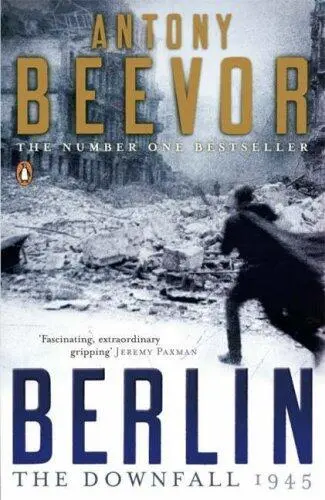
- Название:Berlin: The Downfall 1945
- Автор:
- Издательство:Penguin Books
- Жанр:
- Год:2007
- Город:New York
- ISBN:978-0-141-90302-6
- Рейтинг книги:3 / 5. Голосов: 1
-
Избранное:Добавить в избранное
- Отзывы:
-
Ваша оценка:
Berlin: The Downfall 1945: краткое содержание, описание и аннотация
Предлагаем к чтению аннотацию, описание, краткое содержание или предисловие (зависит от того, что написал сам автор книги «Berlin: The Downfall 1945»). Если вы не нашли необходимую информацию о книге — напишите в комментариях, мы постараемся отыскать её.
Antony Beevor reconstructs the experiences of those millions caught up in the nightmare of the Third Reich's final collapse, telling a terrible story of pride, stupidity, fanatacism, revenge and savagery, but also one of astonishing endurance, self-sacrifice and survival against all odds.
Berlin: The Downfall 1945 — читать онлайн бесплатно полную книгу (весь текст) целиком
Ниже представлен текст книги, разбитый по страницам. Система сохранения места последней прочитанной страницы, позволяет с удобством читать онлайн бесплатно книгу «Berlin: The Downfall 1945», без необходимости каждый раз заново искать на чём Вы остановились. Поставьте закладку, и сможете в любой момент перейти на страницу, на которой закончили чтение.
Интервал:
Закладка:
Ironically, it was the Americans, in the form of Allen Dulles of the OSS (Office of Strategic Services) in Berne, who provoked the biggest row with the Soviet Union at this time. Dulles had been approached by SS Obergruppenführer Karl Wolff about an armistice in north Italy. The Soviet leadership’s demands to participate in the talks were rejected in case Wolff might break them off. This was a blunder. Churchill acknowledged that the Soviet Union was understandably alarmed. Stalin clearly feared a separate peace on the Western Front. His recurrent nightmare was a revived Wehrmacht supplied by the Americans, even if this was an illogical fear. The vast majority of Germany’s most formidable formations had either been destroyed, captured or surrounded, and even if the Americans had provided all the weapons in the world, the Wehrmacht in 1945 bore little resemblance to the fighting machine of 1941.
Stalin also suspected that the huge numbers of Wehrmacht troops surrendering to the Americans and British in the west of Germany revealed not just their fear of becoming prisoners of the Red Army. He thought it was part of a deliberate attempt to open up the Western Front to allow the Americans and British to reach Berlin first. In fact, the reason for such large surrenders at that time was Hitler’s refusal to allow any withdrawal. If he had brought his armies back to defend the Rhine after the Ardennes débâcle, the Allies would have faced a very hard task. But he did not, and this allowed them to trap so many divisions west of the Rhine. Similarly, Field Marshal Model’s fixed defence of the Ruhr was equally doomed. ‘We owed much to Hitler,’ Eisenhower commented later.
In any case, Churchill felt strongly that until Stalin’s post-war intentions in central Europe were clearer, then the West had to grab every good card available for bargaining with him. Recent reports of what was happening in Poland, with mass arrests of prominent figures who might not support Soviet rule, strongly suggested that Stalin had no intention of allowing an independent government to develop. Molotov had also become extremely aggressive. He was refusing to allow any western representatives into Poland. In fact, his general interpretation of their agreement at Yalta was very different from what both the British and the Americans had understood to be ‘the letter and the spirit’ of their accord.
Churchill’s earlier confidence based on Stalin’s lack of interference in Greece had now started to disintegrate. He suspected that both he and Roosevelt had been the victims of a massive confidence trick. Churchill still did not seem to realize that Stalin judged others by himself. It would appear that he had acted on the principle that Churchill, after all his comments at Yalta about having to face the House of Commons over the subject of Poland, had simply needed a bit of democratic gloss to keep any critics quiet until everything was irreversibly settled. Stalin now appeared to be angered by Churchill’s renewed complaints over the Soviet Union’s behaviour in Poland.
The Soviet authorities were well aware of the main political and military disagreements between the Western Allies, even if they did not know all the details immediately. The rift grew even greater after Eisenhower’s SCAF-252 signal to Stalin. Eisenhower, stung by the furious British reaction, wrote later that the Combined Chiefs of Staff, after Tedder’s visit to Moscow in January, had allowed him to communicate directly with Moscow ‘on matters that were exclusively military in character’. ‘Later in the campaign,’ he wrote, ‘my interpretation of this authorization was sharply challenged by Mr Churchill, the difficulty arising out of the age-old truth that politics and military activities are never completely separable.’ In any case, Eisenhower’s view that Berlin itself was ‘no longer a particularly important objective’ demonstrated an astonishing naϊvety.
The irony, however, is that Eisenhower’s decision to avoid Berlin was almost certainly the right one, albeit for totally the wrong reasons. For Stalin, the Red Army’s capture of Berlin was not a matter of bargaining positions in the post-war game. He saw it as far too important for that. If any forces from the Western Allies had crossed the Elbe and headed for Berlin, they would almost certainly have found themselves warned off by the Soviet air force, and artillery if in range. Stalin would have had no compunction in condemning the Western Allies and accusing them of criminal adventurism. While Eisenhower gravely underestimated the importance of Berlin, Churchill, on the other hand, underestimated both Stalin’s determination to secure the city at any price and the genuine moral outrage which would have greeted any western attempt to seize the Red Army’s prize from under its nose.
At the end of March, while the British and American chiefs of staff disagreed over Eisenhower’s plans, the Stavka in Moscow put the finishing touches to the plan for ‘the Berlin operation’. Zhukov left his headquarters on the morning of 29 March to fly back to Moscow, but bad weather forced him down in Minsk shortly after midday. He spent the afternoon talking with Ponomarenko, the secretary of the Communist Party of Belorussia, and, since the weather had still not improved, he took the train to Moscow.
The atmosphere in the Kremlin was extremely tense. Stalin was convinced that the Germans would do everything possible to make a deal with the Western Allies in order to hold off the Red Army in the east. The American talks in Berne with General Wolff about a possible cease-fire in northern Italy seemed to confirm his worst fears. Yet the Soviet leadership’s intense suspicions failed to take into account Hitler’s fanaticism. Figures around him might make peace overtures, but Hitler himself knew that surrender in any form, even to the Western Allies, offered him no future, save humiliation and the gallows. There could be no deal without some form of palace coup against the Führer.
Zhukov, who was to be responsible for seizing Berlin, also shared Stalin’s fears that the Germans would open their front to the British and Americans. On 27 March, two days before he left for Moscow, the Reuters correspondent at 21st Army Group wrote that British and American troops heading for the heart of Germany were encountering no resistance. The Reuters report rang alarm bells in Moscow.
‘The German front in the west has entirely collapsed,’ was the first thing Stalin said to Zhukov when he finally reached Moscow. ‘It seems that Hitler’s men do not want to take any measures to stop the advance of the allies. At the same time they are strengthening their groups on the main axes against us.’ Stalin gestured to the map, then knocked the ash from his pipe. ‘I think we are going to have a serious fight.’
Zhukov produced his front intelligence map and Stalin studied it. ‘When can our troops start to advance on the Berlin axis?’ he asked.
‘The 1st Belorussian Front will be able to advance in two weeks,’ Zhukov replied. ‘Apparently the 1st Ukrainian Front will be ready at the same time. And according to our information, the 2nd Belorussian Front will be held up liquidating the enemy at Danzig and Gdynia until the middle of April.’
‘Well,’ Stalin replied. ‘We’ll just have to start without waiting for Rokossovsky’s Front.’ He went to his desk and leafed through some papers, then passed Zhukov a letter. ‘Here, read this,’ Stalin said. According to Zhukov, the letter was from ‘a foreign well-wisher’ tipping off the Soviet leadership about secret negotiations between the Western Allies and the Nazis. It did, however, explain that the Americans and British had refused the German proposal of a separate peace, but the possibility of the Germans opening the route to Berlin ‘could not be ruled out’.
Читать дальшеИнтервал:
Закладка:
Похожие книги на «Berlin: The Downfall 1945»
Представляем Вашему вниманию похожие книги на «Berlin: The Downfall 1945» списком для выбора. Мы отобрали схожую по названию и смыслу литературу в надежде предоставить читателям больше вариантов отыскать новые, интересные, ещё непрочитанные произведения.





Обсуждение, отзывы о книге «Berlin: The Downfall 1945» и просто собственные мнения читателей. Оставьте ваши комментарии, напишите, что Вы думаете о произведении, его смысле или главных героях. Укажите что конкретно понравилось, а что нет, и почему Вы так считаете.