Antony Beevor - Berlin - The Downfall 1945
Здесь есть возможность читать онлайн «Antony Beevor - Berlin - The Downfall 1945» весь текст электронной книги совершенно бесплатно (целиком полную версию без сокращений). В некоторых случаях можно слушать аудио, скачать через торрент в формате fb2 и присутствует краткое содержание. Город: New York, Год выпуска: 2007, ISBN: 2007, Издательство: Penguin Books, Жанр: nonf_military, История, на английском языке. Описание произведения, (предисловие) а так же отзывы посетителей доступны на портале библиотеки ЛибКат.
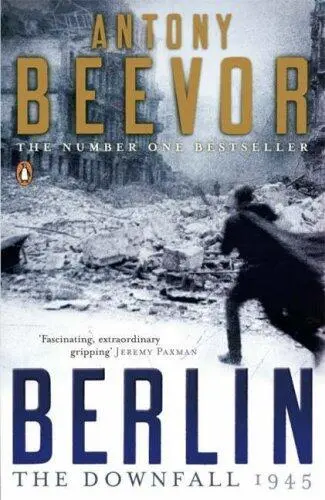
- Название:Berlin: The Downfall 1945
- Автор:
- Издательство:Penguin Books
- Жанр:
- Год:2007
- Город:New York
- ISBN:978-0-141-90302-6
- Рейтинг книги:3 / 5. Голосов: 1
-
Избранное:Добавить в избранное
- Отзывы:
-
Ваша оценка:
Berlin: The Downfall 1945: краткое содержание, описание и аннотация
Предлагаем к чтению аннотацию, описание, краткое содержание или предисловие (зависит от того, что написал сам автор книги «Berlin: The Downfall 1945»). Если вы не нашли необходимую информацию о книге — напишите в комментариях, мы постараемся отыскать её.
Antony Beevor reconstructs the experiences of those millions caught up in the nightmare of the Third Reich's final collapse, telling a terrible story of pride, stupidity, fanatacism, revenge and savagery, but also one of astonishing endurance, self-sacrifice and survival against all odds.
Berlin: The Downfall 1945 — читать онлайн бесплатно полную книгу (весь текст) целиком
Ниже представлен текст книги, разбитый по страницам. Система сохранения места последней прочитанной страницы, позволяет с удобством читать онлайн бесплатно книгу «Berlin: The Downfall 1945», без необходимости каждый раз заново искать на чём Вы остановились. Поставьте закладку, и сможете в любой момент перейти на страницу, на которой закончили чтение.
Интервал:
Закладка:
This was then elaborated in the Führer order of 9 March setting up the Fliegende Standgericht, the mobile drumhead court martial. Its establishment consisted of three senior officers, with two clerks and typewriters and office material, and, most essential of all, ‘ 1 Unteroffizier und 8 Mann als Exekutionskommando’. The guiding principle of its actions was simple: ‘The justice of mercy is not applicable.’ The organization was to start work the next day, ready to judge all members of the Wehrmacht and Waffen SS. Hitler’s blitzkrieg against his own soldiers was extended to the Luftwaffe and Kriegsmarine in an instruction signed by General Burgdorf. He instructed them to make sure that the president in each case was ‘firmly anchored in the ideology of our Reich’. Martin Bormann, not wanting the Nazi Party to be outdone, also issued an order to Gauleiters to suppress ‘cowardice and defeatism’ with death sentences by summary courts martial.
Four days after the Führer order on the Fliegende Standgericht, Hitler issued yet another order, probably drafted by Bormann, on National Socialist ideology in the army. ‘The overriding priority in the duties of a leader of troops is to activate and fanaticize them politically and he is fully responsible to me for their National Socialist conduct.’
For Himmler, the man who preached pitilessness to waverers, the stress of command proved too much. Without warning Guderian, he retired with influenza to the sanatorium of Hohenlychen, some forty kilometres to the west of Hassleben, to be cared for by his personal physician. Guderian, on hearing of the chaotic situation at his headquarters, drove up to Hassleben. Even Lammerding, Himmler’s SS chief of staff, begged him to do something. Learning that the Reichsführer SS was at Hohenlychen, Guderian went on to visit him there, having guessed the tactic to adopt. He said that Himmler was clearly overworked with all his responsibilities — Reichsführer SS, chief of the German Police, minister of the interior, commander-in-chief of the Replacement Army and commander-in-chief of Army Group Vistula. Guderian suggested that he should resign from Army Group Vistula. Since it was clear that Himmler wanted to, but did not dare tell Hitler himself, Guderian saw his chance. ‘Then will you authorize me to say it for you?’ he said. Himmler could not refuse. That night Guderian told Hitler and recommended Colonel General Gotthardt Heinrici as his replacement. Heinrici was the commander of the First Panzer Army, then involved in the fighting against Konev opposite Ratibor. Hitler, loath to admit that Himmler had been a disastrous choice, agreed with great reluctance.
Heinrici went to Hassleben to take up command. Himmler, hearing of his arrival, returned to hand over with a briefing on the situation which was full of pomposity and self-justification. Heinrici had to listen to this interminable speech until the telephone rang. Himmler answered. It was General Busse, the commander of the Ninth Army. A terrible blunder had taken place at Küstrin. The corridor to the fortress had been lost. Himmler promptly handed the telephone to Heinrici. ‘You’re the new commander-in-chief of the army group,’ he said. ‘You give the relevant orders.’ And the Reichsführer SS took his leave with indecent haste.
The fighting in the Oder bridgeheads either side of Küstrin had been ferocious. If Soviet troops captured a village and found any Nazi SA uniforms or swastikas in a house, they often killed everyone inside. And yet the inhabitants of one village which had been occupied by the Red Army and then liberated by a German counter-attack ‘had nothing negative to say about the Russian military’.
More and more German soldiers and young conscripts also showed that they did not want to die for a lost cause. A Swede coming by car from Küstrin to Berlin reported to the Swedish military attaché, Major Juhlin-Dannfel, that he had passed ‘twenty Feldgendarmerie control points whose task was to capture deserters from the front’. Another Swede passing through the area reported that German troops appeared thin on the ground and the ‘soldiers looked apathetic due to exhaustion’.
Conditions had been miserable. The Oderbruch was a semi-cultivated wetland, with a number of dykes. To dig in against artillery and air attack was a dispiriting experience, since in most places you reached water less than a metre down. February was not as cold as usual, but that did little to lessen the cases of trench foot. Apart from the lack of experienced troops, the German Army’s main problems were shortages of ammunition and shortages of fuel for their vehicles. For example, in the SS 30. januar Division, the headquarters Kübelwagen could be used only in an emergency. And no artillery battery could fire without permission. The daily ration was two shells per gun.
The Red Army dug their fire trenches in a slightly rounded sausage shape, as well as individual foxholes. Their snipers took up position in patches of scrub woodland or in the rafters of a ruined house. Using well-developed camouflage techniques, they would stay in place for six to eight hours without moving. Their priority targets were first officers and then ration carriers. German soldiers could not move in daylight. And by restricting all movement to darkness, Soviet reconnaissance groups were able to penetrate the thinly held German line and snatch an unfortunate soldier on his own as a ‘tongue’ for their intelligence officers to interrogate. Artillery forward observation officers also concealed themselves like snipers; in fact they liked to think of themselves as snipers at one remove, but with bigger guns.
The spring floodwaters on the Oder proved an unexpected advantage for the Red Army. Several of the bridges which their engineers had constructed now lay between twenty-five and thirty centimetres below the surface of the water, turning them into artificial fords. The Luftwaffe pilots, flying Focke-Wulfs and Stukas, found them very hard to hit.
While Goebbels the minister of propaganda still preached final victory, Goebbels the Gauleiter and Reich Defence Commissar for Berlin ordered obstacles to be constructed in and around the city. Tens of thousands of under-nourished civilians, mostly women, were marched out to expend what little energy they had on digging tank ditches. Rumours of resentment at Nazi bureaucracy, incompetence and the time wasted on useless defence preparations began to circulate, in spite of the penalties for defeatism. ‘In the whole war,’ one staff officer wrote scathingly, ‘I have never seen a tank ditch, either one of ours or one of the enemy’s, which managed to impede a tank attack.’ The army opposed such senseless barriers constructed on Nazi Party orders, because they hindered military traffic going out towards the Seelow Heights and caused chaos with the stream of refugees now coming into the city from villages west of the Oder.
Brandenburger farmers who had to stay behind because they had been called up into the Volkssturm meanwhile found it increasingly difficult to farm. The local Nazi Party farm leader, the Ortsbauernführer, was ordered to requisition their carts and horses for the transport of wounded and ammunition. Even bicycles were being commandeered to equip the so-called tank-hunting division. But the most telling degree of the Wehrmacht’s loss of equipment during the disastrous retreat from the Vistula was its need to take weapons from the Volkssturm.
Volkssturm battalion 16/69 was centred on Wriezen, at the edge of the Oderbruch, close to the front line. It mustered no more than 113 men, of whom thirty-two were on defence works in the rear and fourteen were ill or wounded. The rest guarded tank barricades and bridges. They had three sorts of machine gun, including several Russian ones, a flame-thrower lacking essential parts, three Spanish pistols and 228 rifles from six different nations. One must assume that this report on their weapon states is accurate since the district administration in Potsdam had issued a warning that to make a false report on this subject was ‘tantamount to a war crime’. But in many cases even such useless arsenals were not handed over because Nazi Gauleiters told the Volkssturm to give up only weapons which had been lent by the Wehrmacht in the first place.
Читать дальшеИнтервал:
Закладка:
Похожие книги на «Berlin: The Downfall 1945»
Представляем Вашему вниманию похожие книги на «Berlin: The Downfall 1945» списком для выбора. Мы отобрали схожую по названию и смыслу литературу в надежде предоставить читателям больше вариантов отыскать новые, интересные, ещё непрочитанные произведения.









Обсуждение, отзывы о книге «Berlin: The Downfall 1945» и просто собственные мнения читателей. Оставьте ваши комментарии, напишите, что Вы думаете о произведении, его смысле или главных героях. Укажите что конкретно понравилось, а что нет, и почему Вы так считаете.