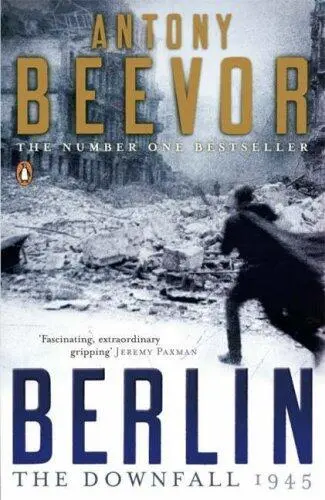
Antony Beevor - Berlin - The Downfall 1945
Здесь есть возможность читать онлайн «Antony Beevor - Berlin - The Downfall 1945» весь текст электронной книги совершенно бесплатно (целиком полную версию без сокращений). В некоторых случаях можно слушать аудио, скачать через торрент в формате fb2 и присутствует краткое содержание. Город: New York, Год выпуска: 2007, ISBN: 2007, Издательство: Penguin Books, Жанр: nonf_military, История, на английском языке. Описание произведения, (предисловие) а так же отзывы посетителей доступны на портале библиотеки ЛибКат.
- Название:Berlin: The Downfall 1945
- Автор:
- Издательство:Penguin Books
- Жанр:
- Год:2007
- Город:New York
- ISBN:978-0-141-90302-6
- Рейтинг книги:3 / 5. Голосов: 1
-
Избранное:Добавить в избранное
- Отзывы:
-
Ваша оценка:
Berlin: The Downfall 1945: краткое содержание, описание и аннотация
Предлагаем к чтению аннотацию, описание, краткое содержание или предисловие (зависит от того, что написал сам автор книги «Berlin: The Downfall 1945»). Если вы не нашли необходимую информацию о книге — напишите в комментариях, мы постараемся отыскать её.
Antony Beevor reconstructs the experiences of those millions caught up in the nightmare of the Third Reich's final collapse, telling a terrible story of pride, stupidity, fanatacism, revenge and savagery, but also one of astonishing endurance, self-sacrifice and survival against all odds.
Berlin: The Downfall 1945 — читать онлайн бесплатно полную книгу (весь текст) целиком
Ниже представлен текст книги, разбитый по страницам. Система сохранения места последней прочитанной страницы, позволяет с удобством читать онлайн бесплатно книгу «Berlin: The Downfall 1945», без необходимости каждый раз заново искать на чём Вы остановились. Поставьте закладку, и сможете в любой момент перейти на страницу, на которой закончили чтение.
Интервал:
Закладка:
Just after the capture of Pomerania, Captain Agranenko, always the playwright collecting new material, travelled round taking notes. He observed that when he was scribbling away in his little notebook, people looked at him fearfully, thinking that he must be a member of the NKVD.
On 23 March, when in Kolberg, he exulted in the sudden arrival of spring weather. ‘Birds are singing. Buds are opening. Nature does not care about war.’ He watched Red Army soldiers trying to learn to ride their plundered bicycles. They were wobbling dangerously all over the place. In fact, Front commands issued an order forbidding them to ride bicycles on the road as so many of them were being knocked down and killed. The rapid invasion of Pomerania had liberated thousands of foreign workers and prisoners. At night, the roads were lined with their campfires. By day, they embarked on their long trudge home. Most of them had fashioned national flags to identify them as non-German. Agranenko and some other officers encountered some Lithuanians displaying their flag. ‘We explained to them,’ he wrote, ‘that now their national flag is red.’ Clearly Agranenko, like most Russians, regarded the Soviet Union’s seizure of the Baltic states as quite natural, even if they did not realize that it was part of the secret protocol of the Nazi-Soviet pact.
While the liberated foreign labourers and prisoners carried their flags, Germans wore white armbands and hung white flags from their houses to emphasize their surrender. They knew that any sign of resistance or even resentment would do them no good. The Soviet-appointed bürgermeister in Köslin, a fifty-five-year-old Jewish jeweller named Usef Ludinsky, wore a bowler hat and a red armband when he read out proclamations from the military authorities from the town-hall steps. The German inhabitants listened in silence. In Leba, the cavalry which captured it had looted all the clocks and watches, so each morning the bürgermeister had to walk up and down the streets ringing a large handbell and shouting ‘ Nach Arbeit! ’ to wake the townsfolk mobilized for labour by the Soviet authorities.
In Stargard, Agranenko observed a tankist in padded leather helmet approach the fresh graves in the square opposite the magistrate’s court. The young soldier read the name on each grave, evidently searching. He stopped at one, took off his tank helmet and bowed his head. Then, he suddenly jerked his sub-machine gun up and fired a long burst. He was saluting his commander buried there at his feet.
Agranenko also chatted with young women traffic controllers. ‘Our weddings won’t happen soon,’ they told him. ‘We’ve already forgotten that we’re girls. We’re just soldiers.’ They seemed to sense that they would be part of that generation condemned to post-war spinsterhood by the Red Army’s 9 million casualties.
While Zhukov’s armies had been destroying the ‘Baltic balcony’, Marshal Konev’s 1st Ukrainian Front was still engaged in Silesia. His main obstacle was the fortress city of Breslau, astride the Oder, defended under the fanatical leadership of the Gauleiter, Karl Hanke. But Konev did not want to miss the Berlin operation, so he besieged the city, as Zhukov had done with Poznan, and pushed on across the Oder from the Steinau and Ohlau bridgeheads. His objective was the Neisse, the southern tributary of the Oder, from which he would launch his assault to the south of Berlin.
On 8 February, Konev’s armies attacked from the two bridgeheads either side of Breslau. The main thrust came from the Steinau bridgehead against the so-called Fourth Panzer Army, whose defence line quickly crumbled. To speed the advance from the Ohlau bridgehead, Konev then switched Rybalko’s 3rd Guards Tank Army. By 12 February, Breslau was surrounded. Over 80,000 civilians were trapped in the city.
Lelyushenko’s 4th Guards Tank Army pushed forward to the Neisse, which it reached in six days. During the advance, the tank troops found that only a few inhabitants had remained behind. Sometimes the local priest would come out to meet them with a letter from the village ‘to assure the Russians of their friendship’, and the 1st Ukrainian Front noted that on several occasions German civilian doctors ‘offered assistance to our wounded’.
Lelyushenko then had a nasty surprise. He found that the remnants of the Grossdeutschland Corps and Nehring’s XXIV Panzer Corps were attacking his lines of communication and rear echelon. After two days of fighting, however, the Germans had to pull back. The result was that Konev remained in firm control of over 100 kilometres of the Neisse. His start-line for the Berlin operation was secured and Breslau was surrounded. But fighting still continued south of the Ohlau bridgehead throughout the rest of February and March against the German Seventeenth Army.
The Nazis had thought that the fact of fighting on German soil would automatically fanaticize resistance, but this does not always appear to have been the case. ‘Morale is being completely destroyed by warfare on German territory,’ a prisoner from the 359th Infantry Division told his Soviet interrogator. ‘We are told to fight to the death, but it is a complete blind alley.’
General Schörner had the idea of a counter-attack against the town of Lauban, starting on 1 March. The 3rd Guards Tank Army was taken by surprise and the town was reoccupied. Goebbels was ecstatic. On 8 March, he drove down to Görlitz, followed by photographers from the propaganda ministry, where he met Schörner. Together, they drove to Lauban, where they made speeches of mutual congratulation in the market square to a parade of regular troops, Volkssturm and Hitler Youth. Goebbels presented Iron Crosses to some Hitler Youth for the cameras, and then went to visit the Soviet tanks destroyed in the operation.
The following day, Schörner’s next operation to recapture a town was launched. This time it was the turn of Striegau, forty kilometres west of Breslau. The German forces who retook the town claimed that they found the few surviving civilians wandering around, psychologically broken by the atrocities committed by Konev’s troops. They swore that they would kill every Red Army soldier who fell into their hands. But the behaviour of German troops at this time was certainly not above reproach. The Nazi authorities were not disconcerted by reports of them killing Soviet prisoners with spades, but they were shocked by more and more reports of what Bormann termed ‘looting by German soldiers in evacuated areas’. He issued orders through Field Marshal Keitel that officers were to address their soldiers at least once a week on their duty towards German civilians.
The fighting in Silesia was merciless, with both sides imposing a brutal battle discipline on their own men. General Schörner had declared war on malingerers and stragglers, who were hanged by the roadside without even the pretence of a summary court martial. According to soldiers from the 85th Pioneer Battalion taken prisoner, twenty-two death sentences were carried out in the town of Neisse alone during the second half of March. ‘The number of death sentences for running away from the field of battle, desertion, self-inflicted wounds and so forth is increasing every week,’ the 1st Ukrainian Front reported on prisoner interrogations. ‘The death sentences are read out to all soldiers.’
Soviet propaganda specialists in the 7th Department of Front headquarters soon discovered through the interrogation of prisoners that resentment in the ranks against commanders could be exploited. With bad communications and sudden withdrawals, it was quite easy to make German soldiers believe that their commander had run away and left them behind. For example, the 20th Panzer Division, when surrounded near Oppeln, began receiving leaflets which said, ‘Colonel General Schörner leaves his troops in Oppeln in the lurch! He takes his armoured command vehicle and drives like hell for the Neisse.’ German soldiers were also suffering badly from lice. They had not changed their underclothes or visited a field bath unit since December. All they received was ‘a completely useless louse powder’. They had also received no pay for the months of January, February and March and most soldiers had not received any letters from home since before Christmas.
Читать дальшеИнтервал:
Закладка:
Похожие книги на «Berlin: The Downfall 1945»
Представляем Вашему вниманию похожие книги на «Berlin: The Downfall 1945» списком для выбора. Мы отобрали схожую по названию и смыслу литературу в надежде предоставить читателям больше вариантов отыскать новые, интересные, ещё непрочитанные произведения.








Обсуждение, отзывы о книге «Berlin: The Downfall 1945» и просто собственные мнения читателей. Оставьте ваши комментарии, напишите, что Вы думаете о произведении, его смысле или главных героях. Укажите что конкретно понравилось, а что нет, и почему Вы так считаете.