Antony Beevor - Berlin - The Downfall 1945
Здесь есть возможность читать онлайн «Antony Beevor - Berlin - The Downfall 1945» весь текст электронной книги совершенно бесплатно (целиком полную версию без сокращений). В некоторых случаях можно слушать аудио, скачать через торрент в формате fb2 и присутствует краткое содержание. Город: New York, Год выпуска: 2007, ISBN: 2007, Издательство: Penguin Books, Жанр: nonf_military, История, на английском языке. Описание произведения, (предисловие) а так же отзывы посетителей доступны на портале библиотеки ЛибКат.
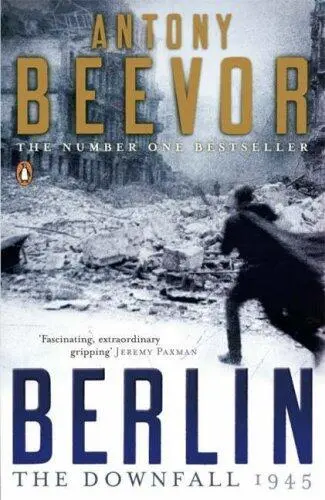
- Название:Berlin: The Downfall 1945
- Автор:
- Издательство:Penguin Books
- Жанр:
- Год:2007
- Город:New York
- ISBN:978-0-141-90302-6
- Рейтинг книги:3 / 5. Голосов: 1
-
Избранное:Добавить в избранное
- Отзывы:
-
Ваша оценка:
Berlin: The Downfall 1945: краткое содержание, описание и аннотация
Предлагаем к чтению аннотацию, описание, краткое содержание или предисловие (зависит от того, что написал сам автор книги «Berlin: The Downfall 1945»). Если вы не нашли необходимую информацию о книге — напишите в комментариях, мы постараемся отыскать её.
Antony Beevor reconstructs the experiences of those millions caught up in the nightmare of the Third Reich's final collapse, telling a terrible story of pride, stupidity, fanatacism, revenge and savagery, but also one of astonishing endurance, self-sacrifice and survival against all odds.
Berlin: The Downfall 1945 — читать онлайн бесплатно полную книгу (весь текст) целиком
Ниже представлен текст книги, разбитый по страницам. Система сохранения места последней прочитанной страницы, позволяет с удобством читать онлайн бесплатно книгу «Berlin: The Downfall 1945», без необходимости каждый раз заново искать на чём Вы остановились. Поставьте закладку, и сможете в любой момент перейти на страницу, на которой закончили чтение.
Интервал:
Закладка:
The NKVD troops were understandably merciless in their search for Ukrainians and Caucasians who had worked as camp guards, where they had frequently proved themselves even more brutal than their German overseers. Yet the fact that Red Army prisoners of war could be treated in virtually the same way as those who had put on enemy uniform was part of a systematic attitude within the NKVD. ‘There must be a single view of all the categories of prisoners,’ the NKVD rifle regiments in the 2nd Belorussian Front were told. Deserters, robbers and former prisoners of war were to be treated in the same way as ‘those who betrayed our state’.
While it is extremely hard to have any sympathy for camp guards, the vast majority of the Hiwis had been brutally press-ganged or starved into submission. Of the categories in between, many who served in SS or German army units were nationalists, whether Ukrainians, Baits, Cossacks or Caucasians, all of whom hated Soviet rule from Moscow. Some Vlasovtsy had had no compunction about joining their former enemy because they had not forgiven the arbitrary executions of friends by Red Army officers and blocking detachments during 1941 and 1942. Others were peasants who loathed forced collectivization. Yet many of the ordinary Vlasov soldiers and Hiwis were often extraordinarily naïve and ill-informed. A Russian interpreter in a German prisoner-of-war camp recounted how, at one propaganda meeting to recruit volunteers for Vlasov’s army, a Russian prisoner put up his hand and said, ‘Comrade President, we would like to know how many cigarettes one is given per day in the Vlasov army?’ Evidently for many, an army was just an army. What difference did it make whose uniform you wore, especially if you were fed, instead of being starved and maltreated in a camp? All of those who followed that route were to suffer far more than they had ever imagined. Even those who survived fifteen or twenty years in the Gulag after the war remained marked men. Those thought to have cooperated with the enemy did not have their civic rights restored until the fiftieth anniversary of the victory in 1995.
Letters were found on Russian prisoners of war who had served in the German Army, almost certainly as Hiwis. One, barely literate, was written on a blank fly-leaf torn from a German book. ‘Comrade soldiers,’ it said, ‘we give ourselves up to you begging a big favour. Tell us please why are you killing those Russian people from German prisons? We happened to be captured and then they took us to work for their regiments and we worked purely in order not to starve to death. Now these people happen to get to the Russian side, back to their own army, and you shoot them. What for, we ask. Is it because the Soviet command betrayed these people in 1941 and 1942?’
8. Pomerania and the Oder Bridgeheads
In February and March, while bitter fighting continued for the Oder bridgeheads opposite Berlin, Zhukov and Rokossovsky crushed the ‘Baltic balcony’ of Pomerania and West Prussia. In the second and third weeks of February, Rokossovsky’s four armies across the Vistula pushed into the southern part of West Prussia. Then, on 24 February, Zhukov’s right-flank armies and Rokossovsky’s left flank forced northwards towards the Baltic to split Pomerania in two.
The most vulnerable German formation was the Second Army. It still just managed to keep open the last land route from East Prussia along the Frische Nehrung sandbar to the Vistula estuary. The Second Army, with its left flank just across the Nogat in Elbing and maintaining a foothold in the Teutonic Knights’ castle of Marienburg, was the most overstretched of all Army Group Vistula.
Rokossovsky’s attack began on 24 February. The 19th Army advanced north-westwards towards the area between Neustettin and Baldenburg, but its troops were shaken by the ferocity of the fighting and it faltered. Rokossovsky sacked the army commander, pushed a tank corps into the attack as well, and forced them on. The combination of the tank corps and the 2nd and 3rd Guards Cavalry Corps led to the rapid fall of Neustettin, the ‘cornerstone’ of the Pomeranian defence line.
Soviet cavalry played a successful part in the reduction of Pomerania. They captured several towns on their own, such as the seaside town of Leba, mainly by surprise. The 2nd Guards Cavalry Corps, which formed the extreme right of Zhukov’s 1st Belorussian Front, was commanded by Lieutenant General Vladimir Viktorovich Kryukov, a resourceful leader married to Russia’s favourite folk-singer, Lydia Ruslanova.
Zhukov’s attack northwards some fifty kilometres east of Stettin began in earnest on 1 March. Combining the 3rd Shock Army and the 1st and 2nd Guards Tank Army, it was a far stronger force. The weak German divisions did not stand a chance. The leading tank brigades dashed ahead, charging through towns where unprepared civilians stared at them in horror. The 3rd Shock Army and the 1st Polish Army coming behind consolidated their gains. On 4 March, the 1st Guards Tank Army reached the Baltic near Kolberg. Colonel Morgunov, the commander of the 45th Guards Tank Brigade, the first to reach the sea, sent bottles of saltwater to Zhukov and to Katukov, his army commander. It proved Katukov’s dictum. ‘The success of the advance,’ he had told Grossman, ‘is determined by our huge mechanized power, which is now greater than it has ever been. A colossal rapidity of advance means small losses and the enemy is scattered.’
The whole of the German Second Army and part of the Third Panzer Army were now completely cut off from the Reich. And as if to emphasize the Baltic catastrophe, news arrived that Finland, albeit under heavy pressure from the Soviet Union, had declared war on her former ally, Nazi Germany. Among those cut off to the east of Zhukov’s thrust was the SS Charlemagne Division, already greatly reduced from its strength of 12,000 men. Along with three German divisions, they had been positioned near Belgard. General von Tettau ordered them to try to break out north-westwards towards the Baltic coast at the mouth of the Oder. The Charlemagne commander, SS Brigadeführer Gustav Krukenberg, accompanied 1,000 of his Frenchmen on silent compass marches through snow-laden pine forests. As things turned out, part of this ill-assorted group of right-wing intellectuals, workers and reactionary aristocrats, united only by their ferocious anti-Communism, was to form the last defence of Hitler’s Chancellery in Berlin.
Hitler, however, demonstrated scant sympathy for the defenders of his Reich. When the commander of the Second Army, Colonel General Weiss, warned Führer headquarters that the Elbing pocket, which had cost so much blood already, could not be held much longer, Hitler simply retorted, ‘Weiss is a liar, like all generals.’
The second phase of the Pomeranian campaign began almost immediately, only two days after the 1st Guards Tank Army reached the sea. The 1st Guards Tank Army was transferred temporarily to Rokossovsky. Zhukov telephoned him to say that he wanted Katukov’s army ‘returned in the same state as you received it’. The operation consisted of a large, left-flanking wheel to roll up eastern Pomerania and Danzig from the west, while Rokossovsky’s strongest formation, the 2nd Shock Army, attacked up from the south, parallel to the Vistula.
The commander of the Soviet 2nd Shock Army, Colonel General Fedyuninsky, was keeping a close eye on the calendar. He had been wounded four times in the course of the war. Every time it happened on the 20th of the month, and so now he never moved from his headquarters on that day. Fedyuninsky did not believe that the looted resources of Prussia should be squandered. He made his army load livestock, bread, rice, sugar and cheese on to trains, which were sent to Leningrad to compensate its citizens for their suffering during the terrible siege.
Читать дальшеИнтервал:
Закладка:
Похожие книги на «Berlin: The Downfall 1945»
Представляем Вашему вниманию похожие книги на «Berlin: The Downfall 1945» списком для выбора. Мы отобрали схожую по названию и смыслу литературу в надежде предоставить читателям больше вариантов отыскать новые, интересные, ещё непрочитанные произведения.






Обсуждение, отзывы о книге «Berlin: The Downfall 1945» и просто собственные мнения читателей. Оставьте ваши комментарии, напишите, что Вы думаете о произведении, его смысле или главных героях. Укажите что конкретно понравилось, а что нет, и почему Вы так считаете.