Antony Beevor - Berlin - The Downfall 1945
Здесь есть возможность читать онлайн «Antony Beevor - Berlin - The Downfall 1945» весь текст электронной книги совершенно бесплатно (целиком полную версию без сокращений). В некоторых случаях можно слушать аудио, скачать через торрент в формате fb2 и присутствует краткое содержание. Город: New York, Год выпуска: 2007, ISBN: 2007, Издательство: Penguin Books, Жанр: nonf_military, История, на английском языке. Описание произведения, (предисловие) а так же отзывы посетителей доступны на портале библиотеки ЛибКат.
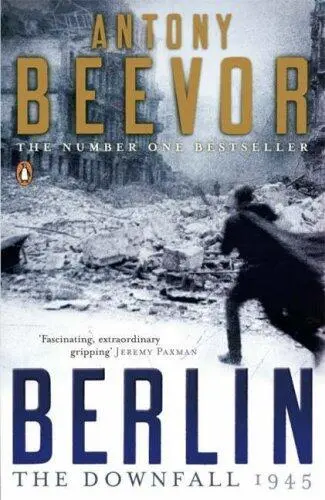
- Название:Berlin: The Downfall 1945
- Автор:
- Издательство:Penguin Books
- Жанр:
- Год:2007
- Город:New York
- ISBN:978-0-141-90302-6
- Рейтинг книги:3 / 5. Голосов: 1
-
Избранное:Добавить в избранное
- Отзывы:
-
Ваша оценка:
Berlin: The Downfall 1945: краткое содержание, описание и аннотация
Предлагаем к чтению аннотацию, описание, краткое содержание или предисловие (зависит от того, что написал сам автор книги «Berlin: The Downfall 1945»). Если вы не нашли необходимую информацию о книге — напишите в комментариях, мы постараемся отыскать её.
Antony Beevor reconstructs the experiences of those millions caught up in the nightmare of the Third Reich's final collapse, telling a terrible story of pride, stupidity, fanatacism, revenge and savagery, but also one of astonishing endurance, self-sacrifice and survival against all odds.
Berlin: The Downfall 1945 — читать онлайн бесплатно полную книгу (весь текст) целиком
Ниже представлен текст книги, разбитый по страницам. Система сохранения места последней прочитанной страницы, позволяет с удобством читать онлайн бесплатно книгу «Berlin: The Downfall 1945», без необходимости каждый раз заново искать на чём Вы остановились. Поставьте закладку, и сможете в любой момент перейти на страницу, на которой закончили чтение.
Интервал:
Закладка:
The notion that Soviet women and girls taken for slave labour in Germany ‘had sold themselves to the Germans’ was very widespread in the Red Army, which provides part of the explanation of why they were so badly treated. Young women who had somehow managed to stay alive under Wehrmacht occupation were known as ‘German dolls’. There was even an airman’s song about it:
Young girls are smiling at Germans
Having forgotten about their guys…
When times became hard, you forgot your falcons,
And sold yourselves to Germans for a crust of bread.
It is hard to pin down the origin of this assumption about women collaborating with the enemy. It cannot be traced to remarks made by political officers in late 1944 or early 1945, yet it appears that a general idea had earlier been fomented by the regime that any Soviet citizen taken to Germany, either as a prisoner of war or as a slave labourer, had tacitly consented because they had failed to kill themselves or ‘join the partisans’. Any notion of ‘the honour and dignity of the Soviet girl’ was accorded only to young women serving in the Red Army or the war industries. But it is perhaps significant that, according to one woman officer, female soldiers in the Red Army started to be treated badly by their male counterparts from the time that Soviet troops moved on to foreign territory.
Official complaints of rape to a senior officer were worse than useless. ‘For example, Eva Shtul, born 1926, said, “My father and two brothers joined the Red Army at the beginning of the war. Soon the Germans came and I was taken to Germany by force. I worked in a factory here. I cried and waited for the day of liberation. Soon the Red Army came and its soldiers dishonoured me. I cried and told the senior officer about my brothers in the Red Army and he beat me and raped me. It would have been better if he had killed me.” ’
‘All this,’ concluded Tsygankov, ‘provides fertile ground for unhealthy, negative moods to grow among liberated Soviet citizens; it causes discontent and mistrust before their return to their mother country.’ His recommendations, however, did not focus on tightening Red Army discipline. He suggested instead that the main political department of the Red Army and the Komsomol should concentrate on ‘improving political and cultural work with repatriated Soviet citizens’ so that they should not return home with negative ideas about the Red Army.
By 15 February, the 1st Ukrainian Front alone had liberated 49,500 Soviet citizens and 8,868 foreigners from German forced labour, mainly in Silesia. But this represented only a small percentage of the total. Just over a week later, the Soviet authorities in Moscow estimated that they should prepare to receive and process a total of 4 million former Red Army soldiers and civilian deportees.
The first priority was not medical care for those who had suffered so appallingly in German camps, it was a screening process to weed out traitors. The second priority was political re-education for those who had been subject to foreign contamination. Both the 1st Belorussian Front and the 1st Ukrainian Front were ordered to set up three assembly and transit camps well to their rear in Poland. The re-education teams each had a mobile film unit, a radio with a loudspeaker, two accordions, a library of 20,000 Communist Party booklets, forty metres of red fabric for decorating premises and a set of portraits of Comrade Stalin.
Solzhenitsyn wrote of liberated prisoners of war, with their heads down as they were marched along. They feared retribution simply for having surrendered. But the need for reinforcements was so great that the vast majority were sent to reserve regiments for re-education and retraining, in order to have them ready for the final offensive on Berlin. This, however, was just a temporary reprieve. Another screening would come later when the fighting was over, and even those who fought heroically in the battle for Berlin were not immune from being sent to the camps later.
The Red Army’s urgent need of more ‘meat for the cannon’ meant that former slave labourers without any military training were also conscripted on the spot. And most of the ‘western Belorussians’ and ‘western Ukrainians’ from the regions seized by Stalin in 1939 still regarded themselves as Poles. But they were given little choice in the matter.
Once they reached the screening camp, the liberated Soviet prisoners had many questions. ‘What will be their status? Will they have full citizens’ rights on returning to Russia? Will they be deprived in some way? Will they be sent to the camps?’ Once again the Soviet authorities did not acknowledge that these were pertinent questions. They were immediately attributed to ‘fascist propaganda, because the Germans terrified our people in Germany and this false propaganda was intensified towards the end of the war’.
The political workers in the camps gave talks, mainly of Red Army successes and the achievements of the Soviet rear, and about the Party leaders, especially Comrade Stalin. ‘They also show them Soviet movies,’ reported the chief of the political department of the 1st Ukrainian Front. ‘The people like them very much, they cry “Hooray!” very often, especially when Stalin appears, and “Long live the Red Army”, and after the cinema show they go away crying in happiness. Among those who were liberated are only a few who betrayed the Motherland.’ In the screening camp in Kraków, only four were arrested as traitors out of a total of forty suspects. Yet these figures were to rise greatly later.
There are stories, and it is very hard to know how true they are, that even forced labourers from the Soviet Union were executed shortly after liberation without any investigation. For example, the Swedish military attaché heard that after the occupation of Oppeln in Silesia, around 250 of them were summoned to a political meeting. Immediately afterwards, they were cornered by Red Army or NKVD troops. Somebody yelled a question at them demanding why they had not become partisans, then the soldiers opened fire.
The term ‘Traitor of the Motherland’ did not just cover soldiers recruited from prison camps by the Germans. It was to cover Red Army soldiers who had been captured in 1941, some of whom had been so badly wounded that they could not fight to the end. Solzhenitsyn argued in their case that the phrase ‘Traitor of the Motherland’, rather than ‘Traitor to the Motherland’ was a significant Freudian slip. ‘They were not traitors to her. They were her traitors. It was not they, the unfortunates, who had betrayed the Motherland, but their calculating Motherland who had betrayed them.’ The Soviet state had betrayed them through incompetence and lack of preparation in 1941. It had then refused to acknowledge their dreadful fate in German prison camps. And the final betrayal came when they were encouraged to believe that they had redeemed themselves by their bravery in the last weeks of the war, only to be arrested after the fighting was over. Solzhenitsyn felt that ‘to betray one’s own soldiers and proclaim them traitors’ was the foulest deed in Russian history.
Few Red Army soldiers, whether prisoners of war or those fortunate enough never to have been captured, would ever forgive those who had put on German uniform whatever the circumstances. Members of Vlasov’s ROA, known as Vlasovtsy, SS volunteers, Ukrainian and Caucasian camp guards, General von Pannwitz’s Cossack cavalry corps, police teams, anti-partisan ‘security detachments’ and even the unfortunate ‘Hiwis’ (short for Hilfsfreiwillige, or volunteer helpers) were all tarred with the same brush.
Estimates for all categories range between 1 million and 1.5 millon men. Red Army authorities insisted that there had been over a million Hiwis serving in the Wehrmacht. Those taken, or who surrendered voluntarily, were frequently shot on the spot or soon afterwards. ‘ Vlasovtsy and other accomplices of the Nazis were usually executed on the spot,’ the latest Russian official history states. ‘This is not surprising. The battle code of the Red Army infantry demanded that each soldier must “be ruthless to all turncoats and traitors of the Motherland”.’ It also appears to have been a matter of regional honour. Men from their area would be found to take revenge: ‘A man from Orel kills a man from Orel and an Uzbek kills an Uzbek.’
Читать дальшеИнтервал:
Закладка:
Похожие книги на «Berlin: The Downfall 1945»
Представляем Вашему вниманию похожие книги на «Berlin: The Downfall 1945» списком для выбора. Мы отобрали схожую по названию и смыслу литературу в надежде предоставить читателям больше вариантов отыскать новые, интересные, ещё непрочитанные произведения.




Обсуждение, отзывы о книге «Berlin: The Downfall 1945» и просто собственные мнения читателей. Оставьте ваши комментарии, напишите, что Вы думаете о произведении, его смысле или главных героях. Укажите что конкретно понравилось, а что нет, и почему Вы так считаете.