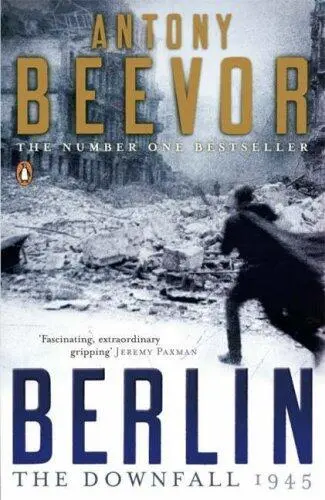
Antony Beevor - Berlin - The Downfall 1945
Здесь есть возможность читать онлайн «Antony Beevor - Berlin - The Downfall 1945» весь текст электронной книги совершенно бесплатно (целиком полную версию без сокращений). В некоторых случаях можно слушать аудио, скачать через торрент в формате fb2 и присутствует краткое содержание. Город: New York, Год выпуска: 2007, ISBN: 2007, Издательство: Penguin Books, Жанр: nonf_military, История, на английском языке. Описание произведения, (предисловие) а так же отзывы посетителей доступны на портале библиотеки ЛибКат.
- Название:Berlin: The Downfall 1945
- Автор:
- Издательство:Penguin Books
- Жанр:
- Год:2007
- Город:New York
- ISBN:978-0-141-90302-6
- Рейтинг книги:3 / 5. Голосов: 1
-
Избранное:Добавить в избранное
- Отзывы:
-
Ваша оценка:
Berlin: The Downfall 1945: краткое содержание, описание и аннотация
Предлагаем к чтению аннотацию, описание, краткое содержание или предисловие (зависит от того, что написал сам автор книги «Berlin: The Downfall 1945»). Если вы не нашли необходимую информацию о книге — напишите в комментариях, мы постараемся отыскать её.
Antony Beevor reconstructs the experiences of those millions caught up in the nightmare of the Third Reich's final collapse, telling a terrible story of pride, stupidity, fanatacism, revenge and savagery, but also one of astonishing endurance, self-sacrifice and survival against all odds.
Berlin: The Downfall 1945 — читать онлайн бесплатно полную книгу (весь текст) целиком
Ниже представлен текст книги, разбитый по страницам. Система сохранения места последней прочитанной страницы, позволяет с удобством читать онлайн бесплатно книгу «Berlin: The Downfall 1945», без необходимости каждый раз заново искать на чём Вы остановились. Поставьте закладку, и сможете в любой момент перейти на страницу, на которой закончили чтение.
Интервал:
Закладка:
The scratch crews of the Kriegsmarine, using any craft available — tenders, barges, pinnaces, tugs and E-boats — returned in a constant shuttle to snatch the civilians and wounded to ferry them across to the small port of Hela at the tip of the nearby peninsula. Destroyers offshore gave the small boats as much anti-aircraft covering fire as possible. The sailors hardly ever faltered, even though a near miss was enough to overturn some of the smaller craft. On 25 March, a young woman from the Polish resistance brought General Katukov a plan of the Gdynia defence system. At first he thought it might be a trick, but it proved to be authentic. As the Soviet troops fought into the outskirts of Gdynia, the Kriegsmarine carried on, even accelerating its rhythm to grab as many refugees as possible before the end. Their boats now had to contend with another weapon. Katukov’s tank crews had learned to adapt their gunnery to targets at sea, making it an even more dangerous task.
A fragment of a platoon from the Grossdeutschland, which had escaped amid nightmare scenes from the final evacuation of Memel at the most north-eastern point of East Prussia, found itself reliving a similar experience. Deciding to shelter in a vaulted cellar as Soviet troops fought towards the port, they found a doctor delivering a baby by the light of a couple of lanterns. ‘If the birth of a child is usually a joyful event,’ wrote one of the soldiers, ‘this particular birth only seemed to add to the general tragedy. The mother’s screams no longer had any meaning in a world made of screams, and the wailing child seemed to regret the beginning of its life.’ The soldiers hoped for the child’s sake, as they made their way down to the port, that it would die. The Soviet advance into Gdynia was marked by a horizon of red flames against thick black smoke. The final attack had begun, and by that evening of 26 March the Red Army was in possession of the town and port.
The sack of Gdynia and the treatment of the survivors appear to have shaken even the Soviet military authorities. ‘The number of extraordinary events is growing,’ the political department reported in its usual vocabulary of euphemisms, ‘as well as immoral phenomena and military crimes. Among our troops there are disgraceful and politically harmful phenomena when, under the slogan of revenge, some officers and soldiers commit outrages and looting instead of honestly and selflessly fulfilling their duty to their Motherland.’
Just to the south, meanwhile, Danzig too was under heavy assault from the west. The defenders were forced back bit by bit, and by 28 March Danzig also fell, with appalling consequences for the remaining civilians. The remainder of Saucken’s troops withdrew eastwards into the Vistula estuary, where they remained besieged until the end of the war.
For German officers, especially Pomeranians and Prussians, the loss of the Hanseatic city of Danzig, with its fine old buildings marked by distinctive stepped gables, was a disaster. It signified the end of German Baltic life for ever. Yet while mourning the loss of a long-established culture, they closed their eyes to the horrors of the regime which they had so effectively supported in its war aims. They may not have known about the manufacture of soap and leather from corpses in the Danzig Anatomical Medical Institute, but they certainly knew about Stutthof concentration camp in the Vistula estuary, because Wehrmacht troops, not just SS, had been involved in the massacre of its prisoners as the Red Army approached.
West Prussia and Pomerania may not have suffered quite as much as East Prussia, but the fate of civilians was still terrible. Their culture was also exterminated as churches and old buildings went up in flames.
The Soviet commandant of Lauenburg complained to Captain Agranenko that it was ‘absolutely impossible to stop the violence’. Agranenko found that Red Army soldiers did not bother with official euphemisms for rape, such as ‘violence against the civil population’ or ‘immorality’. They simply used the phrase ‘to fuck’. A Cossack officer told him that German women were ‘too proud’. You had to ‘get astride’ them. Others complained that German women looked ‘like draught-horses’. In Glowitz, he noted that women were ‘using children like a screen’. Soviet soldiers once again demonstrated an utterly bewildering mixture of irrational violence, drunken lust and spontaneous kindness to children.
Young women, desperate to escape the notice of soldiers, rubbed wood-ash and soot into their faces. They tied peasant headkerchiefs low over the brow, bundled themselves up to hide their figures and hobbled along the roadside like ancient crones. Yet this concealment of youth was no automatic safeguard. Many elderly women were raped as well.
German women developed their own verbal formulae for what they had been through. Many used to say, ‘I had to concede.’ One recounted that she had to concede thirteen times. ‘Her horror seemed to contain a touch of pride at what she had endured,’ Libussa von Oldershausen noted with surprise. But far more women were traumatized by their terrible experiences. Some became catatonic, others committed suicide. But as with Libussa von Oldershausen, pregnant women usually rejected this escape route. An instinctive duty to their unborn child became paramount.
A few women had the idea of dotting their faces with red to indicate spotted typhus. Others discovered the Russian word for typhus and its Cyrillic form in order to put up warning notices on their doors implying that the household was infected. In more remote areas, whole communities hid in farmsteads away from major routes. A lookout always remained close to the road, with a flashlight at night or a shirt to wave by day to warn of Soviet troops turning off towards their hiding place. Women then rushed to hide, and poultry and pigs were driven into pens concealed in the forest. Such precautions for survival must have been used in the Thirty Years War. They were probably as old as warfare itself.
Of all the signs of fighting which refugees found when forced to return home after the fall of Danzig, the worst were the ‘gallows alleys’ where SS and Feldgendarmerie had hanged deserters. Signs had been tied around their necks, such as, ‘Here I hang because I did not believe in the Führer.’ Libussa von Oldershausen and her family, forced to return home by the fall of the two ports, also saw a couple of Feldgendarmerie who had been caught and hanged by the Soviets. The route back was littered with wrecked wagons pushed into ditches by Soviet tanks, with looted baggage scattered all around, bedlinen, crockery, suitcases and toys. The carcasses of horses and cattle in roadside ditches had had strips of meat hacked from their flanks.
Many Pomeranians were murdered in the first week of occupation. Near the Puttkamers’ village, an elderly couple were chased into the icy waters of a village pond, where they died. A man was harnessed to a plough, which he was forced to drag until he collapsed. His tormentors then finished him off with a burst of sub-machine-gun fire. Herr von Livonius, the owner of an estate at Grumbkow, was dismembered and his body thrown to the pigs. Even those landowners who had been part of the anti-Nazi resistance fared little better. Eberhard von Braunschweig and his family, assuming that they had little to fear, awaited the arrival of the Red Army in their manor house at Lübzow, near Karzin. But his reputation and numerous arrests by the Gestapo did him little good. The whole family was dragged outside and shot. Villagers and French prisoners of war sometimes bravely came to the defence of a well-liked landowner, but many others were left to their fate.
Nothing was predictable. In Karzin, the elderly Frau von Puttkamer retired to bed when the sounds of firing and tank engines could be heard. Not long afterwards, a young Soviet soldier opened her bedroom door, very drunk after the capture of the next-door village. He signalled for her to get out of bed to let him sleep there. She refused, saying that it was her bed, but that she would give him a pillow and he could sleep on the bedside rug. She then put her hands together and began to say her prayers. Too befuddled to argue, the young soldier lay down and slept where he had been told.
Читать дальшеИнтервал:
Закладка:
Похожие книги на «Berlin: The Downfall 1945»
Представляем Вашему вниманию похожие книги на «Berlin: The Downfall 1945» списком для выбора. Мы отобрали схожую по названию и смыслу литературу в надежде предоставить читателям больше вариантов отыскать новые, интересные, ещё непрочитанные произведения.








Обсуждение, отзывы о книге «Berlin: The Downfall 1945» и просто собственные мнения читателей. Оставьте ваши комментарии, напишите, что Вы думаете о произведении, его смысле или главных героях. Укажите что конкретно понравилось, а что нет, и почему Вы так считаете.