Antony Beevor - Berlin - The Downfall 1945
Здесь есть возможность читать онлайн «Antony Beevor - Berlin - The Downfall 1945» весь текст электронной книги совершенно бесплатно (целиком полную версию без сокращений). В некоторых случаях можно слушать аудио, скачать через торрент в формате fb2 и присутствует краткое содержание. Город: New York, Год выпуска: 2007, ISBN: 2007, Издательство: Penguin Books, Жанр: nonf_military, История, на английском языке. Описание произведения, (предисловие) а так же отзывы посетителей доступны на портале библиотеки ЛибКат.
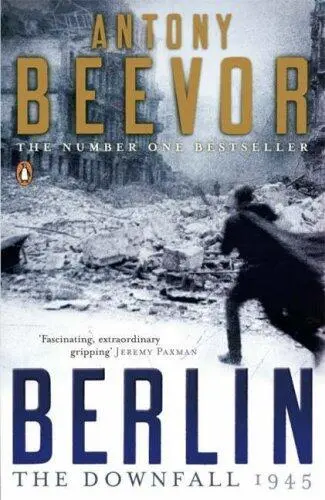
- Название:Berlin: The Downfall 1945
- Автор:
- Издательство:Penguin Books
- Жанр:
- Год:2007
- Город:New York
- ISBN:978-0-141-90302-6
- Рейтинг книги:3 / 5. Голосов: 1
-
Избранное:Добавить в избранное
- Отзывы:
-
Ваша оценка:
Berlin: The Downfall 1945: краткое содержание, описание и аннотация
Предлагаем к чтению аннотацию, описание, краткое содержание или предисловие (зависит от того, что написал сам автор книги «Berlin: The Downfall 1945»). Если вы не нашли необходимую информацию о книге — напишите в комментариях, мы постараемся отыскать её.
Antony Beevor reconstructs the experiences of those millions caught up in the nightmare of the Third Reich's final collapse, telling a terrible story of pride, stupidity, fanatacism, revenge and savagery, but also one of astonishing endurance, self-sacrifice and survival against all odds.
Berlin: The Downfall 1945 — читать онлайн бесплатно полную книгу (весь текст) целиком
Ниже представлен текст книги, разбитый по страницам. Система сохранения места последней прочитанной страницы, позволяет с удобством читать онлайн бесплатно книгу «Berlin: The Downfall 1945», без необходимости каждый раз заново искать на чём Вы остановились. Поставьте закладку, и сможете в любой момент перейти на страницу, на которой закончили чтение.
Интервал:
Закладка:
Nazi Party leaders had heard from Gestapo reports that the civilian population was expressing more and more contempt for the way they ordered others to die but did nothing themselves. The refugees in particular were apparently ‘very harsh about the conduct of prominent personalities’. To counter this, a great deal of military posturing took place. The Gau leadership of Brandenburg issued calls to Party members for more volunteers to fight with the slogan, ‘The fresh air of the front instead of overheated rooms!’ Dr Ley, the chief of Nazi Party organization, appeared at Führer headquarters with a plan to raise a Freikorps Adolf Hitler with ‘40,000 fanatical volunteers’. He asked Guderian to make the army hand over 80,000 sub-machine guns at once. Guderian promised him the weapons once they were enrolled, knowing full well that this was pure bluster. Even Hitler did not look impressed.
Over the last few months, Goebbels had become alarmed at Hitler’s withdrawal from public view. He finally persuaded him to agree to a visit to the Oder front, mainly for the benefit of the newsreel cameras. The Führer’s visit, on 13 March, was kept very secret. SS patrols watched all the routes beforehand, then lined them just before the Führer’s convoy arrived. In fact Hitler did not meet a single ordinary soldier. Formation commanders had been summoned without explanation to an old manor house near Wriezen which had once belonged to Blücher. They were astonished to see the decrepit Führer. One officer wrote of his ‘chalk-white face’ and ‘his glittering eyes, which reminded me of the eyes of a snake’. General Busse, wearing field cap and spectacles, gave a formal presentation of the situation on his army’s front. When Hitler spoke of the necessity of holding the Oder defence line, he made it clear, another officer recorded, ‘that what we already had were the very last weapons and equipment available’.
The effort of talking must have drained Hitler. On the journey back to Berlin, he never said a word. According to his driver, he sat there ‘lost in his thoughts’. It was his last journey. He was never to leave the Reich Chancellery again alive.
9. Objective Berlin
On 8 March, just when the Pomeranian operation was getting into full momentum, Stalin suddenly summoned Zhukov back to Moscow. It was a strange moment to drag a Front commander away from his headquarters. Zhukov drove straight from the central airport out to Stalin’s dacha, where the Soviet leader was recuperating from exhaustion and stress.
After Zhukov had reported on the Pomeranian operation and the fighting in the Oder bridgeheads, Stalin led him outside for a walk in the grounds. He talked about his childhood. When they returned to the dacha for tea, Zhukov asked Stalin if anything had been heard of his son Yakov Djugashvili, who had been a prisoner of the Germans since 1941. Stalin had disowned his own son then for having allowed himself to be taken alive, but now his attitude seemed different. He did not answer Zhukov’s question for some time. ‘Yakov is never going to get out of prison alive,’ he said eventually. ‘The murderers will shoot him. According to our inquiries, they are keeping him isolated and are trying to persuade him to betray the Motherland.’ He was silent for another long moment. ‘No,’ he said firmly. ‘Yakov would prefer any kind of death to betraying the Motherland.’
When Stalin referred to ‘our inquiries’, they were of course Abakumov’s inquiries. The most recent news of Yakov had come from General Stepanovic, a commander of the Yugoslav gendarmerie. Stepanovic had been released by Zhukov’s own troops at the end of January, but then grabbed by SMERSH for interrogation. Stepanovic had earlier been in Straflager X-C in Lübeck with Senior Lieutenant Djugashvili. According to Stepanovic, Yakov had conducted himself ‘independently and proudly’. He refused to stand up if a German officer entered his room and turned his back if they spoke to him. The Germans had put him in a punishment cell. Despite an interview printed in the German press, Yakov Djugashvili insisted that he had never replied to any question from anyone. After an escape from the camp, he was taken away and flown to an unknown destination. To this day, the manner of his death is not clear, although the most common story is that he threw himself at the perimeter fence to force the guards to shoot him. Stalin may have changed his attitude towards his own son, but he remained pitiless towards the hundreds of thousands of other Soviet prisoners of war who had in most cases suffered an even worse fate than Yakov.
Stalin changed the subject. He said that he was ‘very pleased’ with the results of the Yalta conference. Roosevelt had been most friendly. Stalin’s secretary, Poskrebyshev, then came in with papers for Stalin to sign. This was a signal for Zhukov to leave, yet it was also the moment for Stalin to explain the reason for the urgent summons to Moscow. ‘Go to the Stavka, ’ he told Zhukov, ‘and look at the calculations on the Berlin operation with Antonov. We will meet here tomorrow at 13.00.’
Antonov and Zhukov, who evidently sensed that there was a reason for the urgency, worked through the night. Next morning, Stalin changed both the time and the place. He came into Moscow, despite his weak state, so that a full-scale conference could take place at the Stavka with Malenkov, Molotov and other members of the State Defence Committee. Antonov made his presentation. When he had finished, Stalin gave his approval and told him to issue the orders for detailed planning.
Zhukov acknowledged in his memoirs that ‘when we were working on the Berlin operation we took into account the action of our allies’. He even admitted their concern that ‘the British command was still nursing the dream of capturing Berlin before the Red Army reached it’. What he does not mention, however, was that on 7 March, the day before Stalin summoned him so urgently to Moscow, the US Army had seized the bridge at Remagen. Stalin had immediately seen the implications of the Western Allies breaching the Rhine barrier so quickly.
The British desire to head for Berlin had never been concealed from Stalin. During Churchill’s visit to Moscow in October 1944, Field Marshal Sir Alan Brooke told Stalin that after an encirclement of the Ruhr, ‘the main axis of the Allied advance would then be directed on Berlin’. Churchill had re-emphasized the point. They hoped to cut off about 150,000 Germans in Holland, ‘then drive steadily towards Berlin’. Stalin had made no comment.
There was a very strong reason for Stalin to want the Red Army to occupy Berlin first. In May 1942, three months before the start of the battle of Stalingrad, he had summoned Beria and the leading atomic physicists to his dacha. He was furious to have heard through spies that the United States and Britain were working on a uranium bomb. Stalin blamed Soviet scientists for not having taken the threat seriously, yet he was the one who had dismissed as a ‘provocation’ the first intelligence on the subject. This had come from the British spy John Cairncross in November 1941. Stalin’s angry dismissal of the information had been a curious repeat of his behaviour when warned of the German invasion six months before.
Over the next three years, the Soviet nuclear research programme, soon codenamed Operation Borodino, was dramatically accelerated with detailed research information from the Manhattan Project provided by Communist sympathizers, such as Klaus Fuchs. Beria himself took over supervision of the work and eventually brought Professor Igor Kurchatov’s team of scientists under complete NKVD control.
The Soviet programme’s main handicap, however, was a lack of uranium. No deposits had been identified yet in the Soviet Union. The main reserves in Europe lay in Saxony and Czechoslovakia, under Nazi control, but before the Red Army reached Berlin they appear to have had only the sketchiest information on the deposits there. On Beria’s instructions, the Soviet Purchasing Committee in the United States asked the American War Production Board to sell it eight tons of uranium oxide. After consultation with Major General Groves, the head of the Manhattan Project, the US government authorized purely token supplies, mainly in the hope of finding out what the Soviet Union was up to.
Читать дальшеИнтервал:
Закладка:
Похожие книги на «Berlin: The Downfall 1945»
Представляем Вашему вниманию похожие книги на «Berlin: The Downfall 1945» списком для выбора. Мы отобрали схожую по названию и смыслу литературу в надежде предоставить читателям больше вариантов отыскать новые, интересные, ещё непрочитанные произведения.







Обсуждение, отзывы о книге «Berlin: The Downfall 1945» и просто собственные мнения читателей. Оставьте ваши комментарии, напишите, что Вы думаете о произведении, его смысле или главных героях. Укажите что конкретно понравилось, а что нет, и почему Вы так считаете.