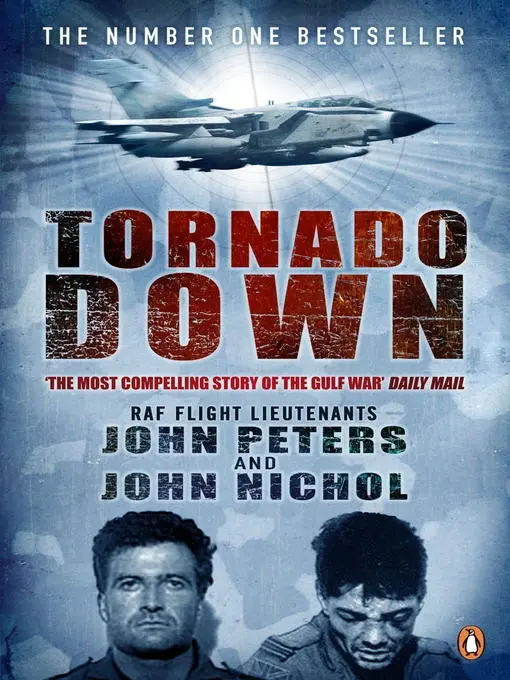
John Nichol - Tornado Down
Здесь есть возможность читать онлайн «John Nichol - Tornado Down» весь текст электронной книги совершенно бесплатно (целиком полную версию без сокращений). В некоторых случаях можно слушать аудио, скачать через торрент в формате fb2 и присутствует краткое содержание. Город: London, Год выпуска: 2008, ISBN: 2008, Издательство: Penguin Adult, Жанр: nonf_military, Биографии и Мемуары, на английском языке. Описание произведения, (предисловие) а так же отзывы посетителей доступны на портале библиотеки ЛибКат.
- Название:Tornado Down
- Автор:
- Издательство:Penguin Adult
- Жанр:
- Год:2008
- Город:London
- ISBN:978-0-14-193771-7
- Рейтинг книги:5 / 5. Голосов: 1
-
Избранное:Добавить в избранное
- Отзывы:
-
Ваша оценка:
Tornado Down: краткое содержание, описание и аннотация
Предлагаем к чтению аннотацию, описание, краткое содержание или предисловие (зависит от того, что написал сам автор книги «Tornado Down»). Если вы не нашли необходимую информацию о книге — напишите в комментариях, мы постараемся отыскать её.
In
, John Peters and John Nichol tell the incredible story of their part in the war against Saddam Hussien’s regime. It is a brave and shocking and totally honest story: a story about war and its effects on the hearts and minds of men.
Tornado Down — читать онлайн бесплатно полную книгу (весь текст) целиком
Ниже представлен текст книги, разбитый по страницам. Система сохранения места последней прочитанной страницы, позволяет с удобством читать онлайн бесплатно книгу «Tornado Down», без необходимости каждый раз заново искать на чём Вы остановились. Поставьте закладку, и сможете в любой момент перейти на страницу, на которой закончили чтение.
Интервал:
Закладка:
My flinching attempts to protect myself seemed to infuriate this particular guard. He became frenzied, lashing out wildly at my features. Finally, it stopped. I could hear them breathing heavily. Through the dense grey mist that surrounded me, I heard one of them ask, ‘What were you signalling?’
‘We were just waving,’ mumbled Larry, through his mashed lips.
‘Right,’ said a guard, ‘you’re dead.’
He took his pistol out, snapping the slide sharply back and releasing it, to charge the weapon.
‘You two stand together.’
They hauled me over next to Larry. The guard pointed his pistol at us.
‘You are now going to die,’ he said. He moved closer, until Larry could see down the barrel of the gun. For a number of seconds, for a long lifetime, the Iraqi just stood like that, quivering with rage, the knuckles of his fingers white, the slack taken right up on the trigger. We were a heart’s beat away from death. He pulled the trigger. Click!
It turned out he had removed the weapon’s magazine before this mock execution – so there had been no bullet in the chamber all along. He sneered at the expression on our faces, and walked out, laughing.
Later, in the evening, they came back. This time they were clutching the rubber truncheons in their fists.
‘Oh no,’ I thought, ‘not again.’
They asked us one more time: who had been waving to us from the other side of the prison? We did not want to answer. One of them whacked his length of hose against the wall. It gave a sharp crack. I looked at Larry. We felt terrible. With a burning sense of shame, we told them which cell it was. And with that they were gone. About ten minutes later, the screams and the yells started floating up from the other side of the prison…
That was a very low time for us, Larry and me: we were responsible for those screams. But we had had enough for one day.
John Peters: Sound dominates your life when you are alone in a prison cell. One of the hardest things to get used to is the ceaseless clanging of the cell doors. After the aching silence of the previous prison, where I had strained to catch the merest whisper of activity, there was now nothing but din in this new gaol.
So I was always listening. It was just about the only way of getting information, and the sound of approaching trouble was the very first thing I learned to recognise. There were two sounds which were particularly strange. They took a while to identify: one a plastic shuffle, which turned out to be Dave Waddington, who had plastic bags for shoes, making his way along the corridor; the other sound was a kind of drag and click, which was the sound of Robbie Stewart limping along with the aid of a makeshift crutch. But the overwhelming sound, that filled my mind and that I learned to hate, was the continuous, never-ending, ceaseless, horrible screaming of Salik. I kept hoping they would knock him unconscious, anything to switch off that noise.
On the second or third day I was in with Jeff, we heard the sound that all prisoners dread: the guards’ heavy boots clanging up the stairs, the echo turning the footsteps into a clattering roar: trouble coming. We were in for it. The two of us crouched down in the small angle of the cell that could not be overlooked by the guards. We were sitting on our bums, hugging our legs with our arms, like small frightened children, our hands clenched together, knuckles white, fingers stuffed against our noses, pressing up against the nostrils, desperately praying that this trouble, whatever it was, which sounded like a real beating, would not come along the corridor to our cell. John Nichol’s voice rang out in alarm, followed by the harsher bark of a guard’s shouted command: ‘Raise your arms!’ I heard an explosive ‘Uuuph!’ of expelled air as the guards thumped John in the stomach. Then came the unmistakable sound of flesh being hit. That sound went on for a very long time.
‘Hang on in there,’ I thought. But then again, my main feeling, to tell the absolute truth, was a feeling of relief that it was not me on the end of it.
John Nichol: That night, the night of 27 February, was one of the worst for air raids during our entire time in the hands of the Iraqis. It was like no other night of the war. It sounded as though every military jet in the world was using our cell as the starting point for its bomb run. There was a continuous scream of engines overhead. The sonic booms the aircraft made as they increased speed to escape after bombing was as loud as the bombing itself. Explosion after explosion crumped incessantly nearby, until the air itself felt exhausted. I had grown accustomed to the bombing, and would miss it when it did not come. But this was different. It was terrifying, lying there huddled up with Larry, both of us still covered in dried blood from our bit of fun earlier. The bomb-blasts seemed to be getting closer and closer. This prison, unlike the last, was jerry–built: it looked as though someone had dumped a load of plaster on the ground and then it had rained for a couple of days. There was no way it would withstand a direct hit, or even a near miss. The noise of the bombing went on all through the night. Strangely, there was very little sign of opposition, no sign of tracer in the sky, hardly any sound of opposing Iraqi ground fire. Then, at first light, there was gunfire, a tumultuous crackle breaking across the city in a wave: small arms, Triple-A, heavier guns, it sounded like a pitched battle was going on in the streets just outside the prison walls. Despite the constant air raids, which had inured us to the sound of gunfire, we had never heard anything like this before. The attacking jets had gone home.
I turned to Larry: ‘What the hell’s going on?’
‘One of three things,’ he replied. ‘One of our guys has been shot down close by and they’ve got hold of him, they’re celebrating; or there’s a battle going on outside – somebody, some of our Special Forces or whatever, is coming in to get us out; or the war has finished.’
Over the rest of that day, there was sporadic gunfire, again most of it small arms, as if people were firing wildly into the air. There was a lot of movement around the prison. Later in the afternoon, a huge Iraqi soldier came around, a good six feet seven inches in height, with a physique to match. He and his entourage began taking names. From time to time, this smiling giant, for he had a fixed smile on his face, would thump one of us, hard, in the stomach or on the head, almost as if in play. We were quite pleased we hadn’t come across him before. It was like being swatted playfully by a full-grown grizzly bear. When they had verified everyone’s identity, they moved us again.
There was a bus outside, with its engine running, its curtains tightly drawn. ‘Do not look out of the windows,’ they said. As they were driving us through the streets, the guards were coming round the bus, wrenching at our hair with their fingers, casually kicking us.
If you had been standing at a little distance from that bus, you would have seen the prayers coming out of it, wraith-like, rising up to the heavens. Everybody, even the heathenest heathen, was praying like a bastard. If the Iraqis really had lost the war, what was to stop them getting rid of us? The transport drew up at a grim-looking army camp. We hadn’t the faintest idea what was going on. As our names were called in turn, we were blindfolded and led off the bus one by one. This was definitely not looking promising. Just for good measure, I was punched and kicked along a gauntlet of soldiers on the way down the corridor. As they removed my blindfold at the cell door, I could see they were paratroopers, busily knocking lumps off the next man in line, and warming to the work. Inside, the cell was one of the dankest, the most dismal I had been in so far. I was back in solitary confinement. Great. The floor was wet, there was very little light and no window. Screams and shouts and kicks and punches filtered through the slit in the door that provided the only light.
Читать дальшеИнтервал:
Закладка:
Похожие книги на «Tornado Down»
Представляем Вашему вниманию похожие книги на «Tornado Down» списком для выбора. Мы отобрали схожую по названию и смыслу литературу в надежде предоставить читателям больше вариантов отыскать новые, интересные, ещё непрочитанные произведения.





Обсуждение, отзывы о книге «Tornado Down» и просто собственные мнения читателей. Оставьте ваши комментарии, напишите, что Вы думаете о произведении, его смысле или главных героях. Укажите что конкретно понравилось, а что нет, и почему Вы так считаете.