John Nichol - Tornado Down
Здесь есть возможность читать онлайн «John Nichol - Tornado Down» весь текст электронной книги совершенно бесплатно (целиком полную версию без сокращений). В некоторых случаях можно слушать аудио, скачать через торрент в формате fb2 и присутствует краткое содержание. Город: London, Год выпуска: 2008, ISBN: 2008, Издательство: Penguin Adult, Жанр: nonf_military, Биографии и Мемуары, на английском языке. Описание произведения, (предисловие) а так же отзывы посетителей доступны на портале библиотеки ЛибКат.
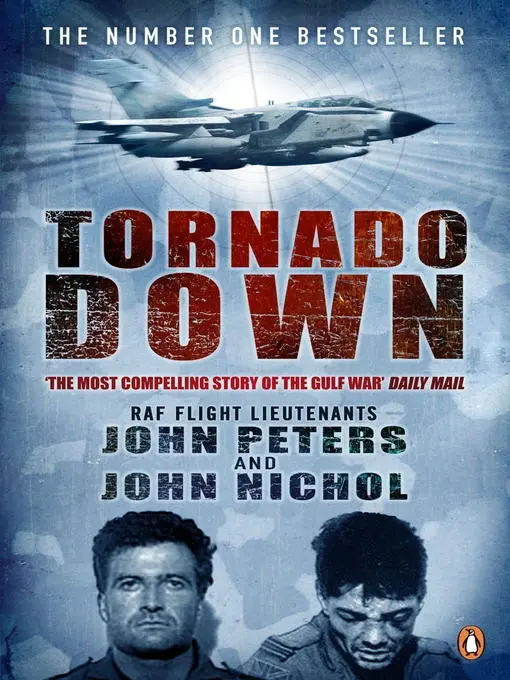
- Название:Tornado Down
- Автор:
- Издательство:Penguin Adult
- Жанр:
- Год:2008
- Город:London
- ISBN:978-0-14-193771-7
- Рейтинг книги:5 / 5. Голосов: 1
-
Избранное:Добавить в избранное
- Отзывы:
-
Ваша оценка:
Tornado Down: краткое содержание, описание и аннотация
Предлагаем к чтению аннотацию, описание, краткое содержание или предисловие (зависит от того, что написал сам автор книги «Tornado Down»). Если вы не нашли необходимую информацию о книге — напишите в комментариях, мы постараемся отыскать её.
In
, John Peters and John Nichol tell the incredible story of their part in the war against Saddam Hussien’s regime. It is a brave and shocking and totally honest story: a story about war and its effects on the hearts and minds of men.
Tornado Down — читать онлайн бесплатно полную книгу (весь текст) целиком
Ниже представлен текст книги, разбитый по страницам. Система сохранения места последней прочитанной страницы, позволяет с удобством читать онлайн бесплатно книгу «Tornado Down», без необходимости каждый раз заново искать на чём Вы остановились. Поставьте закладку, и сможете в любой момент перейти на страницу, на которой закончили чтение.
Интервал:
Закладка:
When we had all been sitting there most of the day, a guard came up. ‘You,’ he said, ‘are going for a little walk.’
They led me inside, where it was freezing. The room was like a small outhouse, its walls lined incongruously with farmyard implements. In the corner was a cast-iron toilet cistern, built sometime while Pontius was in Pilate training. But the thing that I found myself staring at was the black vinyl chair, backless, with a tubular metal frame, identical to the one I had been forced to sit in during the interrogations. The sight of it made my stomach lurch and turn over with fear. The chair. But it turned out they were not beating people this time. They gave me the same interrogation I later discovered everyone else had been through, about the plans for the ground offensive. Like everyone else, I could tell them nothing, even under threat of death.
When they had questioned everyone, they banged us all up for the night. I got immense strength from the fact that during the short walk into the prison I was in a shuffling crocodile made up of all my fellow countrymen and mates. I was part of a group again, even though I was going back into solitary. You don’t have to talk, always, to communicate.
After a couple of days on my own, I was moved into a cell with Jeff Zaun, who was in the grip of a vicious stomach bug. Most of the Americans had the most tremendous squits: perhaps the water supply on their floor had been contaminated. Although we were allowed out to relieve ourselves three times a day, Jeff had to go more often – much more often. He tore a large section off the plastic window-covering, and shat into that. He would then place the resulting package on the windowsill, in an effort to keep down the stink. Memorably, horribly, it still stank, festering away as the hours went by. He would keep it like this, and carry it to the toilet hole whenever we were allowed out. There was nothing else he could do. At night, when there was no one to see, he simply pissed out through the window grille. Because of his sickness, he had not eaten all the bread they! had given him – he’d hoarded a small pile of hard crusty stale pieces in the corner next to him. I really wanted that bread; I would have gobbled it up in a flash. At night, when it was really cold, we tried to warm one another – but it always ended up that the one against the cell wall got warm, while the other, sleeping on the outside, got freezing cold. So we finished up sleeping separately, and both of us froze.
21
The Blues Brothers
John Nichol: We drove across Baghdad for an hour, until the bus stopped outside another prison which the Americans immediately christened ‘Joliet’, after the penitentiary John Belushi is released from in The Blues Brothers . According to them, this new place looked just like the prison in that film. Each cell measured about six feet by ten, and was freezing cold, as usual, and fetchingly carpeted throughout in bird-shit. No blankets. They crammed six or seven of us into each little cubicle. This might seem bad, but it was bliss. This was the first time I had really been with anyone on the same side as me since being shot down. I actually knew some of the people in the room there with me; it was like being at a very small, very crowded party.
After an hour or so, we were allowed to visit the toilet. A couple of us helped Robbie Stewart, who was still without his crutch, to pay a visit. Mohammed Mubarak was with us, heavily bruised, but full of stories culled from the radio and the overheard chatter of the Iraqis. He said that the Allied ground offensive had begun on 21 February.
The luxury of communication. We stayed up all night, chatting, telling stories, even laughing. Everyone was suffering from the same feeling of sensory deprivation: they were bursting to talk, to recount, above all, their experiences of interrogation. It was the one dominant topic. Sitting in solitary confinement, everyone had reached the same conclusion: that they had given in too readily, that they should have held out much longer. The relief of learning that we had all given in, at pretty much the same stage, was immense. The burden of self-reproach and guilt was, for the moment at least, lifted. We were in prison, beaten to shit, we still didn’t know if we were going to survive, but we were on a fantastic high.
We slept for perhaps twenty minutes that night, no more, until a bright winter sun came slithering up the walls. When I woke, there was cacophony. We were in an old, nineteenth-century prison, but for a moment I thought I was on a crowded platform on the London Underground: thousands and thousands of voices, twittering and chirping like a huge flock of human sparrows, resounded in the corridors and courtyards of this aged gaol. There were two floors, the cells giving out onto internal balconies running right round the building on each floor. Guards patrolled this inner space. Through the bars in the cell door, we could see an endless tide of humanity, ebbing and flowing. It was like something out of Charles Dickens. There were thousands and thousands of these prisoners.
After a couple of weeks of Ba’ath Party hospitality, featuring nothing for breakfast, nothing for lunch and a bowl of gruel for tea, we were all extremely skinny, mere skeletons, as you might say, of our former selves. But now, the door clattered open, and lo! Food! A couple of trusties brought in a small amount of bread, a plastic washing-up bowl with steaming lentil soup slopping around in it (steaming!) and another washing-up bowl filled with hot sweet tea. We were suddenly very keen to stay in this lovely prison where we got our first hot food for weeks; but later that same morning they took us out, and sat us down in the prison courtyard, where we remained all day, under the blazing sun.
As if they had nothing better to do, the men detailed to watch us armed themselves with rubber truncheons, and passed the time walking among us, whacking people when the urge took them. JP turned up in the afternoon.
As the day wore on, they took us off one by one, for another round of questioning. All the interrogators wanted to know from us was: what could we tell them about the ground offensive? Where would the main Allied thrust come? Would there be a seaborne landing, a frontal assault on Kuwait City itself? Where would the paratroopers be used, would the US Marines be used? The interrogator went on and on, but of course I knew nothing. Finally, he said to me, ‘Nichol, I am giving you one chance to save your life now.’
‘What?’
‘I am giving you one chance only to save your life. Tell me something I will save your life for.’
‘What do you want me to tell you?’
‘Tell me something about the ground offensive that will help me save your life.’
I was trying quite hard to think of something I could tell him, since he seemed perfectly serious, but there was nothing, nothing at all. My ignorance must have been blindingly obvious to him.
He let me go.
As I was being led back into the courtyard, I passed JP, seated on one side. He looked wasted, as if he had been shrunk a couple of sizes in the wash. Wearing a horrible spade-shaped beard, he was hard to recognise as the same person.
They split us up into two groups, British and Americans, and marched us off in separate crocodiles, as if we were very small school-children. We each had to place one hand on the shoulder of the man in front, and keep our eyes fixed on the ground. JP and I manoeuvred ourselves next to one another. I put my right hand on his shoulder, and squeezed. JP reached his own hand up to cover mine, pressing firmly down on it. That touch was very important. It was a little moment of warmth; nothing more than an instant of human contact. But it made a difference; after the lonely horrors of the beatings and the solitary incarceration, the hatred of the surrounding Iraqis, I felt a surge of morale flooding back, and I could feel the same thing in JP.
Читать дальшеИнтервал:
Закладка:
Похожие книги на «Tornado Down»
Представляем Вашему вниманию похожие книги на «Tornado Down» списком для выбора. Мы отобрали схожую по названию и смыслу литературу в надежде предоставить читателям больше вариантов отыскать новые, интересные, ещё непрочитанные произведения.





Обсуждение, отзывы о книге «Tornado Down» и просто собственные мнения читателей. Оставьте ваши комментарии, напишите, что Вы думаете о произведении, его смысле или главных героях. Укажите что конкретно понравилось, а что нет, и почему Вы так считаете.