John Nichol - Tornado Down
Здесь есть возможность читать онлайн «John Nichol - Tornado Down» весь текст электронной книги совершенно бесплатно (целиком полную версию без сокращений). В некоторых случаях можно слушать аудио, скачать через торрент в формате fb2 и присутствует краткое содержание. Город: London, Год выпуска: 2008, ISBN: 2008, Издательство: Penguin Adult, Жанр: nonf_military, Биографии и Мемуары, на английском языке. Описание произведения, (предисловие) а так же отзывы посетителей доступны на портале библиотеки ЛибКат.
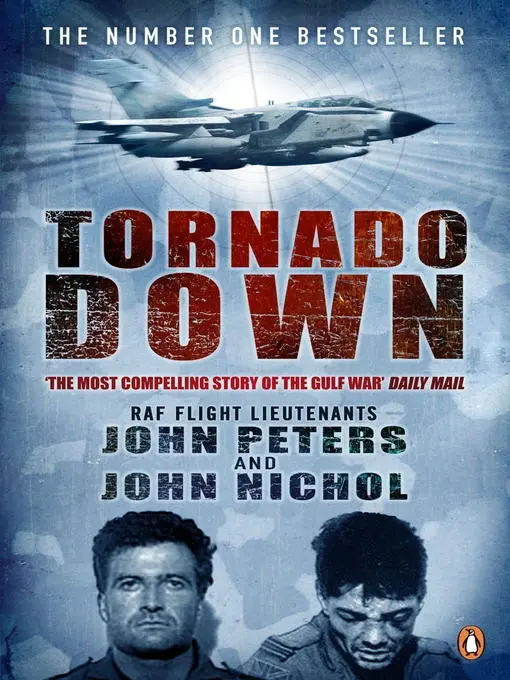
- Название:Tornado Down
- Автор:
- Издательство:Penguin Adult
- Жанр:
- Год:2008
- Город:London
- ISBN:978-0-14-193771-7
- Рейтинг книги:5 / 5. Голосов: 1
-
Избранное:Добавить в избранное
- Отзывы:
-
Ваша оценка:
Tornado Down: краткое содержание, описание и аннотация
Предлагаем к чтению аннотацию, описание, краткое содержание или предисловие (зависит от того, что написал сам автор книги «Tornado Down»). Если вы не нашли необходимую информацию о книге — напишите в комментариях, мы постараемся отыскать её.
In
, John Peters and John Nichol tell the incredible story of their part in the war against Saddam Hussien’s regime. It is a brave and shocking and totally honest story: a story about war and its effects on the hearts and minds of men.
Tornado Down — читать онлайн бесплатно полную книгу (весь текст) целиком
Ниже представлен текст книги, разбитый по страницам. Система сохранения места последней прочитанной страницы, позволяет с удобством читать онлайн бесплатно книгу «Tornado Down», без необходимости каждый раз заново искать на чём Вы остановились. Поставьте закладку, и сможете в любой момент перейти на страницу, на которой закончили чтение.
Интервал:
Закладка:
John Peters: As the dust was settling, I could hear other people being taken out of their cells. They reached me, but there was no way they could get my door open. Although several of them were straining and hacking at the doorframe, they could not even begin to budge it. Eventually they left, saying they would come back the next morning. There were six other prisoners wedged into their ruined cells; someone was howling and howling. Like the Iraqis, we were completely desperate to get out, we were all expecting a second wave of bombs to hit the prison at any time, to finish the job off, if it needed finishing. The whole place was crumbling around our ears, anyway. I could not believe the guards would simply leave us overnight in that wrecked hole.
Simon Burgess, from 17 (F) Squadron, was along the corridor, calling out. In the eerie silence of the ruined shell, only the dust sifting down between our words, the debris slowly trickling, he sounded near to tears. Simon was still suffering massive after-effects of shock.
‘My toilet is smashed,’ he said, ‘all the shit’s across the floor…’ I told him mine was too.
I felt a sudden surge of empathy for him. There is no good age to die, but I was twenty-nine, and had known Helen for ten years, we’d had happy days together, and we had two children. I had left something behind. Simon was much younger, and had been married for only four months. For some reason, the idea he might die that night hit me really hard. He hadn’t really had a chance. I felt pretty much the same for Rupert Clark, whose wife Sue had just moved to live in Germany with him, immediately after she had become pregnant. What was she going to feel if her husband got killed? Perhaps the way I felt about these two mates helped me deal with my own anxiety, transferring it to someone else. Perhaps I was repressing it. I did not think about whether I was going to get killed, but whether they were. In the end, I lay down among the rubble, to try to sleep, on the grounds that if the bombs did hit I would know less about it, and if I woke up at all it would be a bonus. The second wave never came.
Early next morning, squinting through the food hatch, I could just make out the empty corridor, knee-deep in smashed glass and rubble. As they had promised, the Iraqis returned, and began struggling once again to open the door. They failed. A number of them then climbed up onto the roof, where they started trying to crowbar open my cell window from the outside, again without success. They even passed me a crowbar, so that I could work at it from the inside. Finally, completely frustrated, they fetched sledgehammers, smashing them against the metal door, in a deafening tattoo. I sat with my hands pressed firmly over my ears, while the hammer-blows resounded around the room, but even so it was excruciating.
It was obvious they were getting very angry. I had managed to get hold of a small woven mat. I wrapped this around my middle, inside the yellow suit, to provide padding against the inevitable beating, and for warmth. In the end it became quite comic: the guards called in the Baghdad fire brigade, who turned up, strangely enough, looking very much like their Los Angeles counterparts, in black coal-scuttle hats and all the gear. The leader looked like Steve McQueen in The Towering Inferno . More practised in such emergencies, the firemen managed to break down the steel doors. I was the last prisoner freed. They hauled me downstairs to the basement. Here, a stinking lake of water mixed with petrol from ruptured fuel tanks lay ankle deep. I sploshed through it in the laceless plimsolls they had issued along with the yellow POW suits back at the Baghdad Bungalows. It was a miracle there had been no fire. As we emerged on the far side of this subterranean garage, I sneaked a look back at the prison. It was like the end of the world. There were huge slabs of concrete lying together crazily, great mounds of rubble, more glistening puddles of petrol and oil. Some were ablaze, billowing acrid black smoke. But for the scale of the destruction, it could have been contrived; it looked like a film-set. The guts of the building were hanging out into the carpark. At the far end of the open space, at the edge of the carpark, a group of prisoners was sitting on the ground. Simon Burgess was among them, swathed in blankets. I sat beside him, and the guards let us chat for a little while. Then one of them, who had been watching us, sauntered across. He looked admiringly at Simon’s dark hair gleaming in the bright sun. He had his thumbs hooked into the front of his belt. Standing over Simon, the guard smiled winsomely down at him: ‘You very pretty boy,’ he said, nodding and winking at his fellow guards.
Simon was pale anyway, but he turned a shade paler. You did not have to be a genius to guess what the Iraqi was after. ‘No,’ said Simon hurriedly, ‘I’m married. I’ve got a wife.’ The other guards were laughing and pointing, they found this attempt to chat up Simon vastly amusing. He didn’t quite see the joke. The last thing we wanted at this stage was the Iraqis gang-banging us. The guard moved closer, and sat down next to us on the hard ground.
At that moment the air-raid sirens went off.
They pushed us at a fast trot out of the carpark, straight onto what we realised were the streets of Baghdad. Through a hole in the blankets they made us put over our heads, I could see we were walking among the crowds, in the centre of a busy teeming city, in the bright sunshine, in our yellow uniforms. People began staring and pointing at us, muttering angrily. It was as if the guards were showing us, and themselves, off, as if they were proud to be the ones who were in charge of us. We felt extremely vulnerable. We were outside the prison, which was definitely a welcome change, but being outside meant we were at the mercy of these people, whose city had been massively bombed. They must already have lost most of their essential services, electricity, piped water… So it was a huge relief when we arrived in a relatively quiet street, at a small, very ordinary-looking, detached civilian house, where they pushed us down into the front garden. Having learned that Allied aircraft would not strike at civilian targets, the military were occupying residential buildings, evicting their rightful owners. After the all-clear had sounded, we were pushed and prodded at a fast trot back through the streets, to some kind of small headquarters building. Here, they loaded us into a Range Rover. We passed blue-painted mosques, with tall beautiful minarets, gleaming in the strong sun, and the much less beautiful pictures of Saddam Hussein plastered up on giant hoardings by the roadside, which seemed to come up every five minutes. Then we filtered onto the Baghdad ring-road. Heading northwest and then west, judging by the position of the sun and the time of day, we sped past a Triple-A site by the side of the dual carriageway, its gun-barrels angled up at sixty degrees. Here we turned off, bumping along the perimeter of a rubbish tip. Black birds were scavenging among the plastic bottles, polythene bags billowing in the stiff breeze. Some dogs were fighting and snarling over a scrap of food. We had arrived at ‘Joliet’. The guards dumped us down in the same courtyard where the others were waiting. I spotted John Nichol immediately. He looked about half his original bodyweight. He winked at me. I muttered something to the man next to me. A guard immediately came up and whacked me twice over the head with his rifle, for daring to speak without permission. To stop us communicating, we were spread out at wide intervals in the huge courtyard. Just to make sure, everyone had to put his blanket over his head again. We were sitting there cross-legged, like little human pyramids, some shivering in the deep dark shadow cast by the prison walls, some sweating in the bright sun. Through the hole in my blanket, I was inching my head round to see what was going on. But whenever the vigilant guards saw the slightest movement anywhere, they came and smacked the offending head back down. I picked up some pebbles, and a tiny seashell, lying in the dirt at my feet. Later, I played Fivestones with them in the cell, the game coming back to me from my childhood. I also found a slender sliver of wood, about three inches long, which converted into a brilliant needle for sewing up the holes in my blanket, using thread teased out from the frayed ends.
Читать дальшеИнтервал:
Закладка:
Похожие книги на «Tornado Down»
Представляем Вашему вниманию похожие книги на «Tornado Down» списком для выбора. Мы отобрали схожую по названию и смыслу литературу в надежде предоставить читателям больше вариантов отыскать новые, интересные, ещё непрочитанные произведения.





Обсуждение, отзывы о книге «Tornado Down» и просто собственные мнения читателей. Оставьте ваши комментарии, напишите, что Вы думаете о произведении, его смысле или главных героях. Укажите что конкретно понравилось, а что нет, и почему Вы так считаете.