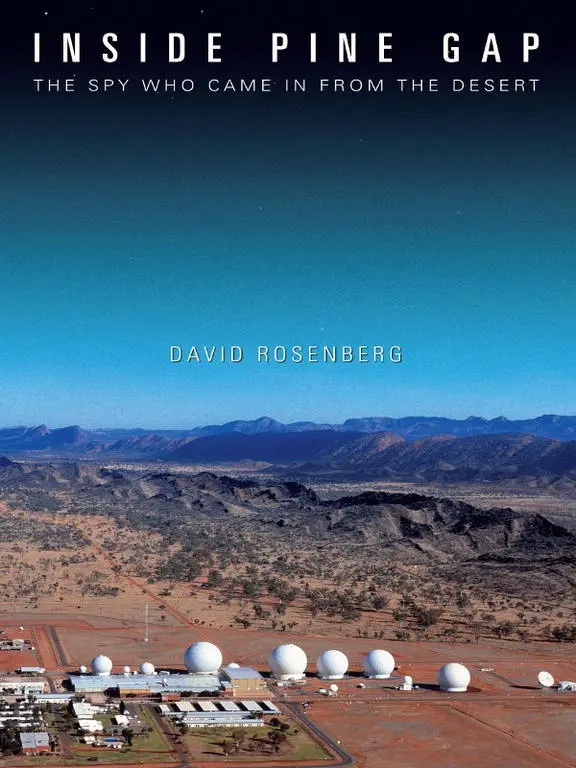
David Rosenberg - Inside Pine Gap
Здесь есть возможность читать онлайн «David Rosenberg - Inside Pine Gap» весь текст электронной книги совершенно бесплатно (целиком полную версию без сокращений). В некоторых случаях можно слушать аудио, скачать через торрент в формате fb2 и присутствует краткое содержание. Город: Melbourne, Год выпуска: 2011, ISBN: 2011, Издательство: Hardie Grant Books, Жанр: Биографии и Мемуары, Политика, на английском языке. Описание произведения, (предисловие) а так же отзывы посетителей доступны на портале библиотеки ЛибКат.
- Название:Inside Pine Gap
- Автор:
- Издательство:Hardie Grant Books
- Жанр:
- Год:2011
- Город:Melbourne
- ISBN:978-1-742-70173-8
- Рейтинг книги:4 / 5. Голосов: 1
-
Избранное:Добавить в избранное
- Отзывы:
-
Ваша оценка:
Inside Pine Gap: краткое содержание, описание и аннотация
Предлагаем к чтению аннотацию, описание, краткое содержание или предисловие (зависит от того, что написал сам автор книги «Inside Pine Gap»). Если вы не нашли необходимую информацию о книге — напишите в комментариях, мы постараемся отыскать её.
Author David Rosenberg details his career with an American intelligence agency during a tumultuous period in history that covered the terms of three American Presidents, four Australian Prime Ministers, the end of the Cold War, a peace treaty between Israel and Jordan, two wars in Iraq, genocide in Rwanda, as well as the ‘War against Terror’ and the emergence of North Korea as a nuclear-armed nation. This is a fascinating glimpse inside the top-secret world of military surveillance.
[This book contain a table.]
Inside Pine Gap — читать онлайн бесплатно полную книгу (весь текст) целиком
Ниже представлен текст книги, разбитый по страницам. Система сохранения места последней прочитанной страницы, позволяет с удобством читать онлайн бесплатно книгу «Inside Pine Gap», без необходимости каждый раз заново искать на чём Вы остановились. Поставьте закладку, и сможете в любой момент перейти на страницу, на которой закончили чтение.
Интервал:
Закладка:
For me, learning about Aboriginal culture was a novel experience. I met many Aboriginals and people of mixed blood in various businesses and as guides or caretakers at the various tourist sites in and around Alice Springs. I also learnt more about the Australian Dreamtime through stories that explain the natural world and how people came to live in it. One of the local Dreamtime legends in Alice Springs relates the story of the caterpillar beings who are said to have formed Emily Gap and much of the landscape around Alice Springs. An ancient rock painting of the caterpillars can still be seen at Emily Gap, which became a very special place for me. In 2004 I commissioned a local friend and very talented artist, Craig Saunders, to paint what became an incredibly beautiful painting of this unique place. To an American this was all a fascinating history, and I found the local Aboriginal people very friendly and helpful. The many and varied Aboriginal paintings found in my home serve as fond memories of my time in the Alice.
One of my African-American friends from the United States Army enjoyed spending time with the Aboriginal people and told me how he learned about ‘skin names’. He told me the Aboriginals use skin names to help identify who one could marry to prevent such things as inbreeding, explaining that skin names are like family surnames that are further broken down into male and female designations. As he learned more about the Aboriginal culture, a friend of his from the Arrernte people presented him with a dot painting that depicted my friend’s life story based on the information he’d provided. These sincere friendships continued to play a vital part in ‘narrowing the gap’ between the local Aboriginal and Pine Gap communities.
While most people in Alice Springs live in harmony, it was clear that there were still some racial divisions. After Darwin, Alice Springs has the second-highest crime per capita of any Australian city. [4] http://en.wikipedia.org/wiki/Crime_in_the_Northern_Territory
The high crime rate among both Aboriginal and non-Aboriginal populations consists largely of domestic violence, daily vandalism to businesses, graffiti, and a relatively high murder rate for such a small population. Truancy and alcohol are major problems and while there is no clear solution to either of these, education seems to be the key to breaking the cycle for future generations.
Central Australia offers a variety of different landscapes, and as a new arrival to Alice Springs one of my early trips was to Australia’s best-known opal fields in Coober Pedy, South Australia. When I saw how diverse opals were, they became my favourite gemstone. Of all the places I have visited, Coober Pedy has to be the most unique. Before my friends and I arrived at the centre of this very small town, we began to see small dirt mounds formed from mine shafts. As we got closer to town, more mounds appeared, until we eventually saw hundreds of mounds in every direction. I then saw one of the strangest warning signs I had ever seen—it was a sign of a person walking backwards with a diagonal line through the centre. The warning was clear: if you walked backwards, you were likely to step into an opal mine shaft. Point taken! It was a memorable trip, and I remember a sobering talk with my friends about how easy it would be to fall into one of those mine shafts. This, coupled with a prevalence of potentially deadly snakes such as the brown, king brown and death adder, meant that Central Australia could be a very dangerous place.
It wasn’t just the piles of dirt and shafts everywhere that made Coober Pedy unique. The weather is inhumanely hot and dry in summer, with rainfall considered to be a rare event, forcing many residents to live underground where the temperature can be more easily regulated. Some underground residents continue to dig horizontally, creating a new room while finding enough opal to pay for the furnishings. Coober Pedy also boasts an underground Anglican house of worship, ‘The Catacomb Church’, which caters to around six Protestant denominations. My friends and I went to some excavated opal dirt piles and did some ‘noodling’ for opals—searching through the piles of dirt for some overlooked precious white and crystal opal. Although we did find small amounts, we went back into town and bought some uncut stones. We took them back to the lapidary shop at Pine Gap, where we were able use the equipment to cut and polish almost every type of precious stone found in Australia. (The lapidary shop at Pine Gap was used by many of the Americans who discovered the wide array of gems that can be found in different parts of the rich Australian outback.)
I would later drive out to the amethyst fields near Glen Helen Gorge and the garnet fields at Gemtree hoping to find those semiprecious stones as well.
Travel was a significant part of the lifestyle in Alice Springs, and I visited Adelaide and Cairns with friends, finally experiencing the beauty of one of the world’s natural wonders, the Great Barrier Reef. My thirst for travel grew while I was in the confines of Alice Springs and I eventually visited Bali and most of the Australian capital cities. The opportunity for regular travel in this part of the world was simply not possible when I worked in Maryland, so I took advantage of my time in Australia to discover and learn more about this vast country.
I also found several places to abseil with a good mate who was with the Australian Protective Service, the government department that provided security to the perimeter around Pine Gap. I also purchased my first motorcycle, a small Suzuki 250, and explored the open off-road spaces around Alice Springs while discovering that the limitless outback proved to be the perfect setting for learning how to ride. I wasn’t the only one who appreciated the hot weather combined with no speed limit: it was also attractive to the Chevrolet company, who typically shipped the newest model Corvette to Alice Springs for hot-weather, high-speed testing. Once every year it was a common sight to see a lucky driver behind the wheel of a new left-hand-drive Corvette, motoring around Alice Springs with the hood covered in a ‘car bra’ so as not to reveal the details of the new-look Corvette.
The senior leadership at Pine Gap could typically rely on the Americans to blend in and make a positive contribution to the community, but occasionally someone managed to get into some kind of trouble. When this occurred, he or she would often be forced to pack that night and take the first flight home to face disciplinary action.
Early into the new millennium, an incident in the Aces Bar at Lasseters caused one contractor to be forced to return home. One night, he and some friends were socialising with some local women. The conversation eventually focused on the Australian women’s opinion that all American men wear Y-front underwear, and it was always white. With a few drinks under his belt, this individual volunteered to prove the Aussie women wrong. ‘My underwear’s not white,’ he said. ‘It’s blue with grey checks; and I’m wearing a thong.’ He then dropped his trousers to prove his point. With the casino’s security cameras still rolling, he was quickly escorted off the premises. When he attempted to re-enter the bar to retrieve his cigarettes and was refused entry, he hit the security guard, which was also captured on film.
Needless to say, the incident was soon reported to Security at Pine Gap and he was told he had to leave Alice Springs. He took the news as well as could be expected, even laughing about the underwear story with his manager. He survived this incident, managed to retain his security clearance, and continues a successful career with the same contractor at another overseas posting. After almost forty years, Harry’s first rule about not tolerating unacceptable behaviour was still, I’m glad to say, firmly in place.
Читать дальшеИнтервал:
Закладка:
Похожие книги на «Inside Pine Gap»
Представляем Вашему вниманию похожие книги на «Inside Pine Gap» списком для выбора. Мы отобрали схожую по названию и смыслу литературу в надежде предоставить читателям больше вариантов отыскать новые, интересные, ещё непрочитанные произведения.







Обсуждение, отзывы о книге «Inside Pine Gap» и просто собственные мнения читателей. Оставьте ваши комментарии, напишите, что Вы думаете о произведении, его смысле или главных героях. Укажите что конкретно понравилось, а что нет, и почему Вы так считаете.