Thomas Goltz - Chechnya Diary
Здесь есть возможность читать онлайн «Thomas Goltz - Chechnya Diary» весь текст электронной книги совершенно бесплатно (целиком полную версию без сокращений). В некоторых случаях можно слушать аудио, скачать через торрент в формате fb2 и присутствует краткое содержание. Город: New York, Год выпуска: 2011, ISBN: 2011, Издательство: Thomas Dunne Books, Жанр: Биографии и Мемуары, military_history, Публицистика, на английском языке. Описание произведения, (предисловие) а так же отзывы посетителей доступны на портале библиотеки ЛибКат.
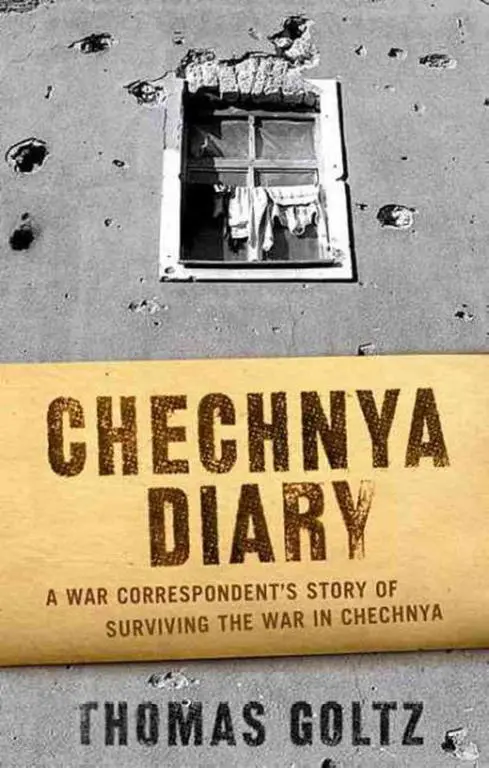
- Название:Chechnya Diary
- Автор:
- Издательство:Thomas Dunne Books
- Жанр:
- Год:2011
- Город:New York
- ISBN:0-312-26874-2
- Рейтинг книги:3 / 5. Голосов: 1
-
Избранное:Добавить в избранное
- Отзывы:
-
Ваша оценка:
Chechnya Diary: краткое содержание, описание и аннотация
Предлагаем к чтению аннотацию, описание, краткое содержание или предисловие (зависит от того, что написал сам автор книги «Chechnya Diary»). Если вы не нашли необходимую информацию о книге — напишите в комментариях, мы постараемся отыскать её.
is part of a larger exploration of the role (and impact) of the media in conflict areas. And at its heart,
is the story of Hussein, the leader of the local resistance in the small town that bears the brunt of the massacre as it is drawn into war.
This is a deeply personal book, a first person narrative that reads like an adventure but addresses larger theoretical issues ranging from the history of ethnic/nationalities in the USSR and the Russian Federation to journalistic responsibility in crisis zones.
is a crossover work that offers both the historical context and a ground-level view of a complex and brutal war.
Chechnya Diary — читать онлайн бесплатно полную книгу (весь текст) целиком
Ниже представлен текст книги, разбитый по страницам. Система сохранения места последней прочитанной страницы, позволяет с удобством читать онлайн бесплатно книгу «Chechnya Diary», без необходимости каждый раз заново искать на чём Вы остановились. Поставьте закладку, и сможете в любой момент перейти на страницу, на которой закончили чтение.
Интервал:
Закладка:
Academic institutions or individuals who have influenced my thinking (or indirectly supported me by means of invitations to speak) include Ned Walker of Berkeley, Stephen Jones of Mount Holyoke, Fred Starr and Charles Fairbanks of Johns Hopkins in D.C., as well as Ken Jensen, executive director of the American Committee on Foreign Relations, who sent me spinning through the American heartland to tell the good folks of Casper, Billings, Boise, Little Rock, Louisville, Tampa, Salt Lake, Rochester (and elsewhere) of the dynamic at play in Chechnya and the Caucasus. Paul Henze shared many published and unpublished manuscripts on the Caucasus with me, and directed me to such luminaries as the Benningsons and Moshe Gammon. I also owe a great debt to Valeri Tishkov for his significant contribution to the study of ethnic insanity in the former USSR, best summed up by the subtitle of his classic Ethnicity, Nationalism and Conflict in and After the Soviet Union: The Mind Aflame (1997) as well as to Terry Martin, whose The Affirmative Action Empire (2001) should soon be declared to be the academic benchmark on the formative process of Soviet nationalities policy. Other useful works that I should mention include Ben Fowkes’s Russia and Chechnya: The Permanent Crisis (2000), Robert Seely’s Russo-Chechen Conflict 1800-2000 (2001), as well as diverse articles and books by the remarkable Ron Suny, whose bibliography of work on the Caucasus might fill up a volume by itself.
Then there is Georgii Derlugian, professor of sociology at Northwestern University, to whom I wish to give special thanks not only for sharing his insights, but for squeezing me out of the realm of romancing the Chechens as noble warriors and to see their particular tragedy as part of a larger sociological context of state building and (self-) destruction. The essence of his argument, set forth in a series of deliciously complex articles in publications such as the New Left Review , and soon to appear in book form, is that the Chechen bid for independence was doomed to failure from the start because of the collapse of the USSR, and the fact that rebellious Chechnya lacked a client relationship with an outside power that would have elevated the Chechen-Russian confrontation to that of a battle of proxies in the larger Cold War. Instead, the brutalized and betrayed Chechens are now in the process of reverting from being a national community to being a religious group—and one more inspired by the Wahhabite school of Islam, practiced by Osama bin Laden, than the nationalist aspirations of Chechen President Djohar Dudayev a decade before.
The above reference to the late president of Chechnya is a good point of departure to lay out a few notes on transliterations of proper names from Russian and Chechen. In the literature, the reader encounters everything from Dzhokhar to Djohar to Jokhar and even Johar. I have opted for the most common of the variations, Djohar, because it is closest to the sound of the name when spoken in English. Other common Muslim names, such as Ibrahim and Muhammad, have been rendered as pronounced in Chechen (or Turkish or Arabic) and not how such names are transliterated in English from Russian, which lacks a soft h and replaces that consonant with a g —e.g., Ibragim and Mugammad/Mogammad—rather like transliterating “Henry” to “Genry.”
Finally, I would like to thank both my literary agent, Diana Finch, and editor and publisher, Peter Wolverton, for their extreme patience with me in finishing this book. By my estimation, I was embarrassingly close to being exactly seven hundred days overdue in submitting the manuscript in its final form.
The reasons for that, I hope, will become clear to anyone who reads the following pages. Writing the story of Samashki and Hussein has been a very painful process.
I fervently hope that it has been worth it for all concerned.
ALSO BY THOMAS GOLTZ
Azerbaijan Diary
Copyright

CHECHNYA DIARY. Copyright © 2003 by Thomas Goltz. All rights reserved. No part of this book may be used or reproduced in any manner whatsoever without written permission except in the case of brief quotations embodied in critical articles or reviews. For information, address St. Martin’s Press, 175 Fifth Avenue, New York, N. Y. 10010.
THOMAS DUNNE BOOKS.
An imprint of St. Martin’s Press.
www.stmartins.com
Book design by Jonathan Bennett
eISBN 9781429974356
First eBook Edition : May 2011
Map © 2003 Mark Stein Studios
Library of Congress Cataloging-in-Publication Data
Goltz, Thomas.
Chechnya diary: a war correspondent’s story of surviving the war in Chechnya / Thomas Goltz.
p. cm.
ISBN 0-312-26874-2
1. Goltz, Thomas. 2. Chechnëì (Russia)—History—Civil War, 1994—Personal narratives, American. 3. War correspondents—United States—Biography I. Title.
DK511.C37G65 2003
947.5'2—dc21
2003054967
First Edition: October 2003
Notes
1
The Russian vernacular for the American greenback is indeed pronounced “bucks.”
2
Cf. Justin McCarthy’s Death and Exile: the Ethnic Cleansing of Ottoman Muslims, 1821-1922 (Princeton: Darwin Press, 1995).
3
Aleksandr Solzhenitsyn, Gulag Archipelago, Vol. 3, trans. Harry Willets (New York: HarperCollins, 1992), pp. 401-402.
4
Martin Cruz Smith, Red Square (New York: Random House/Ballantine Books, 1992), pg. 57.
5
Cf. Carlotta Gall and Thomas de Waal, Chechnya: A Small Victorious War (London: Macmillian/Pan, 1997), p. 83.
6
Peter Fleming, brother of Ian, describes this same disconcerting audio phenomenon in One’s Own Company , his book about wandering around in Manchuria and China in the mid-1930s.
7
There is no such thing as the Washington Red Cross, and I wondered who Vakha’s angel might have been. Rachel Danbar from Human Rights Watch?
8
Sakharov Foundation, By All Available Means, Memorial Report (Moscow, 1996), p. 22.
9
Sonia Mikich, Planet Moskau: Geschichten aus dem neuen Russland (Köln: Verlag Kiepenheuer und Witsch, 1998), pp. 128, 129. Translation from the German is mine.
10
The Mothers’ Movement was organized on a shoestring budget by Maria Iva nova Kirbasova from the Turkic/Buddhist Russian subrepublic of Kalmukia.
11
Later I learned that I, too, had allegedly been beaten, tortured, and likely killed in the military detention center at Mozdok. Concern for me was such that Shirvani had breached the lines and traveled to Ingushetia in search of word of my whereabouts and health. Apparently, the shaven pate of one of the monks had been mistaken for my own hairless dome. By further distortion, it is likely that this is how I came to be mistaken for the doomed Fred Cuny, or vice-versa. Cf. Scott Anderson, The Man Who Tried To Save The World: The Dangerous Life and Mysterious Disappearance of Fred Cuny (New York: Doubleday, 1999), p. 320.
12
Cf. Mikich, op. cit. p. 132. Translation from the German is mine.
13
Sonia’s sole public recollection is that I ruined her beauty sleep by snoring—and thus earned the name she still calls me: Radio Montana.
Читать дальшеИнтервал:
Закладка:
Похожие книги на «Chechnya Diary»
Представляем Вашему вниманию похожие книги на «Chechnya Diary» списком для выбора. Мы отобрали схожую по названию и смыслу литературу в надежде предоставить читателям больше вариантов отыскать новые, интересные, ещё непрочитанные произведения.




Обсуждение, отзывы о книге «Chechnya Diary» и просто собственные мнения читателей. Оставьте ваши комментарии, напишите, что Вы думаете о произведении, его смысле или главных героях. Укажите что конкретно понравилось, а что нет, и почему Вы так считаете.