Thomas Goltz - Chechnya Diary
Здесь есть возможность читать онлайн «Thomas Goltz - Chechnya Diary» весь текст электронной книги совершенно бесплатно (целиком полную версию без сокращений). В некоторых случаях можно слушать аудио, скачать через торрент в формате fb2 и присутствует краткое содержание. Город: New York, Год выпуска: 2011, ISBN: 2011, Издательство: Thomas Dunne Books, Жанр: Биографии и Мемуары, military_history, Публицистика, на английском языке. Описание произведения, (предисловие) а так же отзывы посетителей доступны на портале библиотеки ЛибКат.
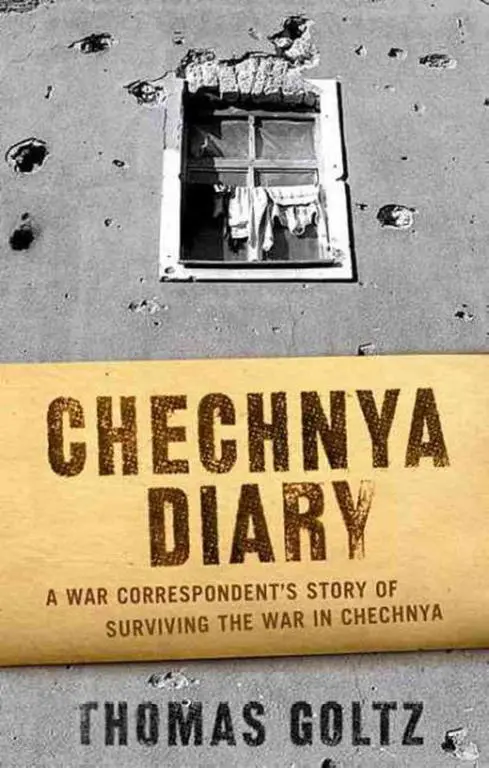
- Название:Chechnya Diary
- Автор:
- Издательство:Thomas Dunne Books
- Жанр:
- Год:2011
- Город:New York
- ISBN:0-312-26874-2
- Рейтинг книги:3 / 5. Голосов: 1
-
Избранное:Добавить в избранное
- Отзывы:
-
Ваша оценка:
Chechnya Diary: краткое содержание, описание и аннотация
Предлагаем к чтению аннотацию, описание, краткое содержание или предисловие (зависит от того, что написал сам автор книги «Chechnya Diary»). Если вы не нашли необходимую информацию о книге — напишите в комментариях, мы постараемся отыскать её.
is part of a larger exploration of the role (and impact) of the media in conflict areas. And at its heart,
is the story of Hussein, the leader of the local resistance in the small town that bears the brunt of the massacre as it is drawn into war.
This is a deeply personal book, a first person narrative that reads like an adventure but addresses larger theoretical issues ranging from the history of ethnic/nationalities in the USSR and the Russian Federation to journalistic responsibility in crisis zones.
is a crossover work that offers both the historical context and a ground-level view of a complex and brutal war.
Chechnya Diary — читать онлайн бесплатно полную книгу (весь текст) целиком
Ниже представлен текст книги, разбитый по страницам. Система сохранения места последней прочитанной страницы, позволяет с удобством читать онлайн бесплатно книгу «Chechnya Diary», без необходимости каждый раз заново искать на чём Вы остановились. Поставьте закладку, и сможете в любой момент перейти на страницу, на которой закончили чтение.
Интервал:
Закладка:
The Baku-based Chechen journalist Mahirbek Tamarov teams up with Djohar Dudayev’s widow, Alla Dudayeva, on a quixotic mission aimed at stripping Aleksandr Solzhenitsyn of his Nobel Prize for Literature. The man who once lauded the Chechens as being the only people who remained unbroken in the Gulag is now charged by those same unbroken people to have embraced a Great Russian cultural chauvinism that borders on racism.
Uncle Lawrence Sheets quits Reuters and spends a year studying fencing, astronomy, and Chinese at Stanford University, as part of a one-year special journalist scholarship that is designed to help overworked hacks chill out, then takes on the job of Moscow office bureau chief for National Public Radio just in time to cover the American-led invasion of Afghanistan in the wake of September 11.
He is at Mazari-Sharif at the time of the capture of the so-called American Taliban, John Walker Lindh.
“Why don’t you come on down?” chides Uncle Larry. “There are kids down here straight out of journalism school making four hundred dollars a day as producers. It’s a madhouse!”
I give Afghanistan a pass. I would give Iraq a pass, too.
Then came the spectacular October 2002 seizure of 750 hostages at the Moscow House of Culture by a squad of fifty Chechen suicide commandos, including fifteen women dressed in Islamic-style chadors who make their demands under the green banner of Islam and not the Chechen national flag. World opinion decides that the hostage takers probably deserved their executions at the hands of Russian commandos, who storm the theater after gassing everyone inside. Some 120 hostages also perish along with the hostage takers, who are individually shot in the head as they lie prone on the floor. The executors go so far as to place a bottle of cognac in the limp hand of the theater seizure action’s leader, a twenty-five-year-old man named Movladi Barayev. He hailed from Alkhan Yurt, the village that had replaced Samashki as the symbol of wanton Russian brutality, after it was blitzed and massacred in December 1999.
On February 20, 2003, ABC News broadcasts a report citing the U.S. Customs Service, who had been tipped off by the Russian Security Service that two Chechen “terrorists” traveling on false Georgian passports “may be attempting” to illegally cross the frontier from Mexico into the United States and make their way up to Montana:
The alert warns that the pair may be followed by four more Chechens from Georgia’s lawless frontier region of the Pankisi Gorge on the border with Chechnya.
U.S. officials are concerned because elements of the Chechen resistance are aligned with Al Qaeda, and they believe the gorge has served as a haven for at least some Al Qaeda fighters fleeing Afghanistan.
Whether this is the start of a trend, the Service says, is still unclear.
It is also unclear what the two Chechens would do in Montana.
Were Hussein or any of his men among the “terrorists”?
Had he become a terrorist?
Was Hussein a terrorist all along?
What was a terrorist?
Was he alive?
Did it matter anymore?
My war went on without me.
Maybe it had never been my war.
Then I got the phone call.
Actually, it was a garbled message on my parents’ answering machine in Bozeman, the town over the mountain from my hideout in Livingston. The essence was that someone’s neighbor in Moscow, who spoke some English, was delivering a message from someone else, whose name was unintelligible, and was leaving a telephone number for me to call back. The problem was that the prefix was neither Moscow nor Russia.
I called it anyway, ringing through an international operator.
“Alma Ata, Kazakhstan, for you sir,” the operator cheerily announced.
“Govorit Tomas Goltz,” I said in Russian. “With whom am I speaking?”
“This is Musa,” said the voice on the other end of the world, twelve time zones away. “Just a second and I will get him.”
And then another disembodied voice was on the line. A voice that breathed exhaustion and remorse and a desperation so profound I have difficulty putting it into words.
Hussein.
“I must see you,” he croaked into the receiver, voice distorted by thousands of electrical miles. “I do not trust anyone else in the world.”
He had gone back to war again, but was now back in exile, seething.
I told him he could rely on me, that I would find my way once again to the town in distant Kazakhstan called Little Hope, his place of exile, his home.
I have yet to keep the pledge, because I have been working on our book of war, as some sort of testament or at least reminder of human foibles and frailty but also devotion.
Myself, I never want to see war again.
As I look up from my desk, literally on the last page of correcting this manuscript before it goes to the publisher to be set in stone, I find two Spring-shaggy young bucks standing in my shrub garden, not twenty feet away, staring at me. Their audacity is so outrageous it makes me laugh for the first time in an ice age, and I only chase them away to save the bushes. Otherwise, they could stay all day, stay forever.
They are the Chechen visitors to Montana that ABC warned me to look out for, friends, symbols from my muddy little town on the north Chechen plain.
Samashki, the Place of Deer.
acknowledgments
There are many people involved in the creation of this book, some whose family names I never knew, remember imperfectly, or chose not to reveal.
At the top of the list is Hussein and his extended family, who invited me into their lives during a period of extreme confusion and duress. I doubt any will ever see this work, but for the record: barkal to Ussam, Shirvani, Xamid, Seylah, Sultan, Rana, as well as Isa, Musa, Muhammad, Commander Ali and his sons Osman and Omar, Akhmad Amaev, and all other friends, alive or dead, from the small town of Samashki.
Although most of my work was performed solo, at times I was often dependent on the generosity of friends and colleagues for transportation, telephone, and even toothpaste. Special thanks are thus due the extraordinary Lawrence Sheets, Elif Kaban, Robert Finn, Andrew Harding, Alexis Rowell, Colin Peck and Sonia Mikich, Stanley Greene, Natalie Nougayrede, Rachel Danbar, Peter Burckhardt, Vanora Bennett, Steve Coppen of ABC TV/Moscow, and, hugely, Danny Schechter of PBS/Global Vision. Other angels in the media include Mark Foley, Bill Holstein, Kevin Buckley, the BBC’s Keith Bowers, and Nik Gowing. Hand-holders range from Margot Kidder, Bill Campbell and Teddy Yates in Montana and, particularly, Jeannie Matthews in London. Readers and critics of the draft manuscript include Charles Frissell, Uta Gaedeke, Bob Mason, Judy Muncy, Gengiz Hancer and, especially, Doctor Ewen Patterson. Thanks to each and every one.
Those who have written books on Chechnya represent a small circle of friends and colleagues whose devotion to the tragic subject does not allow for rivalry. I cite only a few here. Tom de Waal and Carlotta Gall’s Chechnya: A Small Victorious War (U.K. 1997, U.S.A. 1998) was the first contemporary history about the war in Chechnya written by western journalists and it remains a milestone accomplishment of analysis and powerful writing. Anatol Lieven’s Chechnya: Tombstone of Russian Power (1998) is arguably the most comprehensive analytical work to appear to date, and is essential reading. Sebastian Smith’s Allah’s Mountains (1998) and Chris Bird’s To Catch a Tatar (2002) are well-written accounts of their experiences in the Caucasus with a focus on the first round of war of 1994-96. The category of woman-goes-to-war is covered by the Russian journalist Anna Politkovskaya in her A Dirty War (2001) and the French reporter Anne Nivat in her Chienne du Guerre (2001), both of which are gritty journalistic accounts of the renewed violence of 1999. Vanora Bennett’s Cry Wolf! (1998) is more a rhapsody of discovery of the Chechens, while Scott Anderson’s The Man Who Tried to Save the World (1999) is a fascinating study of the life and times of the American aid worker Fred Cuny, who disappeared in Chechnya, even though most of his life (and thus the focus of the book) was spent elsewhere. Yo’av Karny’s The Highlanders (2000) contains important material on the Chechen diaspora community in the Middle East.
Читать дальшеИнтервал:
Закладка:
Похожие книги на «Chechnya Diary»
Представляем Вашему вниманию похожие книги на «Chechnya Diary» списком для выбора. Мы отобрали схожую по названию и смыслу литературу в надежде предоставить читателям больше вариантов отыскать новые, интересные, ещё непрочитанные произведения.




Обсуждение, отзывы о книге «Chechnya Diary» и просто собственные мнения читателей. Оставьте ваши комментарии, напишите, что Вы думаете о произведении, его смысле или главных героях. Укажите что конкретно понравилось, а что нет, и почему Вы так считаете.