Thomas Goltz - Chechnya Diary
Здесь есть возможность читать онлайн «Thomas Goltz - Chechnya Diary» весь текст электронной книги совершенно бесплатно (целиком полную версию без сокращений). В некоторых случаях можно слушать аудио, скачать через торрент в формате fb2 и присутствует краткое содержание. Город: New York, Год выпуска: 2011, ISBN: 2011, Издательство: Thomas Dunne Books, Жанр: Биографии и Мемуары, military_history, Публицистика, на английском языке. Описание произведения, (предисловие) а так же отзывы посетителей доступны на портале библиотеки ЛибКат.
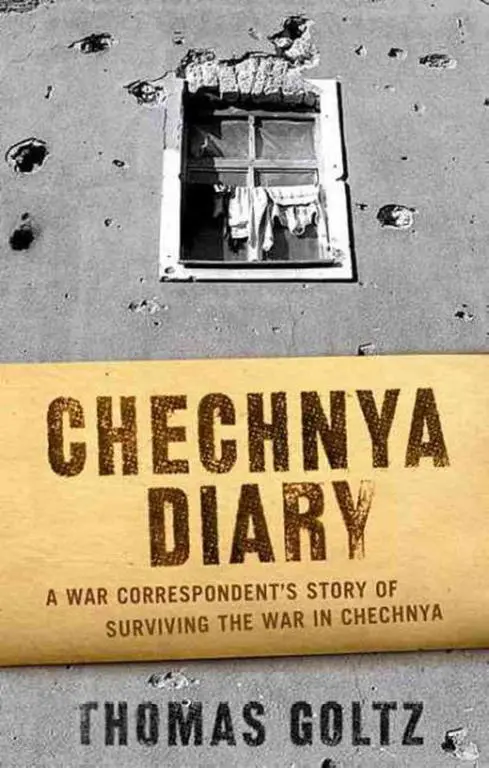
- Название:Chechnya Diary
- Автор:
- Издательство:Thomas Dunne Books
- Жанр:
- Год:2011
- Город:New York
- ISBN:0-312-26874-2
- Рейтинг книги:3 / 5. Голосов: 1
-
Избранное:Добавить в избранное
- Отзывы:
-
Ваша оценка:
Chechnya Diary: краткое содержание, описание и аннотация
Предлагаем к чтению аннотацию, описание, краткое содержание или предисловие (зависит от того, что написал сам автор книги «Chechnya Diary»). Если вы не нашли необходимую информацию о книге — напишите в комментариях, мы постараемся отыскать её.
is part of a larger exploration of the role (and impact) of the media in conflict areas. And at its heart,
is the story of Hussein, the leader of the local resistance in the small town that bears the brunt of the massacre as it is drawn into war.
This is a deeply personal book, a first person narrative that reads like an adventure but addresses larger theoretical issues ranging from the history of ethnic/nationalities in the USSR and the Russian Federation to journalistic responsibility in crisis zones.
is a crossover work that offers both the historical context and a ground-level view of a complex and brutal war.
Chechnya Diary — читать онлайн бесплатно полную книгу (весь текст) целиком
Ниже представлен текст книги, разбитый по страницам. Система сохранения места последней прочитанной страницы, позволяет с удобством читать онлайн бесплатно книгу «Chechnya Diary», без необходимости каждый раз заново искать на чём Вы остановились. Поставьте закладку, и сможете в любой момент перейти на страницу, на которой закончили чтение.
Интервал:
Закладка:
“And that guy you made a film about, that Muslim fighter guy?”
They were asking about Hussein.
epilogue
STUMBLING TOWARD SAMASHKI
AHuman Rights Watch research team in Ingushetia has interviewed five survivors of an October 27 Russian attack on Samashki village, located some eighteen miles west of Grozny. Witnesses said the village was repeatedly shelled, beginning on October 15. The heaviest assault appears to have occurred on October 27, when dozens of Samashki civilians were injured or killed. Human Rights Watch has no information regarding possible military targets in the village. The Russian attack struck homes inhabited by dozens of noncombatants.
Beginning late at night on Oct 26, Russian shells fell with increasing intensity on Samashki. “We had taken shelter in our neighbor’s basement,” recalled Malika Abdullaeva, a thirty-year-old school-teacher. “There were about seventy people with us underground, in cluding many children and babies.” At eleven P.M. on October 27, Abdullaeva took advantage of a lull in the shelling to leave the shelter and look for food together with her twenty-five-year-old sister, Satsita. As they returned to the basement, the house standing above the shelter suffered a direct hit. The two sisters, located some fifteen yards away, were thrown to the ground by the force of the blast. Malika was hit by shrapnel in her right thigh, while Satsita was wounded in her back and left leg. Because no bandages were available, their injuries were bound with torn cloths.
Louiza Abaeva, a thirty-year-old Samashki resident, said that Russian shells “landed on the whole area of the village” on October 27. She said her shoulder wounds were caused by explosives launched from two Russian warplanes strafing the village at ten A.M. The planes scored a direct hit on two nearby homes, killing two women and three children from the Abdukadirov family, and blowing off the leg of twelve-year-old Zelimkhan Yakuev. Forty-two-year-old Hava said that “95 percent” of Samashki’s dwellings were aflame by the evening of October 27, and that many residents were killed or wounded that day.
Human Rights Watch is concerned that the attack on this village may have been conducted without appropriate precautions to avoid grossly disproportionate harm to civilians, and calls on Russia to respect the principle of civilian immunity. [23] “Many Civilians Killed in Samashki Village, Chechnya,” Human Rights Watch press release, November 4, 1999. Available on-line at http://www.hrw.org/press/1999/nov/checha1104.htm (accessed July 9, 2003).
Hunting was rotten that fall in Montana.
Liquor flowed freely.
I howled at the moon.
My war went on without me.
It was no longer my war.
Old names, new events; new names, old events.
My war went on without me.
Maybe it was no longer my war.
Boris Yeltsin resigns the presidency of the Russian Federation on December 31, 1999.
KGB Colonel and interim Prime Minister Vladimir Putin becomes acting president, and then is formally elected to that office in March 2000, campaigning on a platform of restoring the “Dictatorship of the Law.”
Putin declares Russian journalist Andrei Babinksi a traitor for his aggressive reporting on continued atrocities in general and the abominations conducted on young Chechen men in the “filtration” camps in particular.
Reporting on the (renewed) war is becoming women’s work, literally. Russian reporter Anna Poltkovskaya and the French journalist Anne Nivat travel behind and over lines in the attire of traditional Chechen women, detailing horror after horror. Nivat even finds herself in the very operating room where Shamil Basayev is having a damaged foot amputated while on the run from the collapse of the Grozny front.
“What is the situation?” demands Basayev of the doctor, coming out of surgery conducted without anesthetics.
“We have removed your right foot due to the danger of gangrene,” the doctor replies.
“Praise God!” sings Basayev. “I now have a leg in heaven!”
The surgeon, Dr. Hasan Baiyev, becomes an international symbol of medical bravery for applying the letter of the Hippocratic Oath to treat all wounded, whether alleged terrorists or Russian soldiers—and is accused of treason by both sides in the conflict.
The documentary Dark Side of the World is shot by the Czech journalists Petra Procházková and Jaromír Stetina in Grozny and Samashki. It wins the SAIS-Novartis Prize for Excellence in International Journalism.
The Georgian filmmaker Nino Kirtadze creates a haunting piece entitled Il Etait Une Fois La Tchetchen, which translates as “Chechen Lullaby.” It takes the Adolf Grimme and One World Festival prizes.
Then Chechnya slides off the world stage again, save for the occasional report by Moscow-based correspondents on guided day tours to devastated Grozny. The dangers of attempting any other method of getting into Chechnya is summed up by the fate of Roddy Scott, an Englishman killed in September 2002 while on an illegal, cross-border assignment from Georgia into Chechnya, all too much like my original excursion to Samashki.
The seizure of Scott’s camera is a coup for the Russians, as the taped material on the dead journalist proves without a doubt the accuracy of recurrent Russian claims that Chechen fighters are using the north Georgian area around Shatili, known as the Pankisti Gorge, as a base for cross-border operations, a charge long denied by the Georgian president, Eduard Shevardnadze. Shevardnadze, it seems, has even hired elements of the officially nonexistent Chechen fighters to travel to the other side of the country and engage in sabotage missions against the separatist regime in the breakaway province of Abkhazia, in the vain hope of recapturing the city of Sukhumi, which the Abkhaz and Chechens and “rogue” Russian forces had captured in 1993.
Meanwhile, back in Tbilisi, acting ambassador Phillip Remler at the United States embassy declares that in addition to Chechen refugees and now fighters to be found in the Pankisti Gorge, the place has now possibly become home to Al Qaeda types fleeing the American campaign in Afghanistan. The United States sends in hundreds of military trainers to school the Georgians in the art of policing their own country. It is the first deployment of U.S. soldiers in the lands of the former Soviet Union.
The primary Al Qaeda connection to Chechnya is the Arab warlord Khattab. He is assassinated in March 2002 by the clever means of a poisoned letter. The Russian secret service takes credit for the killing, but persistent rumors have it that Khattab was set up for assassination by members of President Asian Maskhadov’s inner circle, who found the Al Qaeda connection embarrassing and Khattab’s Wahhabite-based anti-Sufi campaign offensive. The man who allegedly sent the letter is murdered outside of Baku.
The Grand Mufti of Chechnya, Akhmad Kadyrov, who fought against the Russian forces in the first war, is appointed the leader of the Republic by Putin in an effort to drive a wedge between traditional Sufi Islam and the knots of Wahhabites, and Vladimir Putin calls for a referendum on Chechnya’s status as an integral part of the Russian Federation, essentially declaring it to be legally part of Russia forever.
Speaking for the government-in-hiding of Asian Maskhadov, one of my erstwhile Internet Chechen discussion group partners, Francis Boyd, declares the referendum null and void according to Article 21 (3) of the 1948 Universal Declaration of Human Rights. Boyd’s new title is Attorney of Record for the Chechen Republic of Ichkeria.
The referendum goes ahead anyway in March 2003, with the expected results. The vast majority of Chechens, the Kremlin vote counters declare, have voiced their approval of being an integral part of the Russian Federation. The Maskhadov government-in-hiding calls fraud, noting that thousands of Chechens who have been dead for years have apparently voted yes from their graves.
Читать дальшеИнтервал:
Закладка:
Похожие книги на «Chechnya Diary»
Представляем Вашему вниманию похожие книги на «Chechnya Diary» списком для выбора. Мы отобрали схожую по названию и смыслу литературу в надежде предоставить читателям больше вариантов отыскать новые, интересные, ещё непрочитанные произведения.




Обсуждение, отзывы о книге «Chechnya Diary» и просто собственные мнения читателей. Оставьте ваши комментарии, напишите, что Вы думаете о произведении, его смысле или главных героях. Укажите что конкретно понравилось, а что нет, и почему Вы так считаете.